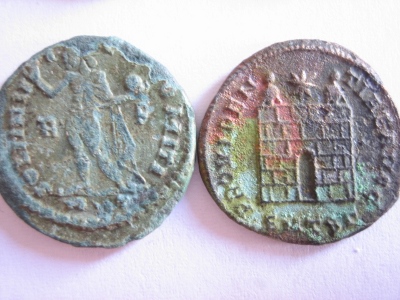
The orange coin is fine, no BD, your also correct in that the reverse does look like GLORIA ROMANORVM.
Quote:
The coins that appear dark/blackish like the const. two victories above, can they be cleaned closer to their original colour or no matter how much I clean it will it remain as is? would this be known as the patina?
They can be stripped back to the original metal leaving them shiny but almost all collectors would consider the coin ruined at that point, if allowed to tone naturally after this they can be considered OK again but it could take decades for it to happen properly! Often on
ebay you will see coins that have at some point in the distant past been well over-cleaned but have then toned naturally and many people still bid on them happily. Very few collectors could claim to have original patina on all their coins.
The patina sits between the base metal of the coin and the dirt, it is the result of the base metal reacting to outside influences in the environment it has sat before being found. The patina can be a number of different colours, brown, green and black are the most common but you can also get blue, red, sandy etc. Effectively it is the patina that has protected the coin.
It can be difficult when cleaning sometimes to tell what is dirt and what is patina, generally the patina should be tougher than the dirt on the coin and it should show about 95% of the detail that remains on the coin below. There are of course exceptions and sometimes patina can not be saved, if its disintegrating it will look like an almost 'eggshell' layer of the coin is flaking away.
Even though the patina rarely reflects the original colour of the coin it is pretty and most like it to remain on the coin.
As your just starting it will take a bit of trial and error before you understand the whole thing, everyone started like this and we have all ruined coins in the past by over-cleaning so dont stress if it happens to you

.
Its also true that some coins will never, ever clean using 'soft' measures and it becomes a choice of either having a dirty, un-attributable coin or using acids or electrolysis to try and get the job done. I've used both the above with disastrous and excellent results.
Your last coin is a 'fallen horseman' type and probably of Constantius II.
https://goccf.com/t/104719The orientation of the reverse of the coins vary, it is commonly known as 'die rotation', if you hold your coin looking at the bust with it face up and spin it on a horizontal axis and the reverse is the correct way up it is called '0 degrees rotation. If you do the same and the reverse is upside down it would be called '180 degrees rotation'.
Most coins are roughly 0 or 180, but the full 360 degrees can be found. This is due to the less than perfect manufacturing procedures used. Some coins are deliberately not 0 or 180.




 First Page


 Posted 10/27/2012 12:07 pm





 back!
back!


