| Author |
 Replies: 16 / Views: 3,029 Replies: 16 / Views: 3,029 |
|
New Member
United States
31 Posts |
Hi Guys, Big Al here. Be nice now, I'm new here :)...OK...IF a 1966 P Kennedy 50c was silver would it have to weigh very close to 12.5 gms? What if she is the 1965 planchet but MISSING the copper? What would it weigh? My scale is broken but my Jeweler got 11.4 or so. I will try to weigh it a few other place. Id love to hear from da' fellas on this. Here is my 1966. Should I go back to sleep and wait for the next dream? PEACE 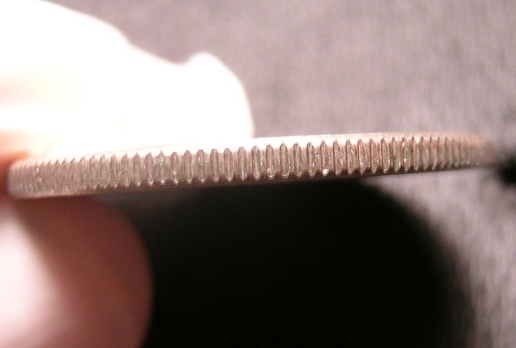 Edited by big al
10/29/2012 8:39 pm
|
|
|
|
Pillar of the Community
United States
3640 Posts |
Hi If it was a 1964 Kennedy half it would weigh around 12.5 grams Those are all 90% silver. The 1965 through 1970 are 40% silver and weigh approx. 11.5 grams. So a full gram lighter. Those are clad silver. There is a possibility of finding a 1965 or 1966 (maybe even 1967 and on up) 90% silver half. It's a good idea to weigh every one up. You never know ? If a genuine find you would have a coin with a very nice premium. |
|
Bedrock of the Community
Australia
21789 Posts |
Comparative ring tone test would solve your problems without scales.
|
|
New Member
 United States
31 Posts |
It rings like silver and passed the tissue test..but the weight was 11.4__ something not 12.5 What do you guys think of the photo of the edge? I do nt see copper, clad etc...just silver. thanks |
|
Pillar of the Community
United States
4897 Posts |
Not sure what is confusing. A 1966 JFK Half should weigh 11.5g yours is well within the tolerence. You have a normal coin.
|
|
Pillar of the Community
United States
1431 Posts |
Judging by the weight, it seems you have a normal 1966 40% silver half dollar.
The way the edge appears on the 40% silver pieces can vary somewhat, factoring in subtle variances in alloy mixture, wear, and toning. Most I've seen appear to have a silvery layer on top with a dark grey core. Many will appear to be solid silver on the edge, and some may even look coppery.
|
|
New Member
United States
31 Posts |
How does my edge look in the above photo? Does anyone see anything but silver?
I dont but I am new and learning still. thanks
|
|
Pillar of the Community
United States
3640 Posts |
Like mentioned. The reeding edge can look like
different tones. Yours seems to have more rounded edges also
which is both normal on worn and even Unc. coins. Some have a thicker
squarer edge. Seems like the rounded type edges look more uniformly silver than the others. Correct me here anyone if I am incorrect about this but, the 40% clad type is a little different type of cladding than the modern clad type coins like dimes and quarters. Not just the silver part but on how the cladding was actually accomplished.
Anyway, The weight diff. is the big factor.
|
|
New Member
United States
31 Posts |
trhanks Indian, not to beat a dying horse, but again please tell me. Could it be a 40% without the copper? It passed the tissue test as silver and rings like silver and again, the edge is completely one color (silver) So I am not claiming a 90% planc since it did not weigh anywhere near 12.5 , it weighed 11.4 and change but wondering if a 40% planc with missing copper layer could yield such a coin or even be feasible? OK horse is on his last breath!...Tomorrow I am going to take it elsewhere to re-weigh it. I hope it gains weight over night :) PEACE Al |
|
Rest in Peace
United States
1943 Posts |
As you look at more 40% halves you will see some have a copper colored core showing, some have a dark or black toned core showing and some have an all silver colored edge like your coin. I think the silver edge happens when the blank is punched out. Sometimes the silver from the outer cladding gets smeared over the copper as the punch shears through the coil. So the copper core is there, it just has a thin layer of silver covering it. Weight is the best determining factor.
|
|
Valued Member
United States
294 Posts |
Does the core of a 40% half actually show a copper color? Keep in mind the core of the 1965-1970 halves was composed of an alloy of 79% copper and 21% silver, clad with a layer of 80% silver and 20% copper, giving it the 40% silver content. So I'm thinking the core and the clad layer will both show a silver color. All the ones I have do. Unlike the cores of modern clad coins that are 100% copper, and an outer layer of 75% copper and 25% nickel, which gives those coins the two-tone appearance on the edges..
|
|
Pillar of the Community
United States
3640 Posts |
I would think so. Time I guess to find out. A nice clean cut right through one  Anyone already done this ? Maybe some pics. somewhere ? If not I may give it a shot. Might be cool to have anyway to show off. |
|
New Member
United States
31 Posts |
OK so I cut my 1966 in half and it is one color inside silver. Then I weighed the two halfs...each half weighed 6.25 grams. Now what do I do?...Just kiddin'
|
|
Pillar of the Community
United States
3640 Posts |
Glue it back together and you have a 90% silver half again.
|
|
Pillar of the Community
United States
716 Posts |
The inside is very red. 79% of coppor and 21% of silver give you a red color not silverish color. I drilled a hole on a 68 JFK so I could put it on my key ring to show tellers what I was looking for.
|
|
Valued Member
United States
294 Posts |
Quote:
The inside is very red. 79% of coppor and 21% of silver give you a red color not silverish color. I drilled a hole on a 68 JFK so I could put it on my key ring to show tellers what I was looking for A US nickel is 75% copper, 25% nickel. They aren't red. |
| |
Replies: 16 / Views: 3,029 |






 Posted 10/29/2012 9:57 pm





