| Author |
 Replies: 13 / Views: 5,266 Replies: 13 / Views: 5,266 |
|
|
New Member
United States
3 Posts |
I have in my possession a coin/token from 1860. The story from my family was that a soldier wore this coin/token as a early form of a military dog tag. That was the reason for the hole in the coin. He fought for a Southern state and the coin was to tell which state he from. I do not know the soldiers name or anything other that little tidbit of a story. On one side of the coin it says "The Wealth Of The South Rice Tobacco Sugar Cotton" On to opposite side it says "No Submission To The North." I would like to know where this coin/token came from and if there is any truth to the story of them being used as early types of Dog Tags. I would also like to know if there is any way to get a value on something like this. Thank you in advance for your time. 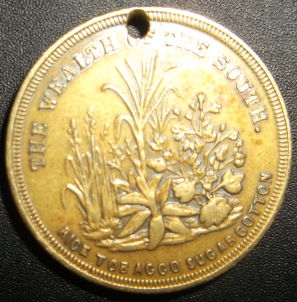 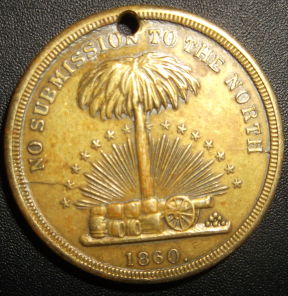 |
|
|
|
Moderator
 United States
195203 Posts |
 to the Community! I moved your welcome post to the 'Tokens, Medals, and other Exonumia' forum for the proper attention.  |
|
New Member
 United States
3 Posts |
Thank you. I wasn't and am still not sure how all this high tec stuff works. I would just love to get the history on this coin/token.
|
|
Pillar of the Community
United States
4897 Posts |
|
|
Pillar of the Community
United States
3253 Posts |
Family stories like that are notoriously difficult to prove; all varieties of coins have been holed for a lot of different reasons. Even if this token was actually found strung around the neck of a fallen Confederate soldier, how could one say that the purpose was identification? With a simple awl he could have carved his name, or at least his initials and regiment. The most obvious thing to point out is, how could this token convey a soldier's home state, when no state is noted in its design?
Edited by philadelphian
11/13/2012 4:20 pm
|
|
New Member
United States
3 Posts |
Thank you for looking and responding to my post. I appriciate any and all input I can get. Why would someone put a hole in a coin Philadelphian? I was under the impression that only certain states made these coins and each state had a different type of design. Like I said I really have nothing to go on but old stories and yes it is a neat story but like you said I will never be able to truely prove it. I was just wondering where it might of been made at and where to go to be able to possibly research it more. I keep finding the token but I can never figue out where it came from. Thank you all for taking the time to converse with a novice like me.
Bschisler
|
|
Pillar of the Community
United States
4897 Posts |
Quote:
The token was designed by Benjamin True and struck in Cincinnati by John Stanton. It was marketed in the South where its sentiment was strongly favored. The philosophy was that the strength of the South came from the land and its crops. The strength of the North was based on man-made facilities and activities such as banking and manufacturing. (Some odd mules were made with these dies. One, for example, has Lincoln on the obverse with the secessionist reverse.)
The token occurs both with and without a hole for suspension. From here: http://www.usrarecoininvestments.co..._2936_da.htm |
|
Pillar of the Community
United States
3253 Posts |
What Amida meant by "patriotic token," is a subgroup of Civil War tokens. Civil War tokens were privately minted tokens that were generally meant to make up for a shortfall of small change due to hoarding during this period. Your token, though usually collected as a Civil War token, was actually produced pre-war, during the 1860 presidential campaign. Did a little searching, and one thing I suspected was confirmed: though sold to Southerners, it was minted by a Northern token maker, Benjamin True of Cincinnati, Ohio. Did the palmetto make you think this was the South Carolina entry in a series of all Southern states? My theory, which I have nothing to back up, is that the palmetto was directed at Southern Democrats, as the party held their convention in Charleston that year.
As to reasons for holing a coin, it could have been nailed to something for display, or strung to other coins to keep or conceal them (sometimes sewn to hidden places in clothing). Early silver dollars had a silk ribbon threaded through a hole and tied to the rail of a crib, as the size of the coin made it ideal for teething babies! Of course, a handsome coin could be worn as jewelry, but there were other reasons to display a coin on one's person. Some early European coins featured a cross or a saint's image; certain varieties were so frequently holed and worn as religious/pilgrimage badges that surviving specimens are nearly always found holed. Many people who held the sentiments of your coin might have proudly worn it to express them, but knowing the history of this token, it may have been more likely to have been worn like a modern political button.
|
|
Pillar of the Community
United States
1721 Posts |
Oops
Edited by mds308
11/13/2012 9:08 pm
|
|
Pillar of the Community
United States
1721 Posts |
philadelphian,
I had to rewrite my post. You are correct. The S.C. Palmetto was used on flags, military buttons and belt buckles. There is a strong S.C. influence in that design.
|
|
Pillar of the Community
United States
4432 Posts |
It's quite likely that a good many of these pieces were carried in a pocket; this, despite the often seen hole for wearing. Ones without the hole tend to fetch a premium. One of these recently sold on ebay for a bit over $400 as I recall. I'm told that, despite the 1860 date, these are likely to be retained in the Civil War patriotic token series. These brass tokens were usually seen being silver plated. Indeed, it appears that traces of silvering remain on this piece. This silvering was done to many political medalets of the era. the silvering would wear off as the token was handled. Emotions were running high just prior to the war, so why wear a piece that might invite a fight? IMHO, this is why condition of most pieces that I've seen tends to be VF or better. No telling who could've worn and/or carried this piece. These are quite popular items! |
|
Moderator
United States
195203 Posts |
Quote:
Did the palmetto make you think this was the South Carolina entry in a series of all Southern states? My theory, which I have nothing to back up, is that the palmetto was directed at Southern Democrats, as the party held their convention in Charleston that year. SC is the Palmetto State, a nickname that dates back to the Revolutionary War. Quote:
The Palmetto State
This nickname refers to South Carolina's official State Tree, the Sabal Palmetto. The Palmetto is rooted in historical significance dating back to the Revolutionary War. On June 28, 1776, the British fleet's attack on Sullivan's Island was repulsed. The palmetto-log fort, under Colonel William Moultrie, withstood the barrage of British cannons until the fleet retreated. The Sabal Palmetto (Inodes Palmetto), commonly referred to as the Cabbage Palmetto, was added to the National flag of South Carolina, after it seceded from the Union in 1861.
The Palmetto is South Carolina's official State Tree. It also appears on the South Carolina State Seal and in the salute to the flag of South Carolina written in 1950 by Mrs. John Raymond Carson and adopted by the General Assembly in 1966: "I salute the flag of South Carolina and pledge to the Palmetto State love, loyalty and faith." The State of South Carolina |
|
New Member
United States
3 Posts |
Thank you all so much. I have learned more from you guys posting in a few days then I was able to find on my own in several weeks of perodic searching. I appriciate all of the input and insight into the origin of this coin/token. Now that I know the proper history of it I can pass that down to my children along with the coin/token and a interesting story, even if I can't prove it 100%. Once again thank you all so much. This has been a wonderful adventure for me and you guys may have just inspired a new coin collector. Even if the piece was worthless the history aspect is priceless.  Bschisler |
|
Moderator
United States
195203 Posts |
Quote:
Even if the piece was worthless the history aspect is priceless. Well said!  |
| |
Replies: 13 / Views: 5,266 |
|







 Posted 11/13/2012 3:00 pm





