









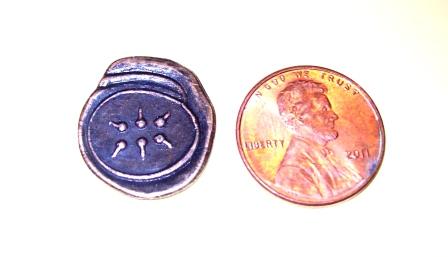
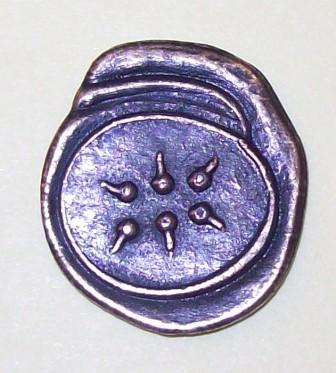


 to CCF Nate. My condolences on your loss. I think it is a coin, I have seen them before. Wait a little while for a pro to chime in.


 Posted 11/20/2012 5:04 pm


Hello and welcome. 
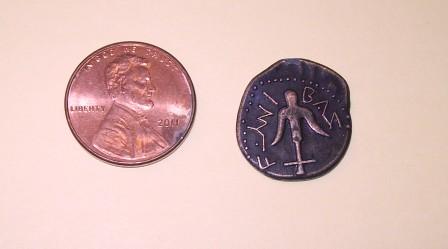
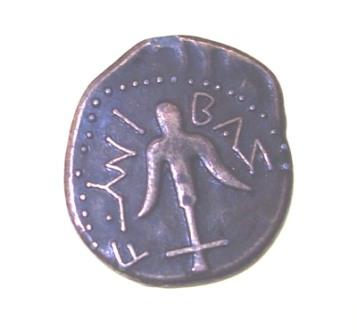
I wish we could tell you good news about this particular heirloom, but alas, it's not a genuine coin. It's a modern reproduction of an ancient Judaean lepta - better known as a "Widow's Mite" because of its association with the biblical story. These particular pieces are mass-produced; you can buy them in bulk from religious supply stores, if you needed to teach a whole congregation or Sunday School class the story and wanted to give everyone a souvenir.
The language on the original Widows Mite is Greek; the language on these replicas is rather badly blundered Greek, but you can still make out "BAS" from "BASILEOS" to the right of the anchor.
Calling them "fakes" or "counterfeits" would be a bit harsh, since they're not very good copies and wouldn't fool anyone actually familiar with what ancient coins look like. But not everyone has such experience; we've seen them several times on this forum before. See this old thread for another example, and here for an earlier one. As you can see, you're not the only person to be confused by them.
I wish we could tell you good news about this particular heirloom, but alas, it's not a genuine coin. It's a modern reproduction of an ancient Judaean lepta - better known as a "Widow's Mite" because of its association with the biblical story. These particular pieces are mass-produced; you can buy them in bulk from religious supply stores, if you needed to teach a whole congregation or Sunday School class the story and wanted to give everyone a souvenir.
The language on the original Widows Mite is Greek; the language on these replicas is rather badly blundered Greek, but you can still make out "BAS" from "BASILEOS" to the right of the anchor.
Calling them "fakes" or "counterfeits" would be a bit harsh, since they're not very good copies and wouldn't fool anyone actually familiar with what ancient coins look like. But not everyone has such experience; we've seen them several times on this forum before. See this old thread for another example, and here for an earlier one. As you can see, you're not the only person to be confused by them.
Don't say "infinitely" when you mean "very"; otherwise, you'll have no word left when you want to talk about something really infinite. - C. S. Lewis


