| Author |
 Replies: 15 / Views: 1,620 Replies: 15 / Views: 1,620 |
|
|
New Member
United States
30 Posts |
I found this in a mixed bag of coins that I had bought a while back. Both surfaces look as if they have been peeled off. Also the coin is a bout 1 mm smaller in diameter than other nickels, while the rim looks undamaged and the same thickness as a regular coin. When I took to the photos I put a regular nickel below this coin to show the difference in size. Is this an error during minting or .....? 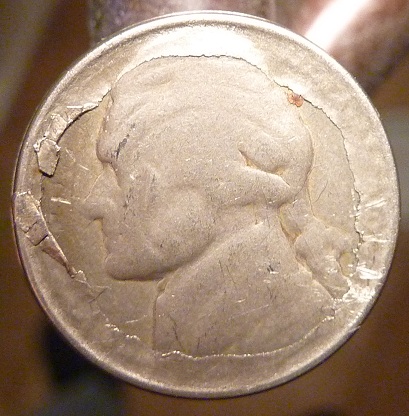 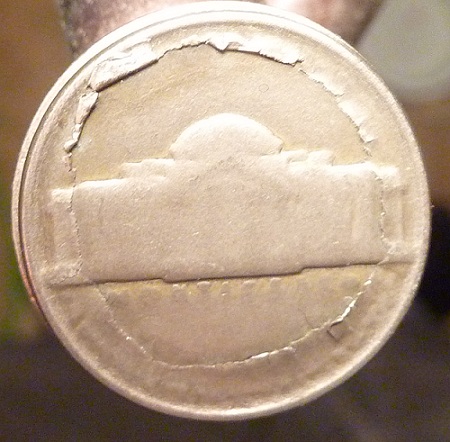 |
|
|
|
Pillar of the Community
United States
1721 Posts |
I'm not guessing on this one. No matter what, it's a nice looking coin.
|
|
Rest in Peace
United States
1943 Posts |
|
|
New Member
 United States
30 Posts |
I checked again and this coin is just a tiny bit thicker than a regular nickel. But still is hard to imagine how the skin peel effect can happen in a dryer. This coin is struck solid not in layers, right?
|
|
Valued Member
United States
163 Posts |
Looks like chemical damage.
|
|
Valued Member
United States
366 Posts |
I agree... looks like acid damaged but hard to tell.
|
|
Bedrock of the Community
Australia
21792 Posts |
The FIRST question that has to be asked is: What is the weight? The answer is essential relating to any explanation. A Dryer Coin may be the answer if the diameter is less, but I have never seen a Dryer Coin that has laminated such as this, perhaps others may have, Without info. on the weight, I can speculate on a few other answers. |
|
New Member
United States
30 Posts |
The weight is 4.8 grams but my scale has an accuracy of -/+0.1 gram. I weighed 4 other nickels, 3 of them showed 5 grams and one showed 4.9.
|
|
Pillar of the Community
United States
3592 Posts |
I have seen Dryer Coins look like this. It is not lamination but the effect of the edge being forced over and down that give it that look. As you can see,the thin layer has even peeled away and folded back up in some areas. |
|
Pillar of the Community
United States
3640 Posts |
I keep reading references to " Dryer Coins" If a coin is stuck in some part of a clothes dryer then it is stuck, and not bouncing around. If it is bouncing around I'm sure that someone would find it in the dryer sooner than later enough not to cause this and or other types of so called Dryer Coin damage. Not saying either way if this coin is damaged (maybe it was) but doubt it was caused by a clothes dryer. |
|
Bedrock of the Community
United States
12437 Posts |
Most dryers for home use have plastic fins but commercial dryers tend to have metal fins and that is where coins may get stuck. The coin will just roll and tumble in the fin, banging on steel the whole way around. The constant abuse smooths the details of the coin and and the tumbling action against the steel slowly folds the rim inward.
|
|
Bedrock of the Community
Australia
21792 Posts |
My hypothesis (not theory) is that the coin has been rolled as with a Dryer Coin. I suspect that his coin may have had a slight laminate blank flaw which would have never have shown up until subject to damaging forces as it has. Continuous radial rolling pressure has caused the laminate failure, and some of the surface laminate has managed to flake off. That's MY hypothesis, anyway. At least, that helps to explain why the remainder remains has a mass of 4.8 grammes. |
|
Pillar of the Community
United States
3592 Posts |
|
|
Valued Member
United States
370 Posts |
Why can I not view the Dryer Coin thread? I actually do appliance repair, I would like to find one like that |
|
Pillar of the Community
United States
3592 Posts |
|
|
Valued Member
United States
370 Posts |
I do appliance repair and j have pulled a lot of coins out of dryers but I have never found one that looks like that.
|
| |
Replies: 15 / Views: 1,620 |
|






 Posted 12/26/2012 3:57 pm





