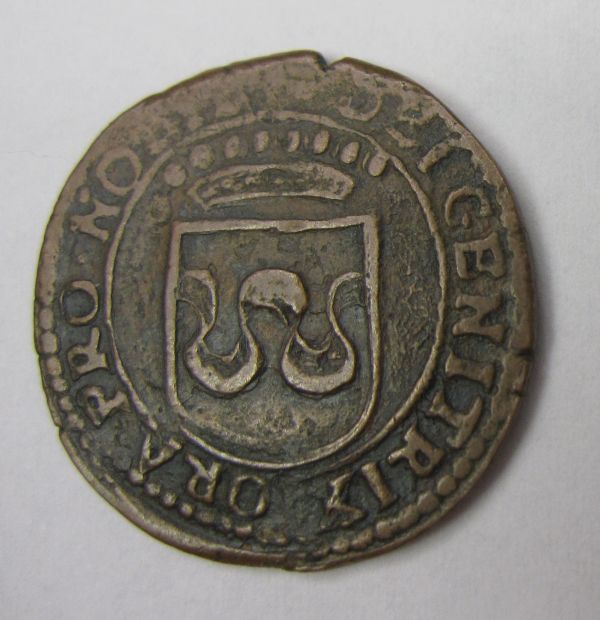
Hi philadelphian! Since you were so helpful I thought I'd give you an update. I emailed the Royal Numismatic Society of Belgium, and a gentleman there forwarded my question to an expert in Liege. Here is his response, translated from French to English with google translator:
Baron Jean-Paul Groesbeeck was lord of Franc-Waret. Pope
Paul V granted him bubbles? January 23, 1613 and its reception as
Canon noble took place January 19, 1618. He became abbot of Dinant on 16
August 1625 and archdeacon of Condroz in 1633

. He was also the
Chancellor of Ferdinand of Bavaria, then resigned, received the Provost
Saint-Lambert July 1, 1652. [4] Just invested with the dignity
provost, he thought it his duty to go to his office and all its glory
claim all the powers which his predecessors had enjoyed. [5]
Thus he came into conflict with Maximilian Henry of Bavaria [6]
argued that many legal cases. He enjoyed a Liege
popularity and the House of Habsburg in him a supporter
sincere. This Méreau very likely was struck during
elevation to the archdeaconry Condroz Jean Paul Groesbeeck as
might suggest the reverse text [7]. Circular legends
Law and setbacks that evoke St. Mary and St. Lambert are
direct references to the patron saints of the cathedral of Liège and
indirectly to the chapter in which John Paul had Groesbeeck
was received as canon since 1618.
In 1633, the mint was still in Dinant activity,
Méreau could therefore have been struck in this workshop

. The March 2, 1632 the
Dinant writer Jerome was Christmas and it is still cited for the last
After April 28, 1634. [9]
The cathedral chapter consisted mainly of Cadets
noble families and wanted to have the members of the nobility at the head of
archidiaconates who were also jurisdictions and were entitled to
rich and a considerable income credit in the state. Also there
we called the richest families in the country, Woestenraedt,
Rennenberg, Eckevoort, Hoen, Groesbeeck, Bocholt, Duras, Stockem,
Liedekerke, Ruyschenbourg in the late sixteenth and early seventeenth century. and
Most of the time, dignities remained in the same family as they
passing from uncle to nephew. [10]









 Posted 12/28/2012 10:17 pm





