| Author |
 Replies: 10 / Views: 4,089 Replies: 10 / Views: 4,089 |
|
|
New Member
United States
4 Posts |
The reverse looks like an 1804 C6 however, it has an 1806 date, the 1804 obverse bulge, but no spiked chin. The chin does look quite similar to the 1804 C3(pre-spiked chin)obverse, but still has the wrong date. It did notice that the PCGS Coin Facts page shows an 1804 C-6 example that appears to have a nub on the side of the 4 which I thought may offer evidence that it was previously struck with an 1806 date. The 1 in 1806 looks a bit narrow but I wondered if this coin could have been a test strike of the die pair. It has noticeable elevated file marks at the obverse bulge and through obverse and reverse lettering. I'm not convinced that a counterfeiter would take the time to do that. The early die state works and the 1804 C6 was actually struck in 1806 so that works too. The Coin came back from PCGS as questionable authenticity but I'm not convinced its a counterfeit. There should be more of these out there. Has anyone seen this die pair as a "counterfeit" or genuine. If so, can you post a photo? The coin has a flat edge however, I have seen an 1806 genuine Half Cent with a flat edge and was told it was made from a cut down one cent planchet. Any input would be appreciated. 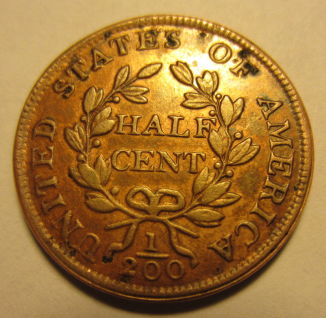  Moved by Forum Mom from Identification forum to Classic Coins forum. Moved by Forum Mom from Identification forum to Classic Coins forum. |
|
|
|
Pillar of the Community
United States
1721 Posts |
I had a 1922 one dollar 'no star' Grant gold coin. It came back from PCGS as 'Questionable Authenticity.' Yes, this is their way of telling us the coin is fake. After my extreme disappointment I showed the coin to 3 other dealers and all three thought the coin was good until I showed them the PCGS QA sticker. One dealer insisted on buying it but told me I could keep the Mylar flip with sticker. He may have used the coin to hoodwink another buyer.
Send the coin to NGC and see what they say. And if they don't tell you what you want to hear, send it to ANACS.
|
|
Pillar of the Community
United States
3546 Posts |
Hi, Would it be possible to upload a more close up, better-angled shot of the obverse if at all possible? Without appearing to be too critical on your first post please consider checking out the following URL on some demonstrated camera lighting tips used by some of the CCF members that have improved the coin photos by eliminating glare and reflections etc...: https://goccf.com/t/88598&whichpage=2These type of improvements may assist interested CCF members to make a more accurate determination as to what is truly going on with this classic coin of yours. And most importantly  to CCF and please realize that all comments at the CCF are only intended to improve the knowledge base of all interested parties viewing a particular thread. Thanks for posting. mdpmedia |
|
New Member
 United States
4 Posts |
Here are a few more photos. The obverse bulge matches the size and shape of the 1804 c6 but shows a lot of raised file marks, that are even apparent behind the "ERTY" which suggests to me that the die pair was cleaned (or filed) vigorously to remove excessive rust prior to striking since they are elevated. Since the size and shape of the bulge did not change throughout the "spiked chin" series, I think that the "obverse bulge" was simply the result of removing excessive rust from the original die pair and not a result of whatever caused the spiked chin. I was not able to determine if the 1804 C3 has the "obverse bulge" since the only known examples (I think there are only 3 or 4 known) are in poor condition. It does not seem likely to me that a counterfeiter would know to include these elevated file marks since they do not appear on any of the regular strikes. That is why I wondered if this may have been a test strike. The edge is sharp (flat) suggesting that, if genuine, was actually struck on a cut down one cent planchet. That would explain some of the surface flaking seen on early copper cents due to impurities in U.S. native copper. The coin also shows curved grooves along the circumference of the obverse only that suggest to me that the coin was struck on a one cent planchet first and then cut down from the obverse side after it was struck. The grooves along the obverse edge (right of the bulge) suggest that the coin may have been repositioned once or twice before the final cut. There even appears to be some very rudimentary evidence of a protrusion from the mouth (that may have become the "cigar"). This is all theory of course but I can't think of any reason why a counterfeiter would know to add these characteristics or could duplicate everything so precisely and then mess up on the "1" in 1806. I do know that date punches were often borrowed from other coin series, like the 7 in the 1807 Half Cent, etc. The "1" in many silver coins at the time look similar to this coin but I haven't done any research yet in this regard to find a match for the "1" date punch do determine if it may have been borrowed from another series (perhaps quarters, halves, etc.). The "806" does look consistent with other 1806's with the exception of the exact location. To me, the 6 appears a little lower that the "high" 6 and a little higher than the "low" 6, but I am not certain. Anyway, thanks for the interest. I welcome any opinions and mostly had resolved that this was a counterfeit until I discovered a genuine 1806 Half Cent with a flat or sharp edge like mine. I wonder if there are enough cut down Half Cents out there to determine if there are any notable edge characteristics that would help to authenticate this coin. Also would really like to know if anyone has ever seen this unusual die pair, counterfeit or genuine. Thanks a bunch. PCGS thought the coin was a counterfeit. Neither PCGS or NGC offered any explanation for their determination. To me, the counterfeit scenario raises way more questions than answers; Like why aren't there more of these? Why the raised file marks? Why the rim grooves? I did forward some photos to ANACS a couple of months ago and was told that they would have to examine the coin more closely to make a determination. That will most likely be my next step. Thanks for the suggestion. 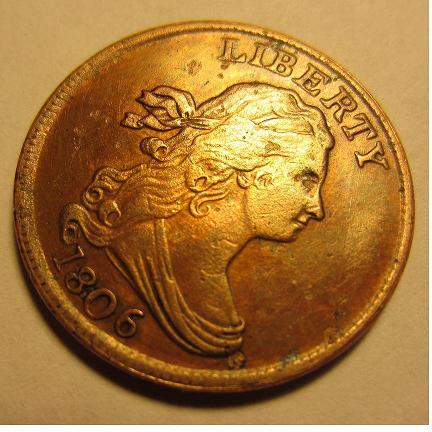 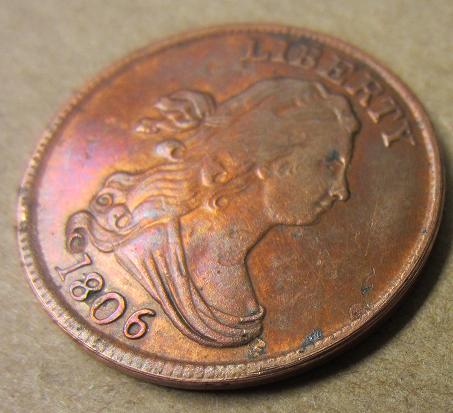 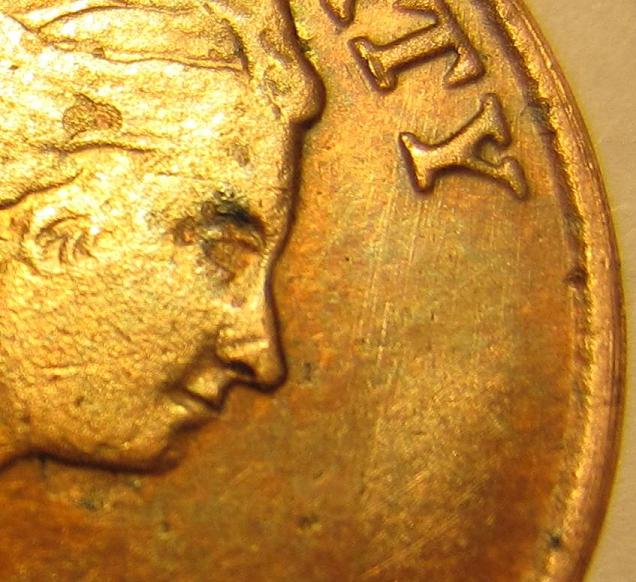 |
|
Pillar of the Community
United States
3453 Posts |
IMHO something looks not quite right. I am new to collecting old copper and there are a lot of varieties so take this for what it is worth. The 1806 bothers me and the color bothers me.
Now let's have someone prove me wrong (and tell me where I went wrong)!
|
|
New Member
United States
4 Posts |
I think the color is due to the photograph. The coin actually looks great in hand and it does still show some mint luster. With regard to the date, I agree that it definitely looks different, especially the "1" however, I did some checking and the "1" in 1806 looks nearly identical to the 1806 Large Cent "1" which was more slender than most Half Cents. Since it was not unusual to use large cent date punches (like the "7" in the 1807 Half Cent) it is possible. At least it appears that the mint did have a date punch that matches. I guess the most convincing evidence that this is a "fake" would be to find more examples of the same die pair. |
|
Moderator
 United States
16694 Posts |
The date and facial features caught my eye right away. It also looks like sub quality copper or another type of metal. What is the weight?
swcoin.ecrater.com
|
|
Pillar of the Community
United States
3253 Posts |
The 6 seems too low for any of the 4 Cohen varieties of this date (there are 4, right? What's a Cohen-6?).
|
|
Pillar of the Community
United States
1721 Posts |
After I found out my Grant coin was fake, I contacted PCGS for an explanation. They told me that they DO NOT disclose why the item received a 'Questionable Authenticity' (fake) because they say it would aid the counterfeiters so they could produce a better counterfeit. PCGS will never use the word counterfeit. They always refer to the coin as Q.A. Probably for legal reasons.
|
|
New Member
United States
4 Posts |
I was able to have the coin tested and it is solid copper. The weight should be 5.44Gm plus or minus 10% according to my research. The coin weights 5.48 grams, so I think it is within the correct range, especially if made on a cut down planchet. The field surfaces show almost no wear and according to NGC varieties plus, the entire series was generally weakly struck, so I don't think this coin saw much circulation wear and would expect it to be close to mint state weight.
I am comparing it to an 1804 "C6" because that's the closest example I could find. It has the correct reverse (earliest Manley state according to Walter Breen) and very early obverse (pre-spiked chin) die state, which apparently there are only a few known examples. With so few examples, I expect the damage to the chin must have happened right away, which further leads me to think this was struck as a die pair test, if genuine of course.
It is especially frustrating that the professional graders don't offer any particular reasons, however I do see the concern. I was verbally told that it "looked like a copy of an original" but, what original? If genuine, it would be a "discovery coin" so, there would be nothing to copy from. If genuine, I suppose it would be an 1806 small high 6 with stems; however it has a 10 berry reverse instead of 11. As an 1806, there would not yet be a Cohen number so the next number C-5 would probably apply, if genuine of course. Without the benefit of any specific reasoning from the grading agencies, most of the questions about the coin are still a mystery. Why wouldn't a counterfeiter match a "1" from a known variety, especially if copying an original, etc. etc. The person that tested the copper is also a collector and even had some "Chinese counterfeits." He advised me that he would not have even tested it if it looked like an obvious "fake". I purchased the coin on a fluke and expect that it would have cost a counterfeiter more to make than I paid for it. Kind of boils down to the same question / where are the rest of the counterfeits? I've searched for almost a year and even asked the grading agencies if they have seen any other examples of the die pair, of course without a response. I was hoping to close the door on this mystery by seeing if any other collectors have seen the die pair.
In any regard, this forum is great and I appreciate the input. Just hope someone out there can help solve the mystery.
|
|
Pillar of the Community
United States
4897 Posts |
Have you contacted EAC? If these folks can't help nobody can.... http://www.eacs.org/edit spellingggg Edited by amida17
01/04/2013 8:01 pm
|
| |
Replies: 10 / Views: 4,089 |
|








 Posted 12/30/2012 4:53 pm


