| Author |
 Replies: 24 / Views: 4,408 Replies: 24 / Views: 4,408 |
|
Pillar of the Community
United States
5155 Posts |
Well anyone who follows my threads knows I recently picked up an Antimachos I drachm in fairly deceny condition with very near complete legends. Now I know there are people out there who know more then I about the Indo-Greek Kingdoms, and there coinage. I have a few pieces from this area, and none like this. I know its not really of consequence but I figured I would pose the question to those out there.What do you guys think the obverse or reverse is supposed to be. Not literally what the images are  but which image is the obverse and which one is the reverse. Traditionally the Indo-Greek kingdoms featured coins similar to that of the Seleucids. A veneration of the king on the obverse with a Greek legend, and on the reverse one of the Gods sacred to the area and or peoples. This coin is a bit different. The "obverse" features what presumably is Antimachos on horseback with Macedonian hat complete a Kharosthi script In this case Maharajasa jayadharasa Antimakasa. On the "reverse", the Nike (Victory) on the reverse with a Greek legend, naming the king and title- in this case BASILEWS NIKYFOROU ANTIMAXOU, This seems to be the reverse of what is usually seen on the coins of the other kings. I wonder the seller (who is an expert in oriental and Indian coins) states that the coin was minted during the Greek invasion and occupation of Gandhara and Taxila (North West India and Pakistan) The coin is similar in style to the later Indo-Scythian kings. That series features a king on horse back on the "obverse" with Greek legends naming the king and title. The reverse features the deity/ god and the Kharosthi script on the "reverse". This is consistent with most other coins of the period yet mine is in conflict. I wonder if this was some how a reflection of the geopolitical situation at the time? Was the coin ment to exact fear in the populous so far from the Greek world? Was the king holding himself second to the Nike, as this would have been the "obverse" feauting the Nike advancing with Palm...Please let me hear what you think...and make heads or tails of this coin? (no pun intended)... All guesses educated or not are welcome as well as any comments, suggestions, additions or corrections are always welcomed...drool is cool too... Oh yea my photo (as it is in hand now...and awesome) Antimachos I (168-160 BC) AR Drachm 17 mm x 2.42 g Obverse: BASILEWS NIKYFOROU ANTIMAXOU, Nike walking left, holding branch, monogram before. Reverse: Karoshti legend: Maharajasa jayadharasa Antimakasa, armed and uniformed King on horseback galloping right. Taxila mint, MACW 1674. Sellers Note: These bilingual drachms were struck during Antimachos'' occupation of Gandhara and Taxila, (Pakistan and North Western India) ca.168-160 BC. ref# Sear 7546 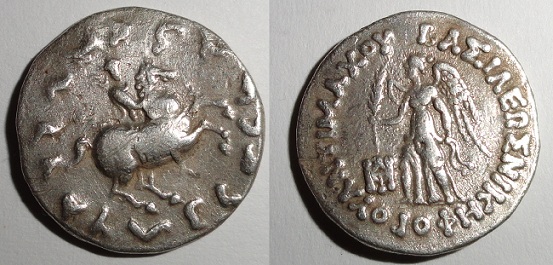 |
|
|
|
Pillar of the Community
United States
2044 Posts |
|
|
Pillar of the Community
United Kingdom
2838 Posts |
Any idea what NIKYFOROU translates to  Oh, and have this  |
|
Bedrock of the Community
United States
37206 Posts |
|
|
Pillar of the Community
Canada
1411 Posts |
|
|
Pillar of the Community
 United States
5155 Posts |
I believe it translates to Victorious, rather than "the victor" ....Thanks Bobby! Now what do you think the obverse or reverse is?
|
|
Pillar of the Community
United States
5155 Posts |
Thanks guys but what is heads and what is tails? Hum....think about it....
|
|
Moderator
 United States
23731 Posts |
Beautiful coin, you know how to pick'em Anoob.
|
|
Pillar of the Community
United Kingdom
2838 Posts |
|
|
Pillar of the Community
United States
4778 Posts |
Pretty nice! A great pickup!
BTW did you get my reply?
|
|
Pillar of the Community
United States
5155 Posts |
BH- Thats how it is cateloged online and in Sear but, and normally I would agree with you- but it seems so unlike the Greeks to put any language ahead of Greek.I 'Cuz of that I am inclined to think that the obverse is Nike. You see how I am perplexed?
VK- Got the email, I will check the link thanks. Haven't got a chance yet. Thanks for reminding me.
|
|
Pillar of the Community
United States
1549 Posts |
(Greek: Νικηφόρος, "Bringer of Victory")
Can you tell which side was on the anvil and which side was on the punch? I prefer using that as indication of which side is obverse (anvil) when possible. Famous examples are Corinth Pegasi and Syracuse chariots that are both obverses while the Athena heads are reverses.
|
|
Pillar of the Community
United States
5155 Posts |
@ Doug- Thanks for the translation clarification...
The coin- If I lay Nike down with the king up the coin is very slightly concave.
Would I be correct in assuming that Nike is the "Anvil" side and the King the "Punch" side?
|
|
Pillar of the Community
United States
1549 Posts |
|
|
Pillar of the Community
United States
5155 Posts |
AH so indeed the Greek Legend is the obverse and the Kharosthi legend the reverse. I guess I was right on my suspicion. Very interesting, thanks for adding "dimension" to my guess work.
|
|
Pillar of the Community
United States
5010 Posts |
i didn't know which way to guess, usually the greek is on the obverse and the king is on the obverse...here all mixed up. anyway, another great coin AN!  |
| |
Replies: 24 / Views: 4,408 |





 Posted 01/02/2013 7:51 pm





