|
This page may contain links that result in small commissions to keep this free site up and running.

Welcome Guest! Registering and/or logging in will remove the anchor (bottom) ads. It's Free!
To participate in the forum you must log in or register. | Author |
 Replies: 10 / Views: 1,467 Replies: 10 / Views: 1,467 |
|
|
Valued Member
United States
234 Posts |
|
|
|
|
Pillar of the Community
2087 Posts |
the J mint mark is Hamburg mint. For a 20 mark in BUNC you are looking at around US$400.00 (2011 prices)
|
|
Pillar of the Community
United States
3546 Posts |
Hi, Is this type of coin commonly counterfeited? If so, what feature on this assumed-authentic ebay example of this CCF thread would be a dead give-away to alert anyone to beware? I have never acquired one of these type of coins and just want to learn more about it in general. Thanks, mdpmedia |
|
Pillar of the Community
2087 Posts |
I think its safe to assume all sovereign sized gold coins have been counterfeited the first check would be weight. The majority of counterfeiters would still produce the coin in gold( Except circa 1872 when Platinum was used) but with a lower fineness than the genuine article. If a modern Middle eastern copy one might see an Arabic Counter stamp
|
|
New Member
United States
34 Posts |
The gold melt value of the coin as of the time that I am writing this, is $383.39.
|
|
Pillar of the Community
614 Posts |
Hehe, this is my area of expertise.  Anyway, Id say this was a very good purchase. I was recently offered one for $480, I refused. 1910-J is a relatively common date, so about $50 over melt is pretty good. The lowest I've gotten for a European fractional was $2 under melt. I bought 1/10 of gold for $155 about a year back. In other words, good purchase. And no, although these have been counterfeited, I do not believe this is a fake, then again, never hurts to check. |
|
Pillar of the Community
United States
3546 Posts |
Hi, 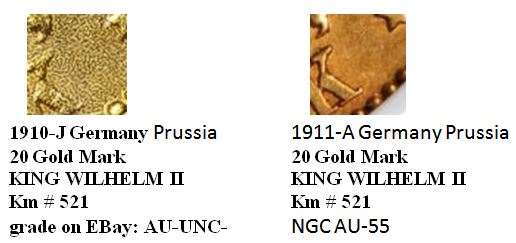 From what I can see both of these coins featured side-by-side above are .9 fine and supposedly have an AU grade listed under the same Krauss # 521. As I previously indicated in this thread my all around expertise with these types of coins is limited. So I would like to know the answers to the following questions: a) Why does the square sectional view of the left photo above have a lighter surface on the 1910-J coin initially featured in this thread compared to a similar 1911-A coin on the right which is shown in its entirety in the URL below?: http://www.coinfactswiki.com/wiki/P...11-A_20_markb) What could be the cause of the apparently pocked marked surface on the left 1910-J coin and why did this defect(IMHO) not cause this coin to be graded at a lower level compared to the smoother surfaced, deeper golden-colored 1911-A coin on the right? c) As a comparison when using US gold coins, the 0.90 fine Au(gold) designation implies a compositional balance of 10% Cu(copper) so a. Is the 10% non-gold component of these Prussian-German coins also composed of 100% copper? and b. Is this 10% non-gold component of these Prussian-German coins 'usually' uniformly mixed throughout the coin similar to US gold coins also minted in the early 1900s? and c. Is it even conceivably possible that this pocked mark surface on the 1910-J coin above is the probable end result of its 10% non-gold compositional portion having accidentally migrated (during an antiquated minting process w/o any consistent QC procedures) to the surfaces of both sides of the coin and then later having reacted to a harsh acid cleansing by someone trying to make the coin look better for resale...? and finally d. Does any evidence currently exist supporting the supposition that the Hamburg, 'J' mint, at times utilized a different grade of gold compared to the mint at Berlin designated by an 'A'? Just thinking out loud :) mdpmedia |
|
Pillar of the Community
2087 Posts |
Quote:
Why does the square sectional view of the left photo above have a lighter surface on the 1910-J coin initially featured in this thread compared to a similar 1911-A coin on the right which is shown in its entirety in the URL below? On line photos can be very deceptive the difference between the two photos could simply be due to a different resolutions Edit: thinking further the difference in colour intriques me(it could just be different lighting of course): could it be the left photo shows a Gold coin alloyed with silver and the right Copper? Aussi Members of this forum may understand where I am coming from: type 2 Aussi Sovereigns 1860-1870 can show such differences I have some in my collection. Australia initially used a silver gold alloy and ( from memory) in 1870 they shifted to the more usual copper gold alloy. Edited by austrokiwi
01/13/2013 06:16 am
|
|
Bedrock of the Community
United States
12437 Posts |
I am not terribly familiar with German gold but I will try to answer a) and b). The 1911 you posted is most likely alloyed with copper judging by the wonderfully original orange glow. The 1910 could appear lighter in color due to the photo lighting or it could have been dipped in a commercial cleaner like Jeweluster or E-Z-Est. Dipping will remove the orange toning from the copper, leaving the gold looking bright yellow. I believe that the pockmarked surface is just a photographic artifact/excessive pixelation because I can see the same texture on the 2x2 as well.
|
|
Valued Member
 United States
234 Posts |
So I'm confused does his coin seem fake?  I've seen it in real life and theres no bumps just a smooth surface,but has a good orange tone  Edited by StashTreasure
01/17/2013 4:14 pm
|
|
Pillar of the Community
United States
567 Posts |
Just looks like a crappy scan through a mylar flip.
Check the weight, gold was very strictly regulated and should be +/- 0.05g (to ccount for wear).
|
| |
Replies: 10 / Views: 1,467 |
|
To participate in the forum you must log in or register.
 
- Counterfeit Detection: ANA Video - Introduction, With Brian Silliman And Jim Robinson Ep. 1
- Counterfeit Detection: ANA Video - Mistakes, Risk Factors, And Counterfeits & Alterations, Ep. 2
- Counterfeit Detection: ANA Video - Pimples And Pits, Looking At Cast Counterfeits, Ep. 4
- Counterfeit Detection: ANA Video - What Year Is That Cent? Key Date Coins, Ep. 5
- Counterfeit Detection: ANA Video - Diagnostics Of The 3, 5, And 10 Cent Coins, Ep. 6
- Counterfeit Detection: ANA Video, Counterfeit Quarter Dollar Diagnostics, Ep. 7
- Counterfeit Detection: ANA Video, Counterfeit Classic Commemorative Coins Diagnostics, Ep. 8
- Counterfeit Detection: ANA Video, Counterfeit Silver Dollar Diagnostics, Ep. 9
- Counterfeit Detectection: ANA Video, Classic US Gold Coin Diagnostics, Ep. 10
- Counterfeit Detection: ANA Video, Diagnostics Of Chinese Made Counterfeits Of US Coins, Ep. 11
- Counterfeit Detection: ANA Video - Wrap Up Recap With Brian Silliman And Jim Robinson Ep. 12
- 2026-P Jefferson Nickel Possible Die Chips, Die Cracks And Other Anomalies
- Commems Collection Modern: What If? 1993 Bill Of Rights Circulating Coinage - A 1990 Attempt
- Split Grading - An Idea That Would Drive Collectors Mad
- 1960 D Lincoln Memorial Cent (Small Date) BIE
- Is This 1888-S A VAM-10, 10A Or Something Else?
- 1994 Brazil 10 Centavo - With Die Clash
- US 1 Cent 1856 Altered From 1858?
- 2009-P Quarter, Puerto Rico, Reed / Edge Error Or PMD?
- 1937-D Walking Liberty Half Dollar. Set Upgrade.
- Post Your Coins And Medals Featuring A Snake.
- Counterfeit Detection: ANA Video - Introduction, With Brian Silliman And Jim Robinson Ep. 1
- Counterfeit Detection: ANA Video - Mistakes, Risk Factors, And Counterfeits & Alterations, Ep. 2
- Counterfeit Detection: ANA Video - Pimples And Pits, Looking At Cast Counterfeits, Ep. 4
- Counterfeit Detection: ANA Video - What Year Is That Cent? Key Date Coins, Ep. 5
- Counterfeit Detection: ANA Video - Diagnostics Of The 3, 5, And 10 Cent Coins, Ep. 6
- Counterfeit Detection: ANA Video, Counterfeit Quarter Dollar Diagnostics, Ep. 7
- How Far Back Can We Go? Ninth Edition!
- Counterfeit Detection: ANA Video, Counterfeit Classic Commemorative Coins Diagnostics, Ep. 8
- Counterfeit Detection: ANA Video, Counterfeit Silver Dollar Diagnostics, Ep. 9
- Counterfeit Detectection: ANA Video, Classic US Gold Coin Diagnostics, Ep. 10
- Counterfeit Detection: ANA Video, Diagnostics Of Chinese Made Counterfeits Of US Coins, Ep. 11
- Counterfeit Detection: ANA Video - Wrap Up Recap With Brian Silliman And Jim Robinson Ep. 12
- Post Your Coins With A "five" Denomination
- Is This 1888-S A VAM-10, 10A Or Something Else?
- Around The World With Coins - A Coin Geography Game
- Post Your Coins/Medals/Tokens That Are Intentionally Dual-Dated
- Post Your Coins Issued By The Mint As Colourised Coins.
- All Members, Post Your Most Recent US Coin Purchases!
- Post Your Coins With Coats Of Arms, Shields, Crests, Crowns, Etc.
Disclaimer: While a tremendous amount of effort goes into ensuring the accuracy of the information contained in this site, Coin Community assumes no liability for errors. Copyright 2005 - 2026 Coin Community Family- all rights reserved worldwide. Use of any images or content on this website without prior written permission of Coin Community or the original lender is strictly prohibited.
Contact Us | Advertise Here | Privacy Policy / Terms of Use
|
| Coin Community Forum |
© 2005 - 2026 Coin Community Forums |
| It took 0.46 seconds to rattle this change. |
 |
|
| |
| |







 Posted 01/09/2013 01:31 am


