| Author |
 Replies: 24 / Views: 4,415 Replies: 24 / Views: 4,415 |
|
Pillar of the Community
United States
4253 Posts |
I just couldn't help myself. I'm a sucker for Tyche/Cybele. P. FURIUS CRASSIPES Denarius Crawford 136/1c, struck at Rome 84 BC OBV: Turreted head of Cybele (Tyche) right, behind, foot pointing upwards, AED.CVR behind head REV: Curule chair inscribed P FOVRIVS; CRASSIPES in exergue 3.88g. 21mm 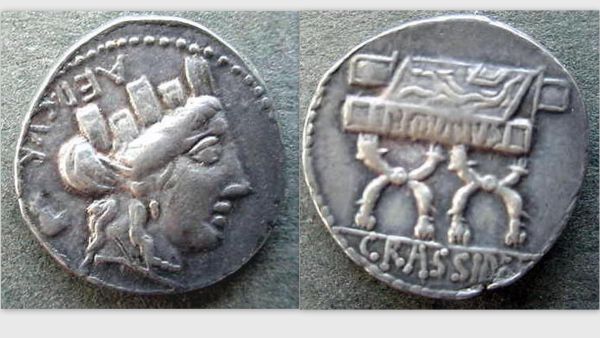 |
|
|
|
Pillar of the Community
United States
2044 Posts |
Very nice coin. Congrats on another great coin!
|
|
Pillar of the Community
United States
5010 Posts |
that is very nice, tyche looks great!  |
|
Pillar of the Community
 United States
4253 Posts |
Thanks guys. Here is a little background:
This coin was struck by Crassipes in virtue of his office of curule aedile and probably to meet some extraordinary expenditure connected with a largesse of corn. The head of the city no doubt refers to his urban duties which included the superintendence of the public baths, fountains, aqueducts, etc. The deformed foot is a type parlant of the name of Crassipes.
Aedile (Latin: Aedilis, from aedes, aedis "temple building") was an office of the Roman Republic. Based in Rome, the aediles were responsible for maintenance of public buildings and regulation of public festivals. They also had powers to enforce public order. There were two pair of aediles. Two aediles were from the ranks of plebeians and the other were called curule aediles (aediles curules). The office of the curule aedile was open to plebeians and patricians, and they were considered curule magistrates.
The office was generally held by young men intending to follow the cursus honorum to high political office, traditionally after their quaestorship but before their praetorship. It was not a compulsory part of the cursus, and hence a former quaestor could be elected to the praetorship without having held the aedileship. However, it was an advantageous position to hold because it demonstrated the aspiring politician's commitment to public service, as well as giving him the opportunity to hold public festivals and games, an excellent way to increase his name recognition and popularity.
|
|
Pillar of the Community
United States
5010 Posts |
oh thanks for that bing, I was trying to figure out what crassipes was supposed to mean...all I was getting vai internet search was a species of plant.
|
|
Pillar of the Community
United States
1316 Posts |
jw, awesome coin, you are really into these Tyche coins...  .. I have my eye on one will look at it next weekend.. sweet coin... You should get a fruit salute...  .  . .  .. .. .. . |
|
Pillar of the Community
United States
5155 Posts |
|
|
Moderator
 United States
23731 Posts |
That's a real Gem, love the detail.
|
|
Bedrock of the Community
United States
37203 Posts |
I love it! Great coin and the first I have seen like it.
|
|
Pillar of the Community
United Kingdom
946 Posts |
Thank you for sharing this beauty with us Bing!
|
|
Pillar of the Community
United States
5155 Posts |
I am really loving this coin!
|
|
Pillar of the Community
United Kingdom
2838 Posts |
Possibly a very stupid question but what does the 'P' stand for and why do many of these older issuers always have an abbreviated letter at the start of their names?
|
|
Pillar of the Community
United States
4253 Posts |
The P stands for Publius: Publius Furius Crassipes, curule aedile in 84 BC. Why they abbreviate the first name, or praenomen, I do not have an answer.
Here is some history of the name as I have found on the internet:
The nomen Furius is a patronymic surname derived from Fusus, apparently an ancient praenomen that had fallen out of use before historical times. This name was preserved, however, as a cognomen used by many of the early Furii, including the families of the Medullini and the Pacili.
The principal names used by members of this family are Lucius, Spurius, Publius, Marcus, Agrippa, Sextus, and Quintus. The Furii Pacili used Gaius, a name not used by other branches of the gens.
Other praenomina appear towards the end of the Republic, and may represent plebeian branches of the family. The Furii Brocchi are distinguished by their use of Gnaeus and Titus. A late 2nd century BC poet bore the praenomen Aulus, while a Furius of equestrian rank during the time of Cicero was named Numerius.
The cognomina of this gens are Aculeo, Bibaculus, Brocchus, Camillus, Crassipes, Fusus, Luscus, Medullinus, Pacilus, Philus, and Purpureo. The only cognomina that occur on coins are Brocchus, Crassipes, Philus, and Purpureo.
Fusus was a surname of two families, the Medullini and Pacili. Some members of the Furia gens, who occur in the Fasti without any other surname than that of Fusus, probably belonged either to the Medullini or the Pacili, and must not be regarded as forming a separate family.
There are some persons bearing the gentile name Furius, who were plebeians, since they are mentioned as tribunes of the plebs; and those persons either had gone over from the patricians to the plebeians, or they were descended from freedmen or some family of the Furii
|
|
Pillar of the Community
Canada
1411 Posts |
Great Coin! Great info with it Bing... |
|
Pillar of the Community
United States
5155 Posts |
These Romans really went off the deep end with there name, names and naming structures.
I almost perfer something more Greek....
Like
Noobiochus I Coingetes
rather than
Noobius Buyus Coinus Internetus
|
|
Pillar of the Community
United States
4253 Posts |
|
| |
Replies: 24 / Views: 4,415 |







 Posted 01/09/2013 10:37 pm





