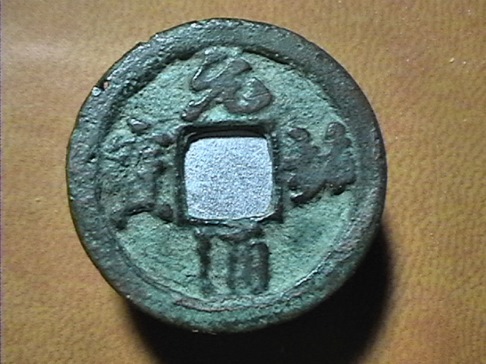
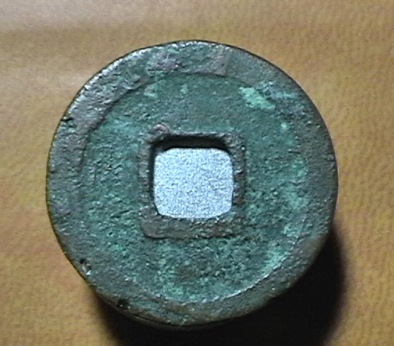
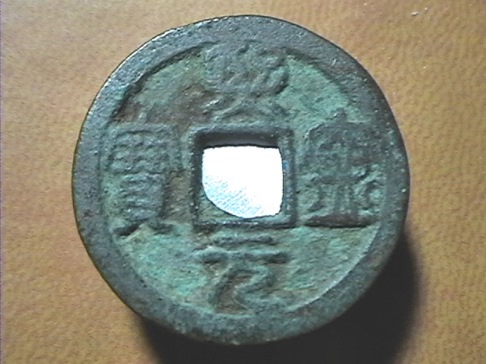
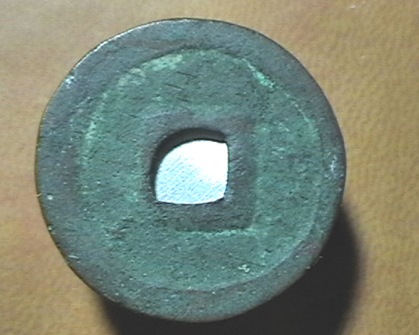
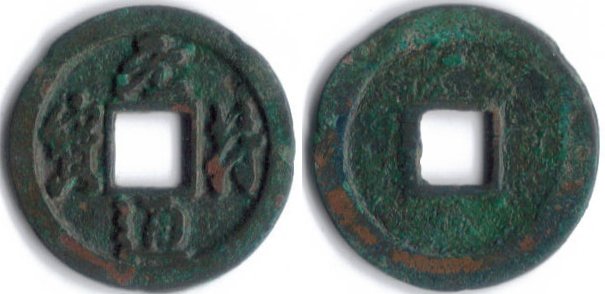
This coin wasn't identified right and so I narrowed it down to Yuan Feng. It's difficult to figure out because the script is written in "grass script". There are several different types. Plain, seal, orthodox, running hand and grass calligraphy styles. Grass script is sort of like cursive would be in English. You can see the characters sort of flow, rather than being uniform lines.
Some history for you. Yuan Feng is the reign title used by emperor Shenzong in 1078 - 1085 AD.
Quote:Emperor Shenzong of Song (Chinese: 宋神宗, Pinyin: Sòng ShénzÅ�ng) (25 May 1048 â€" 1 April 1085) was the sixth emperor of the Chinese Song Dynasty. His personal name was Zhao Xu. He reigned from 1067 to 1085.
The periods within his reign are XÄ« NÃng (熙寧; "Peaceful Prosperity") 1068â€"1077, and Yuán FÄ"ng (å.ƒè±�; "Primary Abundance") 1078â€"1085.
During his reign, Shenzong became interested in Wang Anshi's policies and appointed Wang as Chancellor. Wang implemented his famous reforms aimed at improving the situation for the peasantry and unemployed, which some have seen as a forerunner of the modern welfare state. These acts became the hallmark reform of Shenzong's reign.
Shenzong's other notable act as emperor was his attempt to weaken the formative nation of Xi Xia by invading and expelling the Xi Xia forces from Gansu. Shenzong's army was initially quite successful at these campaigns, but during the battle for the city of Yongle, in 1082, Shenzong's forces were defeated. As a result, Xi Xia grew more powerful and subsequently continued to be a thorn in the side of the Song dynasty over the ensuing decades.
During Shenzong's reign Sima Guang, a minister interested in the history of the previous 1000 years, wrote a very influential history book: "A Comprehensive Mirror for Aid in Government" (simplified Chinese: 资治e€še‰´; traditional Chinese: 資治e€še''; pinyin: ZÄ«zhìtÅ�ngjià n). This book records historical events from the Zhou Dynasty to the Song Dynasty. Another notable literary achievement which occurred during his reign was the compilation of the Seven Military Classics, including the alleged forgery of the Questions and Replies between Tang Taizong and Li Weigong.

Shenzong died in 1085 at the age of 36 and was succeeded by his son. His temple name means "Divine Ancestor".





 Posted 01/14/2013 4:38 pm





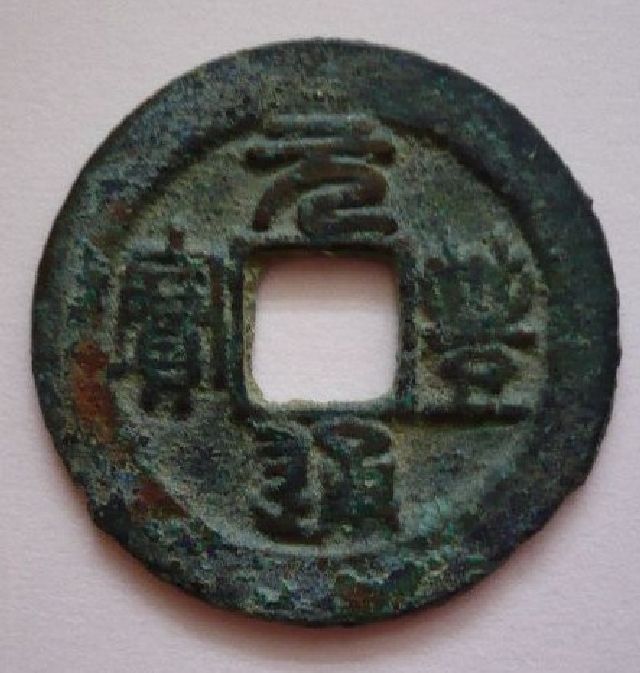


 But not now; I just got back on the bandwagon.