| Author |
 Replies: 11 / Views: 1,155 Replies: 11 / Views: 1,155 |
|
|
Pillar of the Community
United States
2250 Posts |
I know nothing about ancient coins, and don't know if this is a common question or not. Obviously a coin could not be dated 29 BC because they didn't know that Christ was coming in 29 years (give or take).
So what kind of dating system did the coins back then use?
|
|
|
|
Pillar of the Community
United Kingdom
4208 Posts |
Most coins are not dated. Dating is a lot lot later. The current dating system isn't going to come about for a while either.
However, some coins ARE dated. These have the date compared to another date - for example, a roman coin might be dated 'Year 7'. this doesn't mean 7AD, this means the 7th year of the reign of the guy who issued it. This means if he started his rule in march then the date refers to any date between march one year and march the next year.
I must stress though, very few coins are dated - even that system doesn't match a date.
|
|
Moderator
 United States
23731 Posts |
On coins that depict Kings or Emperors knowing when that specific ruler was in power would give a general idea as to date.
|
|
Pillar of the Community
United Kingdom
2838 Posts |
Much of this is borrowed from Wiki but they say it better than I could  It refers only to the Romans, I believe all civilisations had their own systems usually starting at a 'year 1' at an important event or founding. It is not known how years were identified during the Roman monarchy. During the Roman Republic, years were named after the consuls who were elected annually. Thus the name of the year identified a consular term of office, not a calendar year. For example, 205 BC in our system was to them 'The year of the consulship of Publius Cornelius Scipio Africanus and Publius Licinius Crassus'. Lists of consuls were maintained in the fasti. The fasti was a chronological or calendar-based list of official and religiously sanctioned events. 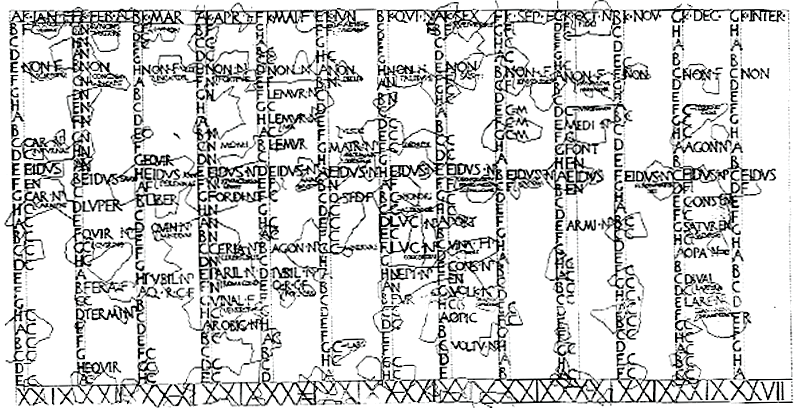 Fasti FastiThe first day of the consular term changed several times during Roman history. It became 1 January in 153 BC. Before then it was 15 March. Earlier changes are a little less certain. There is good reason to believe it was 1 May for most of the 3rd century BC, until 222 BC. Livy mentions earlier consular years starting on 1 Sextilis (August), 15 May, 15 December, 1 October and 1 Quintilis (July). In the later Republic, historians and scholars began to count years from the founding of the city of Rome. Different scholars used different dates for this event. The date most widely used today is that calculated by Varro, 753 BC, but other systems varied by up to several decades. Dates given by this method are numbered ab urbe condita (meaning from the founding of the city, and abbreviated AUC), and correspond to consular years. I believe to get dates meaningful to us ( 29 BC) we have to work back from the founding of the Gregorian calendar (the one we still use today, roughly) in 1582 and use the previous calendars (eg Julian calendar) to help get the scale correct. On the actual coins as Ben and echizento have already stated usually a reignal year or consul year was sometimes included, at certain times the Emperors were coming and going so quickly simply a name was enough to give a tight date. An interesting question that I'd never really thought about jpsned  Edited by bobbyhelmet
02/02/2013 10:14 am
|
|
Pillar of the Community
United Kingdom
946 Posts |
As Bobby states, the Tribunship and Consulship dates on the reverse of some coins gives a date, as long as you know the years the emperor reigned from. Also the Romans dated their year from the founding of Rome, 753 BC. Known as "Ab Urbe Condita" http://en.wikipedia.org/wiki/Ab_urbe_conditaSo for example, the reign of Trajan, in the "AUC" dating system would be 851 - 870 AUC (98-117 AD) Some of the imperial Greek coins, of the Seleucids and Ptolemies used their own dating system. Edited by Masis
02/02/2013 11:43 am
|
|
Pillar of the Community
United States
1812 Posts |
 collecting errors is so much easier |
|
Pillar of the Community
United Kingdom
2838 Posts |
What about ancient errors  |
|
Pillar of the Community
United Kingdom
946 Posts |
Quote:collecting errors is so much easier -Broken-Coin  That's why you do it.  |
|
Pillar of the Community
United Kingdom
2121 Posts |
An example of the Ptolemaic dating mentioned above:- Ptolemaic Kingdom, Cleopatra III and Ptolemy X Soter, Silver tetradrachm Obv:â€" Diademed head of Ptolemy I right wearing aegis Rev:- PTOLEMAIOY BASILEOS, eagle standing left on thunderbolt, wings closed, L I (year 10 of Cleopatra's reign) left, PA right; Minted in Paphos, B.C. 110 Reference:â€" Svoronos 1668, SNG Cop -, Noeske -, 14.258g, 24,1mm, 0o After the death of Ptolemy VIII in 116 B.C. Cleopatra III ruled jointly with her mother Cleopatra II and her son Ptolemy IX. Cleopatra III expelled Ptolemy IX 110 B.C. and replaced him as co-regent with her second son Ptolemy X. Ptolemy IX regained the throne in 109 but was again replaced in 107 B.C. In 101 B.C., after 6 years of joint rule Ptolemy X had his mother Cleopatra III murdered.  Martin |
|
Pillar of the Community
 United States
2250 Posts |
Wow! Fascinating. I guess this brings up the larger question, before the year "0" in our AD calendar, how did the ancients officially refer to the passage of time in their dating systems?
|
|
Pillar of the Community
United Kingdom
4208 Posts |
Firstly - there is no 0ACE!
And secondly, there is no significance given to it in the ancient world. Jesus was a troublesome guy and christians were hated (riotous lot the christians were - messing with the roman's polytheism with their ramblings!). Well, Jews werent loved either. Its all very difficult (well, not really, any abrahamic religion was frowned upon in Rome).
As was mentioned above, the Romans refered to years in the AUC time scale - years since the foundation of Rome. Emperor Phillip the Arab celebrated the year 1000AUC with lavish games. You can buy silver coins commemorating this for a mere £70 (makes me a bit annoyed really being such a historic occasion).
The use of Kings and Pharoahs and Emperors reigns to date with was pretty effective I reckon. The reigns were generally known - at least the order. Egypt has yeieled structures which are literally just a big stone engraved list of the Pharoahs of Egypt.
|
|
Moderator
Australia
17000 Posts |
As has been alluded to in previous posts, the AD calendar we use today was not invented until long after the event it marks as Year 1 took place. Dionysius Exiguus, a monk living around AD 525, invented the calendar to replace the calendar used by the Eastern Church up until that time, the Era of Martyrs calendar which set Year 1 as the accession of emperor Diocletian, the last great persecutor of the church, in AD 284. Apparently, Exiguus believed that perpetuating the memory of Diocletian was something to be avoided. AD dates did not actually appear on coins until much later, the first being a coin from Denmark dated 1234. Regnal-date calendars are the oldest calendar style, and are still used in some countries: Japanese coins, for example, are dated according to the regnal year of the Emperor. Don't say "infinitely" when you mean "very"; otherwise, you'll have no word left when you want to talk about something really infinite. - C. S. Lewis
|
| |
Replies: 11 / Views: 1,155 |
|







 Posted 02/02/2013 09:50 am





