| Author |
 Replies: 11 / Views: 2,102 Replies: 11 / Views: 2,102 |
|
|
Pillar of the Community
United States
539 Posts |
would like to get some feedback on where this might be graded. These are the best pictures I can get. I have to use a scanner as my camera just doesn't work worth a darn for this stuff. The obverse is a little dark but hopefully will work. I'm guessing the yellow stuff is pvc residue or something. I actually chipped a piece off with my fingernail..probably ot the best idea but I did it. Any suggestions on safely removing the rest? 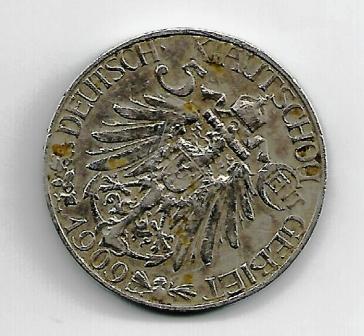 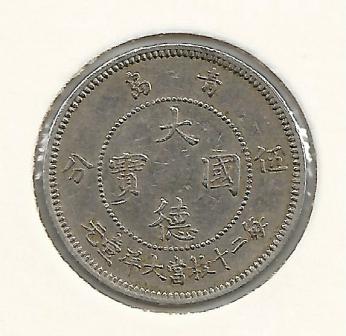 |
|
|
|
Bedrock of the Community
United States
37206 Posts |
Looks like a VF, detail on the crown is almost gone.
|
|
Moderator
 United States
14463 Posts |
are those pictures of the same coin? because the top one looks german, and the bottom one look oriental  |
|
Pillar of the Community
 United States
539 Posts |
fuzzy317,
exactly! It ia coin from the German enclave of Kiau chau. They had it a few years, minted two coins. this one and a 10Cent
Edited by weavus135
02/15/2013 8:47 pm
|
|
Pillar of the Community
United States
2589 Posts |
The German empire owned a colonial leased territory at Tsingtao, China between 1898 and 1914. Its primary purpose was to serve as a naval base for the German East Asia Squadron. At the outbreak of World War One the squadron (under Admiral Von Spee) sortied out in a mad dash across the pacific to avoid being caught in port by superior British Empire forces. The existance of the naval base was an incentive for the Japanese to enter the war, as they wanted its deep water port for their own use. After the Germans refused to had the territory over, the Japanese declared war and took the city after a siege. The German squadron attacked tahiti and sunk a british squadron off Chile before attempting to return home by rounding cape horn. Von Spee made a foolish attempt to raid the Falkland Islands before setting out for Germany and he was attacked by a vastly superior force that had been based there and most of his squadron was destroyed.
The only real imprint on modern society that the German colonization effort in china had was the creation of the Tsingtao brewery, which still produces beer today (they're the leading chinese beer in the usa I beleive).
|
|
Moderator
United States
14463 Posts |
Quote:
weavus135
fuzzy317,
exactly! It is a coin from the German enclave of Kiau chau. They had it a few years, minted two coins. this one and a 10Cent oops, I didn't know that  |
|
Pillar of the Community
United States
539 Posts |
that's a great bit of history of XofG. I knew some of that but didn't have that much detail.
Any other thoughts on grading? Is there a more defined range of VF? I've seen things like VF-20 or VF-35. How does one differentiate? Or does one?
|
|
Bedrock of the Community
United States
37206 Posts |
You will find that Krause only uses solid grades with no numerics as used on US coins. |
|
Pillar of the Community
Luxembourg
588 Posts |
Strange color and more wear then I have usually seen on these coins.
I would also go for a small VF.
|
|
Pillar of the Community
United States
539 Posts |
the color is my fault on the obverse. I was trying to show the yellow stuff which sort of chips off.
So if I may I would like to better understand the difference between VF and XF (EF). I know that Krause says 90% of the detail remaining is XF(EF) and at least 75% of detail remaining is VF. I'm not arguing for either case.
What I am trying to understand (and really just using this coin as an example), is, what does 75% or 90% represent. One comment suggests VF because the detail on the crown was nearly gone. Fair enough, it is certainly lacking detail. My question is really about whether the crown is 90% of the design. Or am I to read this distinction as any design element on the coin needs to be 90% or it is graded lower. In other words, the crown is what the crown is. Clearly it is not 90% of the coins detail but clearly more than 90% of it is missing. But what about the lettering on the back for example. That looks pretty darn good. and although it is hard to tell from my cruddy picture, the shield is in pretty good shape as well. Maybe even 85% of it is there.
Again, I'm not arguing if it is a VF coin. I'm asking only so that I am better educated on this subject. How does one read 90%. Is it the whole coin or is it individual design elements. And if individual elements, how many of them need to be at the appropriate level before a coin is graded there. For example if there are 10 elements, one really stinks but the others are minty fresh, is that a XF(EF)grade? I mean after all 90% of the elements meet that grading level.
Looking for some education.
thanks
|
|
Bedrock of the Community
United States
37206 Posts |
As with all grading it's just someones opinion. Grading from scans is a bit harder to do than looking at hi-res photos. Any reason for the obverse scan out of the 2 x 2 and the reverse taken in the 2 x 2?
The highest points of the coin wear first and with this particular design the crown appears to be the highest point followed by the eagles head, top of anchor and edges of the feathers. Reverse has very little detail to use other than the separation between the beads and rim. In this case there is very good separation so this coin would be a very high end VF coin. Not being a specialist in these coins and knowing strike characteristics, I would guess this one at VF-35 with a shot at EF-40. It would have been a solid EF coin if there was some detail in the center of the crown.
|
|
Pillar of the Community
United States
539 Posts |
thanks IGE. I was not bucking for a better grade just trying to understand how it is all done. And as to the why the obverse is in a 2x2. Well, I took them both out of the 2x2, then put it away. Realized when I went to post that the obverse scan was really bad. So rather than tear it out of the 2x2 I just took the next scan with it in. And I do wish I had the ability to shot this with a camera but I don't
|
| |
Replies: 11 / Views: 2,102 |
|




 Posted 02/15/2013 8:30 pm





