| Author |
 Replies: 10 / Views: 4,631 Replies: 10 / Views: 4,631 |
|
|
New Member
United Kingdom
8 Posts |
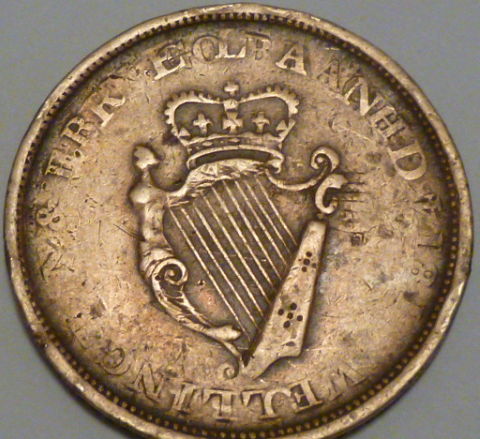 hello everyone. just joined the site. I'm looking for some information. while working on an old chapel dated 1737, while changing the windows, I found a coin in the cavity, it's 33mm diametre & on one side it has the words wellington & .........., I carn't make out what the last word is. it is dated 1814.in the middle, it shows a harp, possibly irish?. the reverse side has the words; one pound value for 240. the centre figure looks like a man with a pony tail, looking left. if anyone has any information, on the coin/token, I would be grateful. thanks for your time, george. 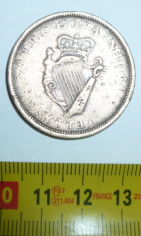 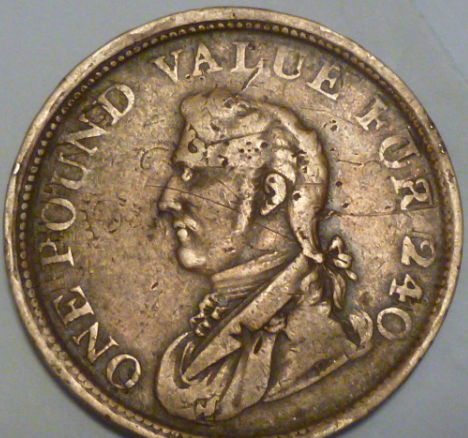 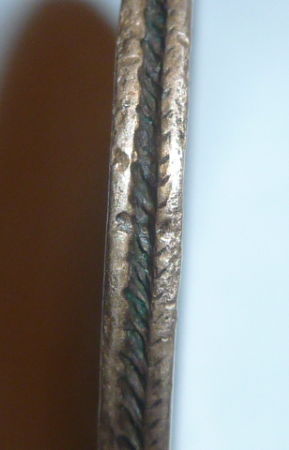 Edited by george haynes
03/03/2013 01:27 am
|
|
|
|
Pillar of the Community
United States
3253 Posts |
As I suspected, this is at Irish copper token of one Edward Stephens of Dublin. The reason why the WELLINGTON & ERIN GO BRAGH is so difficult to make out is because it was stamped over, or it was stamped over something else. These private tokens were often struck over other coins.
|
|
Pillar of the Community
United States
4897 Posts |
 . Stephens was quite prolific and this is a nice example of his work. |
|
Pillar of the Community
United States
3253 Posts |
The original token, that was struck over, had a portrait of Wellington, but that's now obliterated by the harp (with IRELAND above it). The new portrait, on the other side, is of Edmund Burke! Wellington was a popular theme after Waterloo, but the irony of the Wellington Irish tokens is that Wellington himself was virulently anti-Irish.
Know the one about the Duke of Wellington and the Irishman?
On the eve of the battle of Waterloo, the Duke of Wellington was addressing the troops. "Men, I cannot lie to you; we are low on rations, short on ammunition, we lack the high ground, and worst of all, we are outnumbered four to one. But you need only remember one thing tomorrow, boys: Be British! Always be British!"
The next day, as the battle raged on into the afternoon, the Duke saw to one side of the battlefield a skinny little Irishman leaning against a fence, having a smoke. Riding over, he shouted, "Good God, man! Can't you see we're in the fight of our lives! What do you think you're doing!" The Irishman took his pipe out of his mouth and looked up:
"I've kilt my four!"
|
|
New Member
 United Kingdom
8 Posts |
hello. thank you for sharing your knowledge with me. i'll hang on to it for now, & show friends & family. but I'm not a collector, so i'll pass it on to a more interested party later.
thank you very much, george.
|
|
Rest in Peace
United States
4078 Posts |
@ Philadelphian, Quote:
Know the one about the Duke of Wellington and the Irishman? This was way to funny  I had a good belly laugh on this one! |
|
Rest in Peace
United States
4078 Posts |
Sorry George for throwing in my post. Interesting coin as I'm Irish/ American.
|
|
New Member
United Kingdom
8 Posts |
hello, I've not heard the saying about wellington & the irish man, although I can see both sides views!
i have just added the edge view of the coin, as I find this interesting too. although the community is of the opinion the coin is copper, wouldn't it have the orange tint to the colour?
thanks for the warm reception, george.
|
|
Pillar of the Community
United States
3253 Posts |
Perhaps the Irish token experts here can comment on whether these were ever minted in brass or bronze, but copper will naturally tone to a chocolate brown with time (will only turn green when out in the wet). As to the edge, I don't think that's original. Coins of this time period are occasionally found to have been tooled to be used as gears or pulleys, though those will tend to have a hole in the middle. Could this token have been suspending the sashweight in that chapel window? And by the way, is this chapel in Ireland? Or did this token cross the Irish Sea long ago?
|
|
Pillar of the Community
United States
3253 Posts |
Also noticed, beneath the ONE POUND legend, you can still make out E. STEPHENS, the name of the maker of the original token, and DUBLIN beneath FOR 240.
|
|
New Member
United Kingdom
8 Posts |
hello. you have had a close look indeed! the coin was from sheffield, in yorkshire, and was beaneath the window board. had the top two rows of stone not been loose, this coin would still be there in the debris filling the cavity, between the two outer walls of stone. the windows we removed, were fixed pane, although I dout whether these were the original, nearly two hundred years old windows. I had wondered, if there was a reason for putting it there? could there be one under the other six windows? I could borrow a metal detector to try the other windows.
thanks for your information, george.
|
| |
Replies: 10 / Views: 4,631 |
|





 Posted 03/02/2013 3:54 pm





