i found this info online
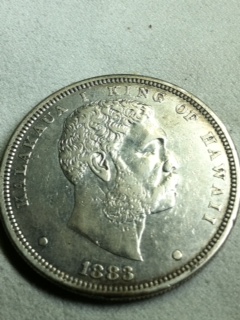
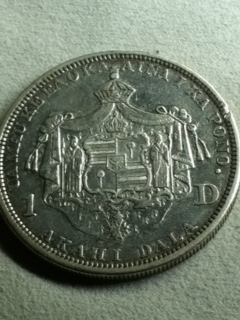
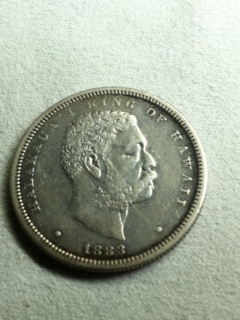
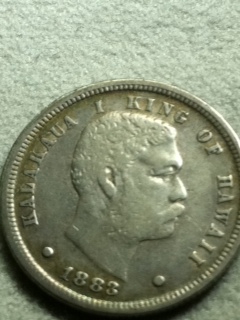
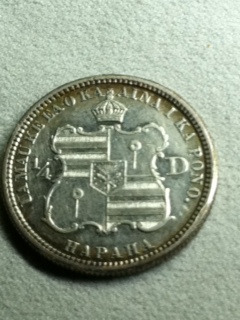
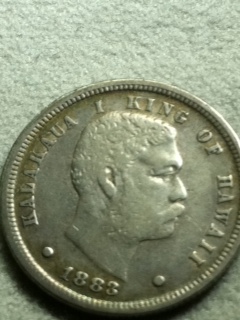
"No more coins were struck for the Kingdom of Hawaii until the 1880s. Under the farsighted rule of the cosmopolitan King Kalakaua (1874-91), who sought to bring the islands up to Western standards of development, representatives from various foreign mints were interviewed on the subject of a contract coinage. This move alarmed sugar magnate Claus Spreckels, whose influence in the islands made him a virtual second king. Certain that Hawaii was vital to the interests of both himself and the United States, he persuaded Kalakaua to have the desired silver coins struck by the USA to American standards. The latter provision was a key selling point, as the use of standard USA coin planchets lowered the cost of this coinage. For reasons not specified, the copper keneta was not included in this proposal, and only silver pieces were ordered to a total of one million dala.
The master hubs and dies for this coinage were prepared by the United States Mint's Chief Engraver,
Charles Barber. He worked from designs submitted by Spreckels and subsequently modified by Mint Director Horatio C. Burchard. Six proof sets were struck at the Philadelphia Mint in September of 1883, both to test the dies and to provide souvenirs for important figures associated with the occasion. Some 20 more sets were produced in 1884 from the same dies, and these were distributed to various Hawaiian dignitaries. None were offered to the public.
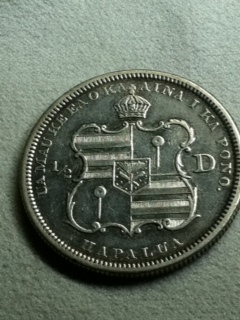
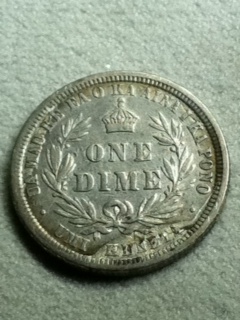
The circulating coinage of Kalakau was executed at the San Francisco Mint between November of 1883 and June of 1884, though all pieces bore the earlier date. The denominations struck corresponded to those provided for in the law of 1846, with one exception. The hapawalu, or eighth dollar, was excluded from regular production in favor of the umi (ten) keneta, or dime. This move facilitated the use of standard USA silver planchets. The eighth dollar, however, was included in the 20 proof sets struck at Philadelphia in 1884.
These silver coins were far more successful than their copper counterparts of an earlier generation, and they remained in circulation after the American annexation of Hawaii in 1898. They were gradually withdrawn thereafter and replaced with American coins of the regular types. Retired pieces were returned to the USA and melted. As a result, all denominations are fairly scarce in circulated grades and genuinely rare in Mint State. The sole exception is the hapaha, or quarter dollar. Several Uncirculated rolls turned up after World War II, and these coins are highly sought by collectors.
"
very interesting history behind the coins.









 Posted 03/13/2013 10:08 pm





