Quote:
Hang about Massis - they could still be barbarians! It simply applies to those who dont speak greek. To the ancient greeks all other languages sound like 'Bar Bar Bar'.
That being said, those with the money and time for an illegal mint probably knew greek anyway.
Well, to digress, we can say for sure that the ancient Greeks looked at the Romans as Barbarians.
It was because of this that Mithradates VI of Pontus launched his war against the Roman occupation of Anatolia and Greece in the 1st century B.C.
Of course, when Rome won, and kept its rule in all Greece, they had to allow these "Barbarians" to compete in the Olympic games, which was normally barred to non-Greeks.
Anyhow, back to the subject, I don't see a link between people who run an
illegal mint and
speaking Greek (or having time or money to spare ) especially when the coin in question comes from the
non-Greek speaking area of the Empire, Britannia and the Rhine-Upper Danube frontiers.
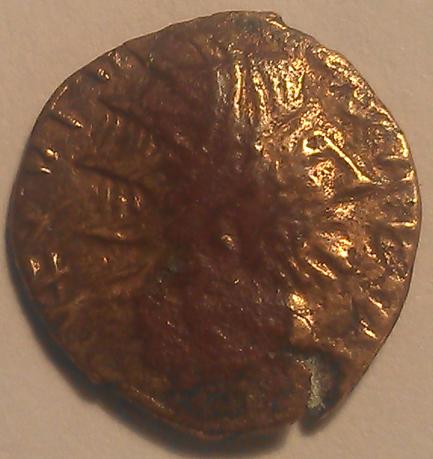
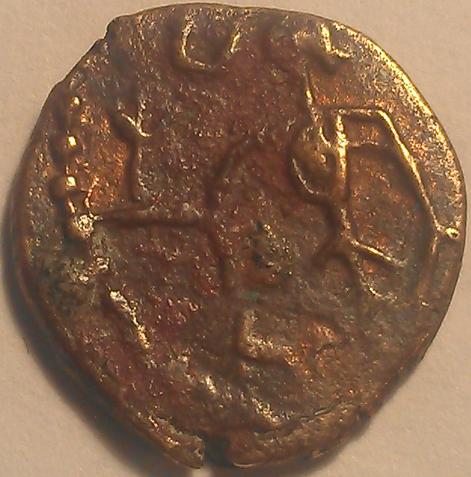
These types of coin (Barbarous Radiates) seem to have been issued from around 260 - 330 A.D. and finds seem to occur mostly along the Upper Danube and Rhine frontiers as well as in England and Wales.
It was an era of major military and political upheaval in the Empire.
The citizens needed ready change, something which in that upheaval was in short supply.
Rather than being the product of lackadaisical and filthy rich philhellenes, they were more likely the product of Gallo-Roman artisans living in or near the frontier towns and forts.
And rather than being issued in one area, they do seem to have been issued locally in the said areas.
Even styles have been attributed to local areas from northern to southern England.
We see that some of these are made quite well, maybe apprentices at the official mint "doing a bit on the side" and then we see totally abstract works, with just a radiate and a blob for what must be a face, as if a Smithy had a go at striking coins.
It is perhaps because of this abstraction (which is seen around three hundred years later in the Germanic successor kingdoms of the west, such as kingdom of the Visigoths, where the draped bust of the king gradually degenerates over the centuries into a a "cubist" figure) that might explain why these Unofficial coins issued within the Roman empire are labeled "Barbarous".
These were not the product of "good, easy times" but chaotic times.
They were not done "as a hobby in spare time" but to buy necessities, though it is unlikely the tax collector would have accepted them.
Old Denarii and if they had one, an Aureus, would have been used for that.
On the crudity of style, we can see this in "Official Issues" of the emperor Regalianus.
 http://en.wikipedia.org/wiki/Regalianus
Which also coincides with the era.
Regalianus himself was "a product of the frontier", the Danube frontier.
Both in terms of mints and politics, the era of 260 - 330 saw a major shift from the "center" to the frontiers of the empire.
Rather than giving up on coins, the Citizens, in Britannia for example, wanted to "keep to what they knew", that is coins with a reassuring emperor and a deity on it.
Obviously being still under Roman rule they couldn't revert to a barter economy, which is what happened eventually when the legions left Britannia in 410 A.D.
And by that date, rather than "Barbarous Radiates" being used, it seems that Unofficial issues of the "Fallen Horseman" type and clipped Siliquas, were used until there was no use at all for them in the early Germanic kingdoms of Britain.









 to the community

 Posted 03/16/2013 4:12 pm





 Tetricus

 )
)


