| Author |
 Replies: 10 / Views: 1,210 Replies: 10 / Views: 1,210 |
|
|
Pillar of the Community
United States
3495 Posts |
Many years ago I took a jewelry class and used the opportunity to make castings of some of my collection. They were not 'perfect' castings but I never intended them to be anything but decorations for the things I was making (rings pendants etc) They were uniface and as such were ideal for attaching to whatever I wanted. I wanted to make a belt buckle ! First I prepared a piece of brass plate and choose several images to place on it. Of course the thought occurred to me that ideally a buckle would/should have a slight curvature rather than be flat plate. No problem as we had acetylene torches various sized hammers and of course an anvil. Sounds quite simple doesn't it ? Try as I might I could barely dent that brass plate and as for curving it .... no way Jose. Around this time the thought crossed my mind .... how could an 'orichalcum' sestertius possibly be "hand stamped" when I could not even bend a slightly thicker piece of brass even with the use of torches and 5lb. sledge. Now some will say that the alloy I was using was 'different'. Well that certainly is true ! What I have researched and found out about Roman orichalcum (brass) is that the mixtures were all over the place. Over time as coinage was recycled the percentage of zinc tended to decrease as it would evaporate in the smelting process and the amount of lead tends to increase up to the time of Gordian and Philip when the alloy had been so degraded that it is best described simply as bronze. As someone untrained in metallurgy I assumed the lead would make the alloy soft. It will but only when the amounts get so high the metal becomes dull in color. Before that time it actually acts as a hardening agent and is partly responsible for the fractures we see in later sestertii. The alloy was getting so hard the coins would crack when minted. Which brings me back to my 'delusion'. Everything I have ever read or seen about ancient coins give a fairly simple explanation where Moe Larry and Curly operate an efficient minting procedure where one guy handles the blanks one guy holds the die in place and another swings a hammer. Conveniently when demonstrating the 'art' of minting coins they always seem to use pure silver. If you have ever worked with pure silver (not sterling which is .925) and annealed it ... well you can bend it with your bare hands. The very definition of malleable. After striking it will develop a hardness and may be re-annealed to work on some more. As far as someone demonstrating on an ounce sized 32mm piece of brass I have never seen it. Now anyone who has ever looked at many sestertii would notice that very many of the them show evidence of being struck at least twice. Usually a ghost like image in a very narrow band around the portrait. I assume that it was probably the standard procedure to strike twice due to great force it would take to mint large sized coins in such high relief. Sometimes of course the double strike is much more obvious Sestertius of Balbinus 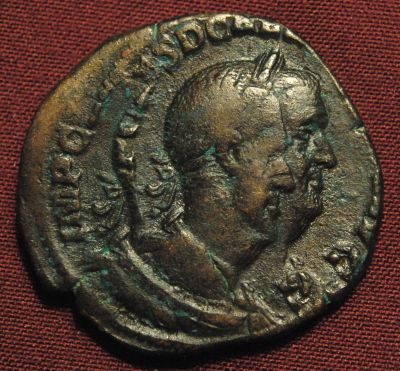 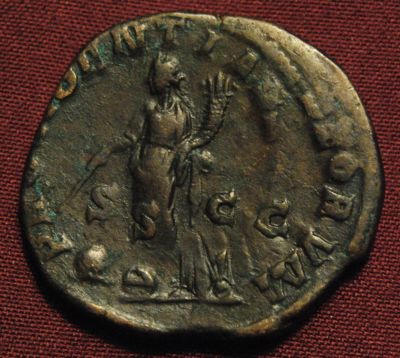 Now a coin blank after being struck once will become hardened and would not easily give up the image it has received from the dies. Thus when hit a second time the original image will not simply go away. Okay easy and simple enough. This is why we have an image on both sides off centered. Now the dies on this coin were not in perfect alignment of rotation with a difference of about 10 degrees or so. But when I compare the angle of the 'noses' with the opposite side where the S's in S C are similarly placed they have the same angle. Not only that but both the 'noses' and the S's are the same distance of 4mm. So according to the book this coin was produced by hand and struck twice with the exact same alignment and rotation of the dies. I beg to differ. The only way this coin could have been produced is with a "machina". Simply put I would argue that a civilization capable of hurling 'balliastae' a quarter mile could have developed a technique for forcing a die into a very unforgiving metal like brass. I hope I didn't bore you to death ! And yes as you can tell I am in love with my sestertius ! |
|
|
|
Valued Member
Canada
491 Posts |
Interesting story for anyone with no experiences with metal working, it certainly does give an appreciation for history and the artisans technical skills.
|
|
Moderator
 United States
23731 Posts |
I really like this coin. Interesting theory how this coin was struck.
|
|
Bedrock of the Community
United States
10045 Posts |
Great read and nice example!  |
|
Pillar of the Community
United States
3229 Posts |
Great coin! Very cool hypothesis! Not boring! |
|
Rest in Peace
United States
4078 Posts |
Thanks FVRIVS, very interesting and informative.
|
|
Pillar of the Community
 United States
3495 Posts |
If you look closely at the S's and the C's you will note a difference in the angles. This difference is the same on obverse when you compare the noses and the letter P in IMP but of course being on opposite sides it is a 'mirror'. On obverse the angle is greater on the right hand side while on reverse the difference is greater on the left. So not only did the coin move 4mm during the stamping but also rotated slightly. The only way I see this as possible is if the dies were mounted and 'fixed'. The coin moved (and rotated) and the dies remained in place. This to me is evidence of a "machine" being used. A simple machine but a machine. When you think about it once you have mounted your dies it is not that much of a stretch to say "Hmmm .... we could make something to 'press' the die". The Sestertii ceased production after Gallienus (excepting Postumus) and no type of coin with similar high relief minted in 'bronze alloy' appeared until modern times and the advent of the coining press. Remember I am talking about alloy. Relatively pure copper like silver is very malleable. But brass (orichalcum) is really tough stuff.
While reading through my Sear one day I noticed that Antoninus Pius minted sestertii dupondii and asses with the 'Britania' reverse. Particularly one type with a "Britania dejected" reverse caught my eye. While comparing the types I noticed that under the description of the 'as' was a notation that he (David Sear) believed based on the 'crude' quality and location of some finds that he attributed "some" of them to be of "British" manufacture. Official coins but not coming from a regular mint. The question I would have is why only the 'as' and not the other two ? A minting operation could surely have doubled the monetary value of the output by making dupondii instead. Orichalcum was made by a process which used calamine as the source of the zinc. I am not an authority on Romano British mining operations but I always believed that northern Europe and Britain were sources of calamine. It makes no economic sense to make asses instead of dupondii and sestertii unless you can't get the alloy (improbable) or you don't have the technology available. Especially if that sort of technology were considered a highly sensitive 'State Secret'.
Edited by FVRIVS RVFVS
03/26/2013 09:13 am
|
|
Moderator
United States
23731 Posts |
You make a good point of the possibility of the Romans using some type of machine to strike their larger brass coins. I've often wondered had a person welding a hammer would deliver enough force to strike those coins. It would stand to reason that some other method would be needed to produce such a deep strike. It's odd though that there are no records or any that I know of that indicate such a machine was in use. After all the Romans were excellent record keepers and they did love their machine.
|
|
Pillar of the Community
United States
1315 Posts |
FVRIVS,
Now all you need is to find evidence of the 'machine' being found.
I love your coin and your hypothesis, it's seems plausible that a press of some sort could of been created in those times. Perhaps just for certain coins, as it might of been a slow process and most production needed to be done at a rapid pace.
|
|
Pillar of the Community
United States
3495 Posts |
I have edited my previous post to correct the impression that 'all' the asses were minted in Britain. They were not but some apparently may have been to supplement the supply. These were only the 'Britannia dejected' asses as far as I know. The use of propaganda to spread the word especially in the north is demonstrated by the 'dejected' theme and were made in the mid 150's when the troubles had gone on for too long. Like wars everywhere eventually the big guy adopts a "carrot and stick" approach.
"The war is over ..... We win and you loose ..... and by the way you work for us now so take this 'bladder' full of coin and if you are a good lad there will be more next month. If you refuse our generous offer we will cut out 'your' bladder fill it full of coin and offer it too your second in command. Any questions ? Good ..... now move along .... next !"
By the second century the AE coinage was becoming 'token' coinage. Real bills got paid with silver and gold. Bronze was for 'chumps' who wanted to get a hair cut or buy a sausage at the Colusseum. Or maybe paying off the 'rubes' in the north. But it doesn't make any sense to create 1/4 sestertii 'tokens' if there is no problem making larger denominations. They are tokens. If you could print perfectly good money why make 5's if you can print 20's ?
I have made this case several times to different people whom I thought might be interested. The response is always the same. "No they did it the way I saw at the International Show in New York" (where of course someone made a 'Greek' style stater ..... out of .999 fine silver)
As for evidence of the actual machine. I doubt you will ever find such a thing. I doubt it would have been of bronze but possibly of the remarkable metal which was made by reworking and re-smelting iron until enough carbon had absorbed into it that you had made a low grade steel. Some Roman swords have been discovered which are of low grade steel. As they had little understanding of what was going on (the carbon coming from the charcoal in the hearth of the smith) I would bet the officers had the 'nice' steel ones while the infantry men had iron. Every old busted/unused machine goes to the scrap yard eventually. Here in Worcester we once had the largest forging press in the world. I can't remember exactly how big but big enough to be heard miles away. Once the 'inventories' had reached an estimated 50 year supply for the US Army forgings they were making the scrap workers came in and chopped it up. (The 'talc' like dust of Iraq wore out the inventories in just a few years .... but thats another story !)
I have rambled on for far too long already and need attend to my daily 'chores' now !
|
|
Moderator
United States
23731 Posts |
An interesting subject and one worthly of some further research.
|
| |
Replies: 10 / Views: 1,210 |
|







 Posted 03/25/2013 11:11 pm





