| Author |
 Replies: 33 / Views: 5,462 Replies: 33 / Views: 5,462 |
|
|
|
Bedrock of the Community
 United States
18888 Posts |
I'm hoping that someone more knowledgeable on old coppers can confirm our theory  |
|
Moderator
 United States
23522 Posts |
You don't need to be a copper expert to understand what's happening here; it's common to all coinage. The reverse is becoming a full Cud - the upper left quadrant of the die is no longer connected to the rest of it, but it's still there. Under repeated strikings, it's being eroded under the surface. Die material is being broken off the bottom of the Cud piece, and it's gradually sinking. Die sinking is a process, not a point occurrence. The original coin here is a later die state than the one TJ posted second. On the second, more of the original die supports its' surface, leading to a more detailed strike. On the original coin, the Cud has sunk so low that an even strike across both faces is no longer possible. The star disappears from the obverse. The die crack (being physically small to begin with) disappears from ONE except at its' strongest points. I'm inclined to think this die broke early in the process, yet lasted a long time after. I think it cracked and was then removed for a bit of polishing to help remove the crack, as earlier states have the dies in alignment but the later states as illustrated here have the obverse die clearly misaligned. |
|
Bedrock of the Community
United States
18888 Posts |
Really Cool SsuperDdave. thanks for adding your comments which completed the puzzle.  very interesting insight into how this occurred. where do you think my coin fell into this strike sequence as it does not have any sign of the die cracks. I am going to say mine was prior to the other two but then mine has no signs of star#1 and the second coin does. thats kind of what threw us off in the first place. we weren't sure how that could have happened. Edited by panzaldi
04/22/2013 3:01 pm
|
|
Moderator
United States
23522 Posts |
Fascinating. I may have to toss the baby out with the bathwater here; that star appears in various levels of strike unrelated to the progression of the Retained Cud. I wonder if the problem for which the die was removed was improper basining, with the die having a low spot at that star. |
|
Pillar of the Community
 United States
3229 Posts |
SsuperDdave, thanks! A lot what you are saying is making sense to me. Panzaldi, I think I am seeing signs of the beginning of the die crack between the D and the wreath and the S and the wreath? 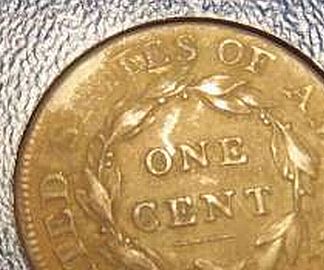 |
|
Bedrock of the Community
United States
18888 Posts |
Good catch TJsCoins! I looped it and there is a faint crack from D to the wreath. I cant see anything in or around the S or from the D to the S. I think this would absolutely confirm that mine was minted prior to the other two. The die crack from the D to the wreath must have occurred first. still does not explain example 2 with full die crack and a star#1. the only thing I can think of is that it was struck with more force as attested to by the clash marks and SsuperDdave's comment, this could account for the star showing on this one and not on yours. Do we have it!
|
|
Bedrock of the Community
United States
17884 Posts |
Yours was definitely struck before the others. The other coins are from Die State VII which clearly show the crack from the D across the O above NE to the wreath, and the triangular die chip that fell out inside the D.
|
|
Pillar of the Community
United States
3229 Posts |
Panzaldi, I think it is figuring itself out in my head:) To me the lack of the star in question is boiling down to poor strike, die sinking, and possibly some basining. It is still curious to me that there seems to no sign of that star when it is not present. Conder, thanks for helping out!  If you don't mind me asking, what is your die state reference? |
|
Bedrock of the Community
United States
17884 Posts |
Encyclopedia of Early United States Cents 1793 - 1814 by Walter Breen.
|
|
Pillar of the Community
United States
1374 Posts |
I'd still suggest die grease as the culprit. For the same reasons as SuperD mentioned, the die breaks make for a weaker strike. For one, the metal is flowing into the cracks. At the same time and for the same reasons, die grease should exacerbate the problem.
|
|
Pillar of the Community
United States
3229 Posts |
Drsandman2, thank you! Explained the way you did it makes sense to me:)
|
|
Bedrock of the Community
United States
18888 Posts |
Drsandman2, can you explain die grease,what is its purpose and how could it produce the results we are seeing. do you think that it could have filled my star#1 and mine may not be a true S-277?
|
|
Pillar of the Community
United States
1374 Posts |
panzaldi, Great questions. From what I understand, they put grease on the die so that the coins eject smoothly and to reduce heat from friction during striking. This grease fills the recesses of the dies, and prevents the blank planchet from filling these recesses. You can imagine that over thousands of strikes, that the coin might start sticking to the die once struck. In fact, lack of die grease might be why we have other errors, like multiple strikes on one planchet. I snagged this picture of Kennedys from another forum. Notice how the first 9 is completely missing on some of these examples. In fact, you can see some weird smudges or metal flow on the coin where the die grease was. The lack of detail from die grease should be more obvious on coins that have large die cracks and Cuds, because these cracks are being filled by metal that would otherwise strike up in other areas. It is possible for a chunk of grease to fill one device on the coin, making it virtually disappear. It could take many strikes until the grease is vacated from the device.  |
|
Pillar of the Community
United States
1374 Posts |
Here are a couple more examples that appear to be die grease.   |
|
Bedrock of the Community
United States
17884 Posts |
Any time you have machinery with metal parts moving past each other you need lubrication to reduce friction, wear, and heat. This means oils or greases. And oils and grease LOVE to attract and accumulate dirt and in the case of the mint, metal dust. Another reason for oil on the dies is because the die steel rusts fairly easily. The oil helps protect the steel from moisture. Another source of oil is the planchets themselves. The presses have automatic feeders and the planchets are given a light coating of oil to keep them from jamming in the feeding tubes. Over time all these oils and their dust loads can build up and fill recesses in the die.
|
| |
Replies: 33 / Views: 5,462 |








 First Page


 Posted 04/22/2013 1:04 pm


