| Author |
 Replies: 10 / Views: 2,083 Replies: 10 / Views: 2,083 |
|
|
Pillar of the Community
United Kingdom
4208 Posts |
DISCLAIMER: Dont clean coins by depatinating them. Thats not a good idea. This isn't for 'cleaning' coins.
Ive got a pile of culls (sesterces, smaller coins) and as they are just sitting looking ugly, id like to make them a bit shinier. These are plain ugly!
These have no descernible detail - these are literally blank, corroded discs. Nothing at all. These are brass or copper discs whose only redeemable characteristic is that the copper/brass was mined by romans.
So, any ideas? Some of these have some...extensive, corrosion. Some are coated in thick, green crud. I'm trying vinegar right now but does anyone have any secrets?
|
|
|
|
Pillar of the Community
Canada
579 Posts |
Lemon juice gets rid of patina pretty quick
|
|
Pillar of the Community
 United Kingdom
4208 Posts |
Id say almost too quick - last coin I did that with got a bit corroded and pitted. Vinegar is apparently much softer - but takes a bit longer. I'm leaving some stuff in over night including some silver (a cut denarius and a billon Didrachm)
|
|
Pillar of the Community
United States
5010 Posts |
I've used vinegar overnight before, came out ok.
|
|
Pillar of the Community
United States
3497 Posts |
Removing the 'crud' will make them look like any piece of bronze you might find lying in the road somewhere run over by 20,000 automobiles. I realize the desire to do something with them but short of recasting the bronze into a 'trinket' I think you will not like cleaned discs very much. I once tried to do it (smelting) with some 'crumby' Sicilian AE's with poor results. The bronze seemed to be contaminated with asbestos. Do you have a Blacksmith in your area ? Believe it or not they are still around in some places. Perhaps if you approach one with a pleasant attitude he might pour the bronze for you and you could fashion a 'bronze age' knife blade !
|
|
Moderator
 Australia
17006 Posts |
The problem with vinegar, lemon juice etc is that they are acidic; they will attack the raw metal as well as the patina. Ideally, you want to use something alkaline rather than acidic, as alkalis don't attack metallic copper or copper alloys.
Sodium hydroxide (also known as caustic soda and known in the coin cleaning trade as "lye") is the alkali agent most commonly quoted as the 'coin cleaner of last resort'. Concentrated ammonia works well too, but can leave the coin an unnatural orange colour.
Note that, if you strip off all the patina off of a heavily corroded coin, you will in all likelihood get a pitted uneven surface, no matter which cleaning agent you use; the corrosion does not always occur evenly across the coin's surface and a corrosion "hotspot" will cause a pit to form underneath the patina layer.
Don't say "infinitely" when you mean "very"; otherwise, you'll have no word left when you want to talk about something really infinite. - C. S. Lewis
|
|
Pillar of the Community
United States
5155 Posts |
I have this coin in which has a reddish bronze color. Somewhere down the line someone removed the patina from this coin, and we got something like this. 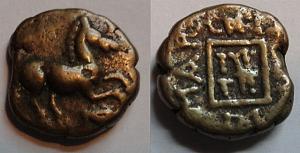 |
|
Pillar of the Community
United States
567 Posts |
Want to keep some patina - Brass wire wheel on a dremel.
Want to make it shiny and go down to bare metal - stainless wire wheel on a dremel.
Brass wheel has wored for me on 500+ coins with only a few boo boos.
|
|
Pillar of the Community
United States
2480 Posts |
Does the brass wheel impart some artificial coloring/shine? Seems like the brass would rub off onto the coin's surface.
|
|
Pillar of the Community
United States
567 Posts |
No. It doesn't leave traces like brass on stainless.
|
|
Valued Member
United States
325 Posts |
Soak for 3 days in distilled water. Use MS 70 cleaner to clean them. It won't degrade the coin surface.
|
| |
Replies: 10 / Views: 2,083 |
|










 Posted 05/01/2013 4:56 pm


