| Author |
 Replies: 17 / Views: 3,317 Replies: 17 / Views: 3,317 |
|
Bedrock of the Community
 United States
18924 Posts |
I finally got a couple nice pics of my 1798 LC. the clashes on the reverse between 4 and 7 o-clock are the identifying features of this R2 coin. she has some very minor porosity behind her face, there are also two light scratches running across the lower curls towards the date, otherwise she's pretty clean. I picked her up in January 2011 for $570. the most expensive coin I have ever purchased. she's a beauty and sits very well in her slot of my type set. I have a grade in mind and will post mine after several opinions. 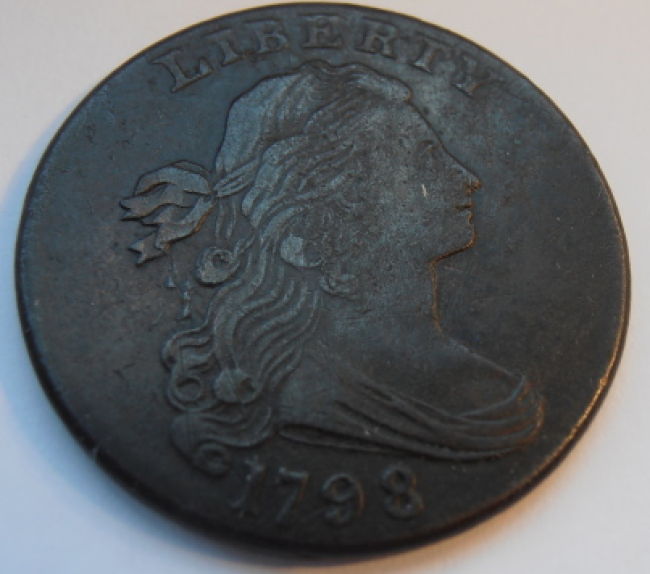 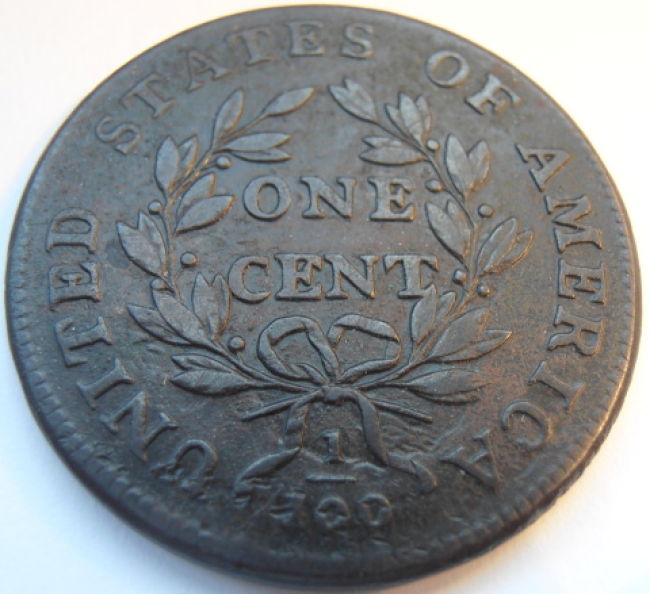 Edited by panzaldi
05/16/2013 08:32 am
|
|
|
|
Pillar of the Community
United States
4337 Posts |
wow that's a nice rare coin i wont attempt to grade her but I will give her a two thumbs up  AWESOME |
|
Pillar of the Community
United States
1054 Posts |
That is a very pretty example of that Sheldon. If I had to guess, VF details for the env. damage/corrosion.
|
|
Pillar of the Community
United States
3229 Posts |
Real nice; cool variety with the die clash! VF-EF w/ corrosion. |
|
Pillar of the Community
United States
5854 Posts |
High VF to EF details, environmental damage.
|
|
Bedrock of the Community
 United States
18924 Posts |
OK, so here's the question based on the comments it looks like there is some agreement on obv corrosion. Here's a question for the copper experts...what is the difference between porosity and corrosion? if the planchet initially was had this, would there be a details grade even though it was original to the coin?
|
|
Valued Member
United States
459 Posts |
This will be really interesting to see what the copper experts say about it.. Puzzling..
|
|
Bedrock of the Community
United States
18924 Posts |
To me it looks like porosity rather than corrosion. I believe it was like this prior to striking. We'll see if anyone can shed some light on it
|
|
Pillar of the Community
United States
3229 Posts |
Panzaldi, maybe you can educate me here. What is it that you believe caused the porosity? Do you think it was the die or maybe the planchete before it was struck? With no offence to your really nice coin, it looks like the porosity was caused after the minting to me.
BTW, is there a technical difference between porosity and corrosion?
|
|
Valued Member
United States
380 Posts |
VF Details Env. Damage or Corrosion.
Still a sweet penny
|
|
Bedrock of the Community
United States
18924 Posts |
TJsCoins. My thought is that the planchet was like this prior to striking. Metal strips produced for planchets in those early years sometimes contained gas bubbles in the strip from which the planchet was punched which caused the porosity. In hand the porosity does not meet the definition of corrosion which tends to deeper and caused by long exposure to water. this coin does not appear to have been exposed to the kinds of conditions to cause that deep crater-like corrosion. Keep in mind also that at that time there was no quality control and they did not waste any planchets.
|
|
Bedrock of the Community
United States
18924 Posts |
Here is an excerpt from a published article by John Pijewski regarding this subject. when reading his explanation and applying it to my coin in hand. I believe it falls into item (3) below (fine granularity). I'm no expert in this field but to me it looks like little fine sand like crystals on the surface
(1) The earliest stage of corrosion seems to be a kind of very shallow corrosion that appears as a thin layer of rust. It usually affects a small area or small areas on a coin, rarely the entire surface. It's usually colored a faint reddish brown (like rust) and doesn't really affect the details of a coin, just its surface. How does this corrosion process begin? Water or humidity? Can this corrosion be removed by cleaning or conservation? If left untouched, will this rust lead to a more serious form of corrosion?
Occasionally a coin will be described as having "light or underlying roughness." What does this really mean? Is it an incipient form of porosity or granularity? Or is it the earliest stage of something that will ultimately erupt into raised corrosion? Or does it refer to a separate kind of corrosion that's been stopped and won't manifest itself beyond the "underlying" range?
(2) Porosity seems to come in various grades of severity (micro, fine, moderate) and manifests itself as surface pitting (think of pores in human skin). Micro-porosity is tiny pitting that is best seen under a microscope or a high-powered loupe. Occasionally the pitting is so tiny that it doesn't detract from a coin's visual appeal (but the coin is still downgraded for this defect).
Fine porosity is visible to the naked eye. Both types of pitting (micro and fine) usually take the normal gloss off a coin's surface and make it appear matte, or non-glossy (it's like comparing flat paint to glossy paint; flat paint, or a matte surface, absorbs light and makes the surface have a dull finish, while glossy paint, or a glossy surface, reflects lights and makes the surface glossy).
Moderate porosity is the worst kind of porosity because the pitting is large and makes the coin unsightly, as though it seems to have a bad case of teenage acne. Micro- and fine porosity are less objectionable since they don't usually erode the details of a coin. Is there any connection between moderate porosity and raised corrosion, or are they just kissing cousins?
Is porosity the natural consequence of shallow rust-like corrosion? Is it caused by moisture or another environmental factor? I know that improper manufacture of copper planchets, either through impure ingredients or improper smelting can also cause pitting in a coin, but this pitting is different from porosity and seems to emerge from the copper itself.
(3) Granularity gives the coin's surface a sandy look, as if very fine sand had been incorporated into the coin's surface. It can be very fine, fine, or moderate, and can take away a coin's glossy surface. Sometimes it can be detected only through a microscope or high-powered loupe (extremely fine granularity), or the naked eye (fine granularity). Moderate granularity is the worst kind because it seriously affects the surface and a coin's details (imagine a saucepan of caramelized sugar and its bubbling surface). I've been told by one EAC dealer that a particular coin's surface is porous, only to be told by another dealer that the coin is granular.
What's the connection between porosity and granularity? They seem to be the product of two separate kinds of chemical reactions. It's as if copper has two basic chromosomes, and X and a Y. When a corrosive (such as water) touches the copper, the X chromosome may kick in and the corrosion exhibits itself as porosity (concave pitting), and if the Y chromosome kicks in then you have granularity (tiny raised dimples). What's the connection between the two types of corrosion? Or are they meant to be totally different types of corrosion, the way mumps are different from chickenpox?
(4) Raised corrosion appears when a coin has been left in the ground or other wet environment for a long time. It can have either moderate or heavy raised corrosion. The coin looks as if it's been lightly battered and then deep fried. All sorts of scaling or corroded metal exude from the coin's surface, obscuring its detail.
Is raised corrosion related in any way to porosity and granularity? Or is it a totally different kind of corrosion? Are there circumstances where some kinds of porosity or granularity can lead to raised corrosion? I suspect the raised part of the corrosion is some kind of oxidation that can be scraped off a coin and the coin's surface smoothed to enhance its eye appeal. I have one large cent where this has been done; the coin has good eye appeal but is still considered scudzy because it has an altered surface.
(5) The last kind of corrosion is called verdigris. This is, I think, oxidation that has reached its final stage of patinization that manifests itself as pale green, brick red, or black. It's the final stage of copper disintegrating into elemental components, but it's not going to crumble in your hands. Most often it's seen in old copper statues where the entire surface has turned a highly desirable pale or murky green (called a patina), or in copper flashing on a century-old building that, too, has turned a warm shade of pale green.
|
|
Pillar of the Community
United States
3229 Posts |
Panzaldi you don't mind I blew up and sharpened your image bit. 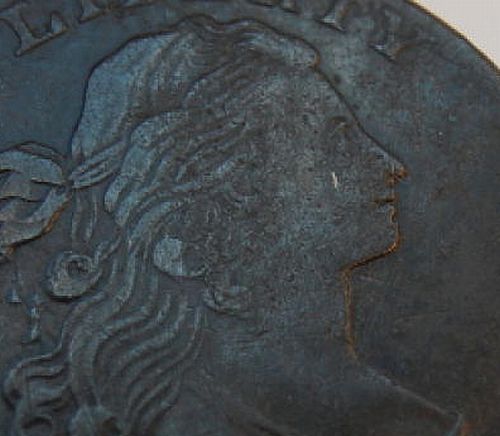 I see what you are talking about and I have heard of poor plachete quality causing porosity. What I have not figured out is how to tell the difference between porosity/corrosion that is post mint vs from the minting process. For your coin, I am just not sure because I do not know enough. Always willing to learn though:) Cool article BTW. I will need to read it a couple more times. |
|
Bedrock of the Community
United States
18924 Posts |
TJsCoins...thanks for the blow-up. I'm not an expert by no means. this is one area I would love to have more knowledge of. from what I've learned, porosity, Granularity and corrosion are basically the same thing. looking at the blow-up it appears to me that it is not raised, it looks more sunken. according to the author of the article, corrosion is raised Quote:
Porosity seems to come in various grades of severity (micro, fine, moderate) and manifests itself as surface pitting (think of pores in human skin). Micro-porosity is tiny pitting that is best seen under a microscope or a high-powered loupe. Occasionally the pitting is so tiny that it doesn't detract from a coin's visual appeal (but the coin is still downgraded for this defect). Fine porosity is visible to the naked eye. Both types of pitting (micro and fine) usually take the normal gloss off a coin's surface and make it appear matte, or non-glossy (it's like comparing flat paint to glossy paint; flat paint, or a matte surface, absorbs light and makes the surface have a dull finish, while glossy paint, or a glossy surface, reflects lights and makes the surface glossy). I am now leaning to my original assessment of Fine Porosity. In hand the "corrosion" does not detract from the overall appearance of the coin, although it may degrade the value of the coin. If I can find a real expert in old coppers, I would like to know if it actually was there on the bar before the planchet was punched (caused by air bubbles in the metal). in that case, I dont believe there would be a reduction in grade. I dont want to slab it as I dont collect slabbed coins, I love seeing them all side-by-side in an album so I dont think I would ever send it in to a TPG. I don't plan on selling it either, but its nice to know a grade and possible value of the coin. |
|
Pillar of the Community
United States
3229 Posts |
Here are couple of coins that I believe show poor planchete quality. I know that the minting of these two may be a little different but I think they still show qualities to look for with poor planchete quality. I think so anyway. This first coin is Russian 5 Kopek that shows uneven surfaces (porosity?). I have been told that the die break looking areas are also planchete flaws. 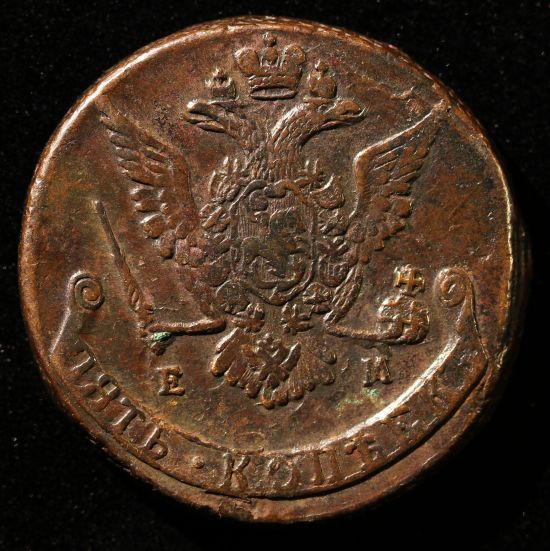 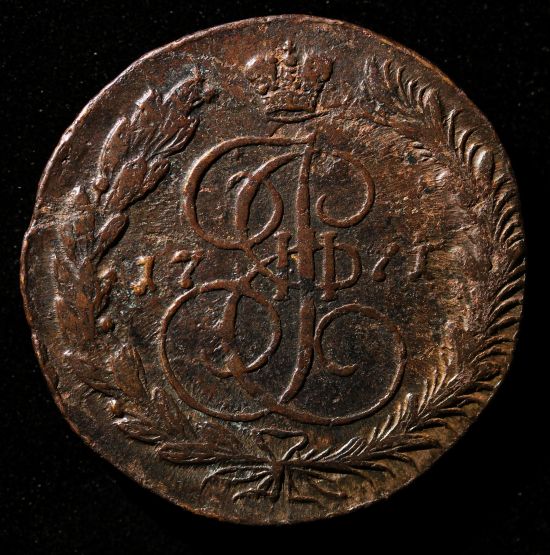 This second one is my 1722 Rosa Americana made of "bath" (poor quality metal) that shows what I believe are lamination bubbles and granular surfaces in the planchete. 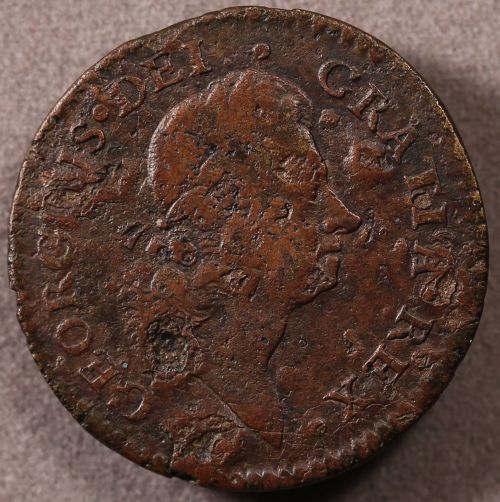  |
|
Pillar of the Community
United States
3486 Posts |
I am a piece of 100% copper.
I am over 200 years old.
Excuse me if I have a few (many) flaws.
BUT I SURVIVED!
Thanks, panzaldi, for this topic.
|
| |
Replies: 17 / Views: 3,317 |







 Posted 05/16/2013 10:53 am





