I dont know if this is the right place for this but this is the time period I'm interested in...Does anyone know where you can purchase coin dies to hammer your own coins to give out to kids. I'm a blacksmith and I perform and conduct several live demos a year at fairs and schools. They include everything but my mainstay is civil war and medieval periods. I usually just make axes, marlin spikes, straighten bent bayonets, etc for the reenactors, but for the kids I usually just make nails and small cloak broaches. Those are quick and the kids have something to carry away. I have everything from in a complete workshop including hammers, forges, anvils, smelted copper/silvers and iron blanks, etc. I hate imitations of items but this could open up a whole new world to these kids regarding coins. They don't even have to be "copies."
Just an idea since I've seen others on YouTube do them at romain demos and numismatic conventions. And ideas or thoughts would be greatly appreciated.
Why not try making your own dies? I'm about to try that-- will buy some ~7/8" tool steel rods from onlinemetals http://www.onlinemetals.com/merchan...top_cat=1354 , cut ~3/4" slices for the anvil (on which I'll carve the obverse) and a longer piece for the hammer (on which I'll carve the reverse). Not sure which metal to use, will probably get their A-2 alloy, air hardenable.
Use various Dremel bits or other tools to carve and polish a design, perhaps the date or something meaningful to your situation and use. Doesn't have to be artistically perfect, look at the crudeness of so many ancient coins!
Here's a video of someone making replica ancient coins, to give you an idea of one possible die shape:
Xq6VSWBF84s
I think it would be a great memento for the kids and fun for you too! Please post pics of your results :)
You could cast a die from one of your roman coins. I doubt anyone sells dies to be struck by hammer any more.
Or, as TIF said - make them. I think that would be ludicrously hard to do though. There was once a timeteam episode where a guy made a die and struck a coin. that would be worth watching.
If you are going to 'mint' .999 Fine silver or copper you need not use steel dies. Bronze dies can be made rather simply by the process of "hubbing". I am not sure of the steel used to make the steel pennies of WWII and whether they are hardenable (probably not) but by annealing the bronze and pressing the penny into the soft bronze you should be able to produce a small sized die. Any finish work can be done with a dremel tool and the bronze heated and quenched to harden it. Soft annealed copper blanks would be quite easy to stamp. Of course you might find a larger steel coin like medal to use and then make alterations with punches and grinding tool. Many people believe that ancient dies were begun with a hubbing and then finished by the engravers before being polished by the master engraver.
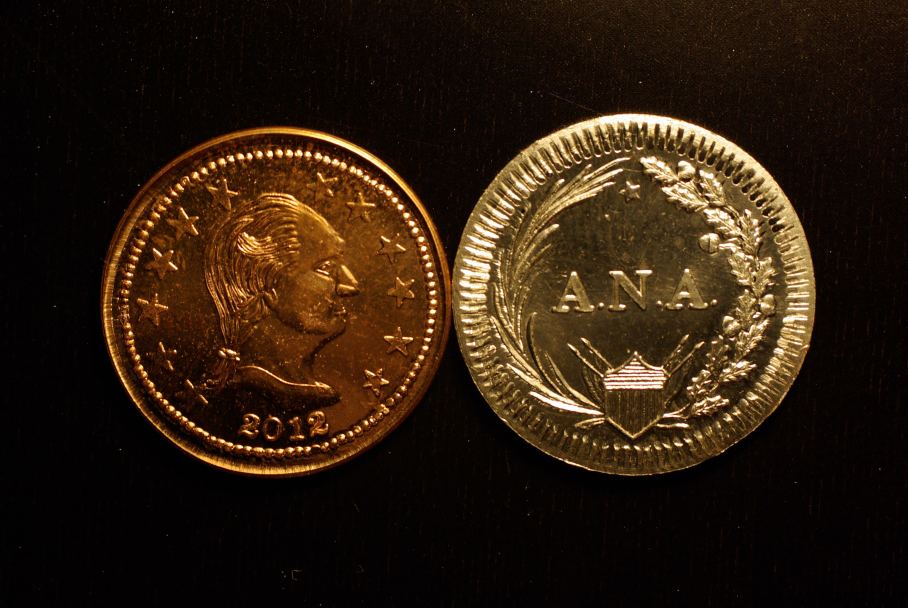
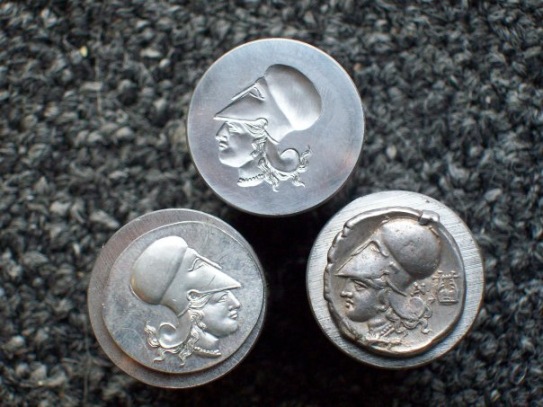
I hope no one takes this personally, but I cringed at some of the responses to this post. Yes, many people still hand cut dies, from hobbyists like myself to the many die cutters who work for various private mints. If you want to make your own dies and strike more than soft metals like pewter and tin, or you want to use them or many years, I would recommend O-1, W-1, or A-2 steel, although cold rolled 1018 works well enough for experimenting. For hand striking, I use 1 inch stock for 3/4 inch coins and 1-1/4 inch stock for 1 inch coins. Hubbing, or hobbing is a bit more complicated than what has been mentioned here and you can't harden bronze by heating and quenching it. Also, the alloy used for ancient bronze dies isn't what you would find at online metals today, ask Ron Landis about that one. I don't use a dremel for engraving, only occasionally for removing a lot of metal. The primary tools are gravers and engraving chisels. Below is a die, a strike form the die and the coin it is based on as well as a Civil War style token I made fort the A.N.A. If you want to make your own dies, I would be glad to offer any help I can, or I can make dies for you. Let me know.
Come to think of it any 'steel' coin would be hardened by previous minting and probably press quite nicely into an annealed bronze surface. Then make the necessary alterations and lap the outer radius. Fasten the rod with the image onto a bushing and set it into a prepared hole in a small anvil and the bottom half of your die set is ready to go.
Excellent dies by the way. I have never worked with bronze besides a few failed attempts at casting using ancient Sicilian AE's which were worn flat. How is bronze hardened ? In the research I attempted on the alloy of early Roman Sesterti one thing was obvious. The alloy of the coins was all over the place with wildly different percentages of lead tin zinc silver and even iron showing up in the analysis. As the coins were wildly different alloys I believe the dies too were probably less than precise in their composition and thus their properties.
From what I've read, the ancient bronze dies were very high tin, on the order of 20% or so which modern metallurgy says isn't necessary, but they did it anyway. Greg Franck-Weiby of Oregon was in the process of making bronze dies of proper alloy to test life expectancy striking denarius sized coins when he passed away a year and a half ago and his partners in this endeavor have not used the dies. Another set may be made but not at this point. As to hardening bronze, I think the two main methods are work hardening and a slooow quench. I have heated bronze to glowing and allowed a room temp cooling and I have water quenched and both ways came up with annealed bronze. I once was cleaning a 4th century bronze and in the process of heating it before waxing, I got it a little too warm, heard a pffft sound, and small silvery balls showed up on the surface. I drove the non alloyed lead out of the coin. Kinda cool.
When I melted the AE's a strange glasslike fibre kept accumulating in the electric crucible. I assumed this to be asbestos (much to the panic and alarm of my companions) I transfered the mixture to a regular crucible and when I applied the torch the alloy commenced to 'fizz'. Exasperated with this effort I just poured it anyway (total failure) and the rest I poured into an open iron mold and made about a 6 inch length of metal which appears normal. I assume being open the fizzing stopped and it became normal again. Could this have been lead boiling off ?
Hmmm, I've never seen asbestos listed as an element found in ancient coins, but I haven't read that much on the subject and I don't know all that much about metallurgy. If you're on Facebook there is a group called inter-kingdom moneyers guild and I think there is a metallurgist in the group who may no more on the subject.
I dont have an artistic bone in my body. I need someone to build me a die. I have some gold but lots of silver and I want to put it in coin form. The die would need to be double sided as I will sell them to the National Guard.
Disclaimer: While a tremendous amount of effort goes into ensuring the accuracy of the information contained in this site, Coin Community assumes no liability for errors. Copyright 2005 - 2026 Coin Community Family- all rights reserved worldwide. Use of any images or content on this website without prior written permission of Coin Community or the original lender is strictly prohibited. Contact Us | Advertise Here | Privacy Policy / Terms of Use










 Posted 05/19/2013 07:07 am