| Author |
 Replies: 13 / Views: 3,263 Replies: 13 / Views: 3,263 |
|
|
New Member
Ireland
12 Posts |
Hi, I'm new to coin collecting and what started off as a pleasant morning identifying some coins I bought has turned into Constantine trying to drive me mad. I've been trawling through whats beginning to seem like thousands of reverse images trying to identify my little follis. What I know (or think that I know) is that its a bronze follis AE3, with the obverse text as 'Constantinvs Max Avg' and the reverse text 'Gloria Exercitvs'. The obverse shows Constantine with a diadem but the distinction between laureate, rosette and plain diadems is causing me no end of trouble. Most of the obverses seem to be rosette but I don't think my one is? The reverse of the two soldiers with two standards seems common on a lot of his coins but I can't determine the mint mark below them to help me identify it. The text looks like a missing later, then 'M,R or K, A or N' and a dot. 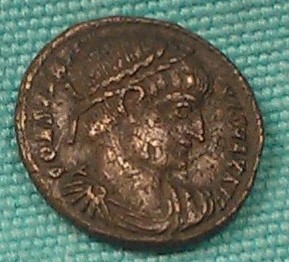 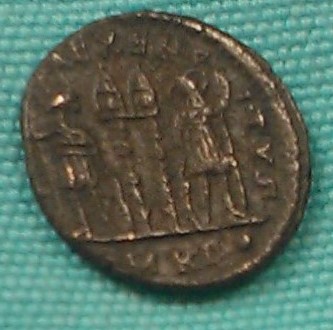 Kinda hoping some one will have a better idea of Constantine's coins and be able to pinpoint the mint mark or help me narrow down my search perimeters? Have been on Wildwinds and a few other coin sites and have looked at just about every image that matches my other text and have still had no joy. Help? Thanks for reading, Jo |
|
|
|
Moderator
 United States
23731 Posts |
I believe the mint mark is SMKB dot, Cyzicus
|
|
New Member
 Ireland
12 Posts |
Thank you,
I see that's for Cyzicus, so searching now focusing on the mintmark and text to narrow down a date for it. Your my hero haha :-)
|
|
Pillar of the Community
United Kingdom
4208 Posts |
|
|
New Member
Ireland
12 Posts |
Thank you Ben for pointing me in the right direction.
Been going through the list and comparing different standards images and I think he's a variation of RIC VII 65.
|
|
Pillar of the Community
United Kingdom
4208 Posts |
Close, but thats no rosette diadem. Heres a rosette diadem:  Heres a pearl diadem:  /010/thumb00323.jpg And heres a laureatte:  Also, when you quote RIC numbers, they usually have a mint city in the name - here you are looking at Cyzicus. Often, there is no valid RIC number, so it should be described instead. See if you can match it with an example - Helvetica is pretty extensive, but I'm not seeing it. Try giving valid details - can you read the mint mark? |
|
Pillar of the Community
United States
5155 Posts |
Ben I can't seem your images.
JO - welcome to the wonderful world of ancient coins. Impressive detective work on your part. (when the coin is in decent condition) 80% of the time you can ID the coin easily based on legend. 90% of the time you can ID the coin with the legends and the reverse devices. The remaining 10% comes from the subtle understanding of the the bust draperies, spaces in the text, a difference in diadem (crown) can make a difference. Any other exception would be either RARE, unpublished,an ancient imitation, or a fake. The fake would have given its self away to you by now.
Nice coin and again welcome.
|
|
Pillar of the Community
United States
5010 Posts |
|
|
Pillar of the Community
United States
567 Posts |
RIC is arranged by volume, then mint (arranged west to east) then chronologically within each mint. Each mint has its own set of numbers. The officinal is sometimes attached to the number if there is more than one for that type.
Constantine is in vol. VII.
I prefer my paper copy of RIC to the websites.
|
|
Pillar of the Community
United States
567 Posts |
|
|
New Member
Ireland
12 Posts |
Thanks for the input everyone. Actually can't wait until I know enough to help someone.
To think I went to bed last night hoping the mystery of my Constantine was solved . Promised my little Licinius coin some attention today and all.
So this morning I've been comparing diadem styles and I think I have a laureate. (Or do I?  ) )
Have my little eyeglass out and the mintmark looks most like SMK and the Greek symbol of a capital pi which doesn't seem to be an option as a mintmark on the lists. So I think its SMK and a delta followed by a dot. Or could still be SMKA dot, but where A is in the four other places on the coin its clearly identifiable but not so with the mintmark.
Was searching by the delta, laureate and two standards but the delta mintmark coins I found have pearl diadems. So have gone back to the 'SMKA dot' with a laureate and found this coin. Who of course hasn't got the end of my mintmark, the dot visible. And the dot isn't mentioned in the description on Helvetica's list but this is the coin image on Wildwinds and as you can see end of mintmark is lost.
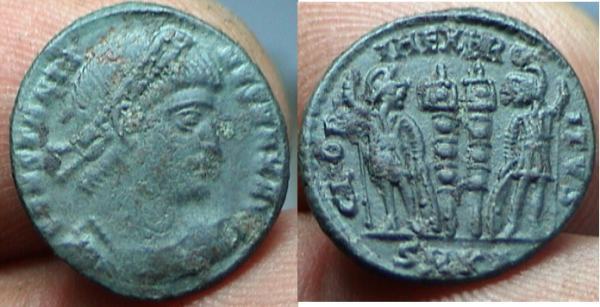
Constantine I. AE3. 330-335 AD. Cyzicus. CONSTANTI-NVS MAX AVG, laureate, draped, cuirassed bust right / GLOR-IA EXERC-ITVS, two soldiers holding spears and shields with two standards between them, dot on banners. Mintmark: SMKA. RIC VII Cyzicus 76.
Now I say this tentatively but possibly I have RIC VII Cyzicus 76, that is if laureate diadem is correct and the dot mark is potentially meant to be on coin. Am I stretching it a bit? 
|
|
Pillar of the Community
United Kingdom
4208 Posts |
Particularly ugly soldier on the right there...
Your ID is 100% correct. Rated RIC R5 (Unique) which means only 1 specimen was found when they looked through the major collections. So its technically R4, Extremely Rare, now.
HOWEVER, I suspect this to be pearl diadem. It ends as a diadem would and has no leaves. But this doesn't make much sense. Where are you getting all these rare/unlisted coins from?!
|
|
New Member
Ireland
12 Posts |
Hey Ben, Bought him before Christmas on aul ebay, described as Constantine follis for €11. My fledging collection is heavy on the late Roman emperors so far. |
|
Pillar of the Community
United Kingdom
4208 Posts |
I recommend buying uncleaned coins - this condition is pretty common in actual ots (unsifted) and much much cheaper. That being said, R5s cost more ad this one has a nicely centered and full obverse.
Plus, uncleaned coins are fun to clean up and you find the odd rarity.
|
| |
Replies: 13 / Views: 3,263 |
|










 Posted 06/01/2013 3:41 pm


