









 Posted 06/10/2007 11:14 am


I'm likin' this one. 
Biokemist, that's a tremendous strike for a '21. It's rare to see the hair detail, cotton bolls, and lower wreath leaves as strong as they are on your coin. Yes, I know, the leaves towards 7:00-8:00 are weak, but there's still a lot more there than is commonly found on 1921's. Remember, these were struck by the gazillions, the dies lived a very hard life indeed, and striking pressures were somewhat reduced with that in mind.
The spots should not detract from the given grade. They're fairly common with 1921's. The luster looks outstanding; I suspect this is a very early strike from the dies. PL designation, of course, is tough from the photo, so I leave that for you to decide.
The marks near OF are another characteristic; I've seen them more often to show greater luster than lesser. I wonder if that's a function of die preparation, or maybe a slightly higher area on the master hub, because 1921-D's show the same thing.
Your lighting is iffy for grading; the marks I see on the cheek might be overstated. I'll call it MS63, but 64 isn't unlikely.
Can you check a couple things for me? First, I see a lot of specks on the lower reverse, under the wreath and around DOLL. 1921-P's have rusted-die artifacts; can you get that area under a loupe to see if the specks might be raised, indicating a rusted die?
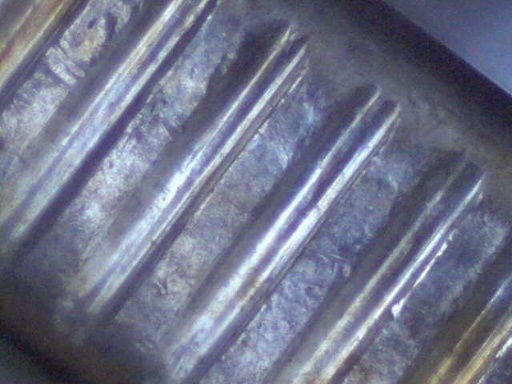
Second, have a look at the reeding. There is an Infrequently Reeded type with fewer reeds than normal. Here's a set of comparison pics:
Normal reeding:
Infrequent Reeding:
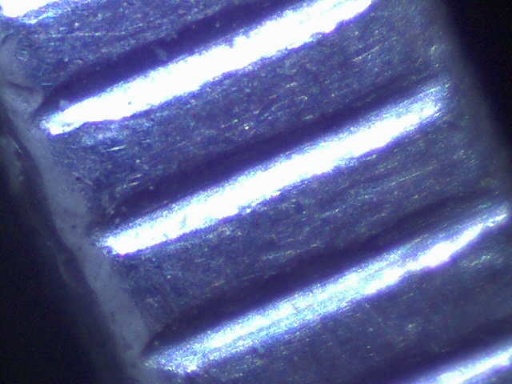
Note that the "lands" of the Infrequent Reeding type are noticeably wider than the "troughs."
Biokemist, that's a tremendous strike for a '21. It's rare to see the hair detail, cotton bolls, and lower wreath leaves as strong as they are on your coin. Yes, I know, the leaves towards 7:00-8:00 are weak, but there's still a lot more there than is commonly found on 1921's. Remember, these were struck by the gazillions, the dies lived a very hard life indeed, and striking pressures were somewhat reduced with that in mind.
The spots should not detract from the given grade. They're fairly common with 1921's. The luster looks outstanding; I suspect this is a very early strike from the dies. PL designation, of course, is tough from the photo, so I leave that for you to decide.
The marks near OF are another characteristic; I've seen them more often to show greater luster than lesser. I wonder if that's a function of die preparation, or maybe a slightly higher area on the master hub, because 1921-D's show the same thing.
Your lighting is iffy for grading; the marks I see on the cheek might be overstated. I'll call it MS63, but 64 isn't unlikely.
Can you check a couple things for me? First, I see a lot of specks on the lower reverse, under the wreath and around DOLL. 1921-P's have rusted-die artifacts; can you get that area under a loupe to see if the specks might be raised, indicating a rusted die?
Second, have a look at the reeding. There is an Infrequently Reeded type with fewer reeds than normal. Here's a set of comparison pics:
Normal reeding:
Infrequent Reeding:
Note that the "lands" of the Infrequent Reeding type are noticeably wider than the "troughs."


 Thanks for your help SuperDave, I knew you could assist on this one.


