| Author |
 Replies: 12 / Views: 7,376 Replies: 12 / Views: 7,376 |
|
|
Pillar of the Community
United States
943 Posts |
Will a green spot on a 90% silver coin inside a PCGS/NGC slab continue to get worse?
What if anything can be done?
|
|
|
|
Pillar of the Community
United States
1699 Posts |
It would depend on what kind of spot it is and how the coin is being stored. Some spots will continue to grow while others will not.
|
|
Pillar of the Community
 United States
943 Posts |
I actually have several modern commemorative dollars with 69 PCGS/NGC grades that have small green spots.
I'm assuming since it is green it's some type of corrosion.
I also assume it wasn't visible when the coin received a 69 grade. I'm not sure how much magnification the graders use.
I'm not the original owner of the slab but the coins are currently in a climate controlled environment.
|
|
Moderator
 United States
23522 Posts |
On silver, green is very likely PVC, which is an active chemical reaction that will in all cases destroy the coin if not eradicated through the use of acetone. Verdigris is another possibility, something which doesn't work as quickly but just as inexorably.
There is no good news for you here.
|
|
Pillar of the Community
United States
943 Posts |
@SsuperDdave:
I would lean more toward it being Verdigris since they are modern commemorative dollars. So is it best to break the coin out of the holder and dip it in something like eZest? I've done that before with silver coins and it removes the green but leaves a dark spot. Is there a better way?
Would they still grade 69 with a Verdigris Spot or has that developed after it was graded in the slab? How might that happen after the fact?
|
|
Pillar of the Community
Canada
2805 Posts |
Sell it quick for the plastic and get a raw one.
|
|
Bedrock of the Community
13014 Posts |
Quote:
Would they still grade 69 with a Verdigris Spot or has that developed after it was graded in the slab? How might that happen after the fact? The slab wont prevent anything already on the coin from continuing to react with it. Kind of the same way milk spots can develop after slabbing. For 69s youre best bet is probably to sell them and get new ones. Youll probably lose a few bucks on each but that difference wont be as great as the cost of regrading them if thats what your intentions were. |
|
Bedrock of the Community
United States
20038 Posts |
Post some pictures. What is the coin, grade and value?
|
|
Pillar of the Community
2087 Posts |
IN this case wouldn't the TPG concerned buy the coin back?......they should have picked up the problem ( or its precursor) at grading |
|
Pillar of the Community
United States
943 Posts |
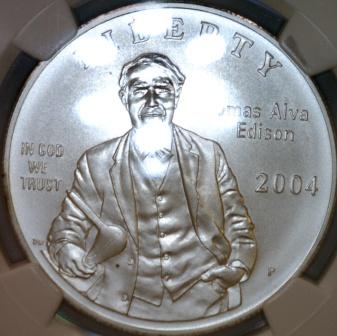 Here's a photo. My microscope has lights I can't turn off. The green spot is below the light bulb in Edison's hand. The coin is graded MS69 by NGC. Edited by RPT
09/25/2013 1:08 pm
|
|
Bedrock of the Community
United States
20038 Posts |
I can't tell much, can you get a close-up of the spot? It looks like plain old verdigris. Make sure you store it inside a ziplock with desiccant and it should be fine. The most common mistake people make with slabs is thinking they are fully protected and safe....not true. Slabs need to cared for just as a raw coin in a 2x2.
Lincoln Cent Lover!VERDI-CARE™ INVENTOR https://verdi.care/
|
|
Pillar of the Community
United Kingdom
4208 Posts |
I would be inclined to sell it now and buy a non afflicted one. People will buy the slab for the 69 rating and then you can buy a new one which is trouble free.
ooooor, perhaps put the whole thing into acetone. I wonder if that would work.
|
|
Pillar of the Community
United States
1432 Posts |
Quote:
perhaps put the whole thing into acetone ~ I wonder if that would work If you were to put acetone on plastic, it is possible that it would eat through the plastic material. This mainly depends on the type of plastic you put it on, since some are stronger than others. It's best that acetone not be put in plastic containers due to the risk that it will break down the container and leak. Acetone is a naturally occurring organic compound that is created in the human body during metabolic processes where fat is broken down into energy. It is also manufactured and used as a solvent, commonly used in pain thinners, epoxy remover, and nail polish removers. Due to its corrosive nature, you should not put acetone on plastic or other substances that may be sensitive to its effects. There are certain situations in which putting acetone on plastic or in plastic containers will do no harm. Certain grades of plastic, like polypropylene, are designed to withstand corrosive substances, so using acetone with these will not cause any reaction. You can find which plastics may be safe by checking the bottom of any plastic item or container for a symbol and the number five. This symbol is usually the circular arrows used on recycling containers and recyclable products. (borrowed the above from http://www.wisegeek.org/what-will-h...-plastic.htm) |
| |
Replies: 12 / Views: 7,376 |
|










 Posted 09/24/2013 12:54 pm


