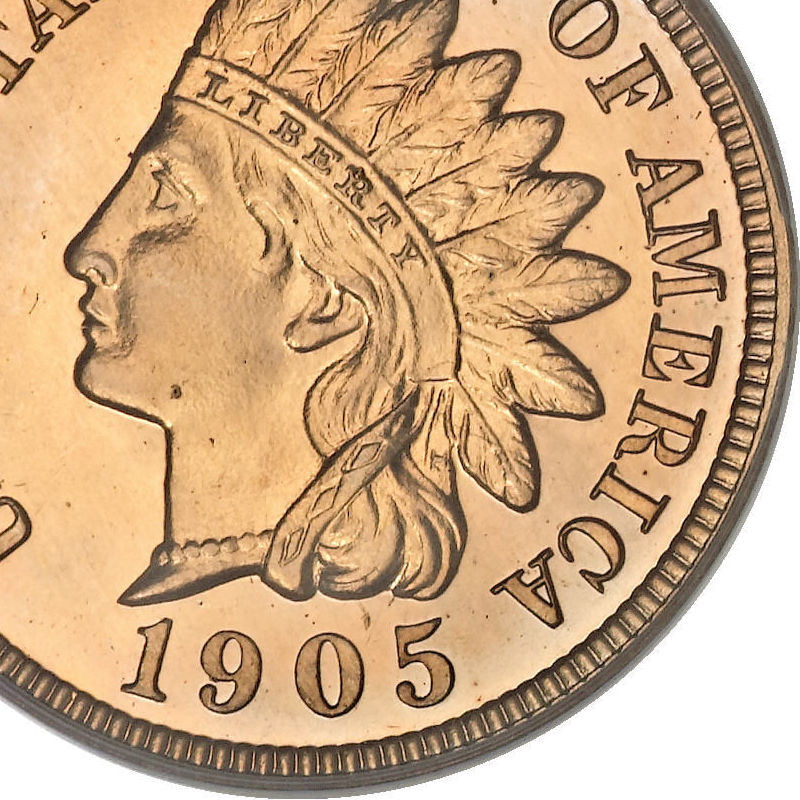
There are additional characteristics that you will also need to familiarize yourself with if you are collecting proof
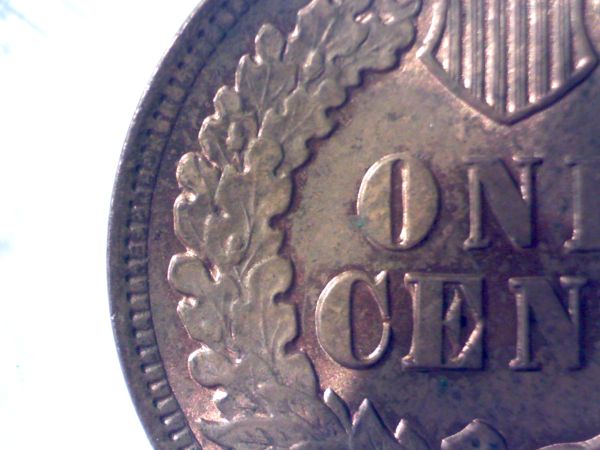
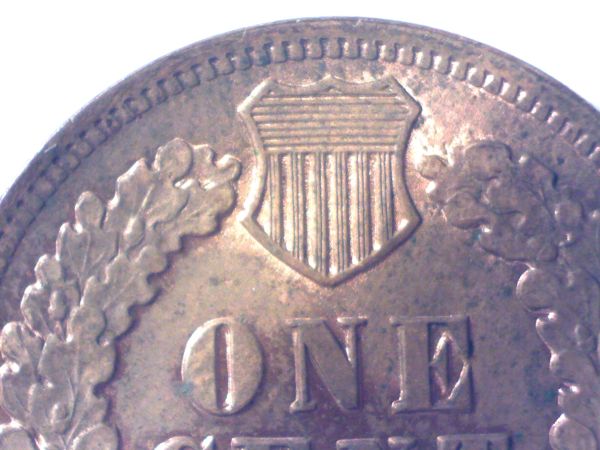
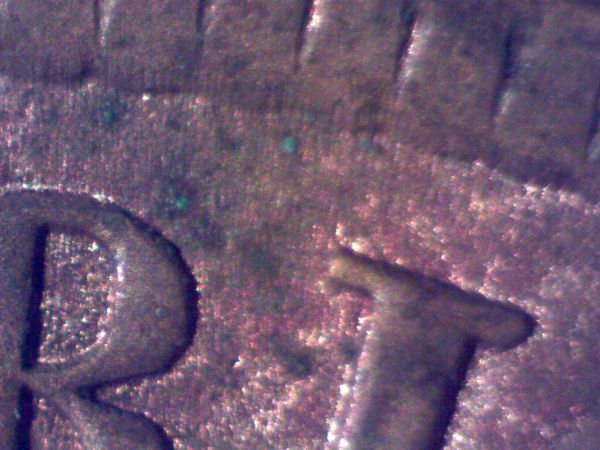
Indian Head cents. Because of the highly mirrored surfaces, proof coins tend to accentuate any handling marks that have gotten onto the coins after they left the mint. Many proofs will exhibit hairlines from being "wiped" to remove dust or fingerprints from the coin. Spots, from flecks of dirt or fine droplets of water can form on the coins, and seriously impair the look (and value) of these coins. These defects are more manifest on proof coins than their regular issue counterparts. Finally, there are certain characteristics that exist only on proofs and not on regular issue coins. Often you will seewhat are known as "lint marks" on proof coins. When proof coins are made, the dies were cleaned before the striking process. A mint is a manufacturing facility - large production presses are utilized in the coinage process - they require grease and oil to function properly - they are dirty places. Sofor the proof production, the dies would be cleaned before the coins were struck - a cotton cloth would be used to wipeany residual dirt, oil or grease from the face of the dies - but small cotton fibers would often adhere to the face of the diesand then, when the first coins were struck after the dies had been wiped, the outline of the cotton fiber would be impressed right into the surface of the coin - a "lint mark". These minuscule cotton fibers would only last for one or two blows, and would disappear from subsequent striking - until the die face was again wiped and then they would again appear on random places on the surface of the struck coin. Lint marks are not generally considered defects on proof coins, but they can affect the grade and value of the coin if they are so obvious or in a location where they affect the"eye appeal" of the coin.
A second characteristic that can be seen on early 20th century proof
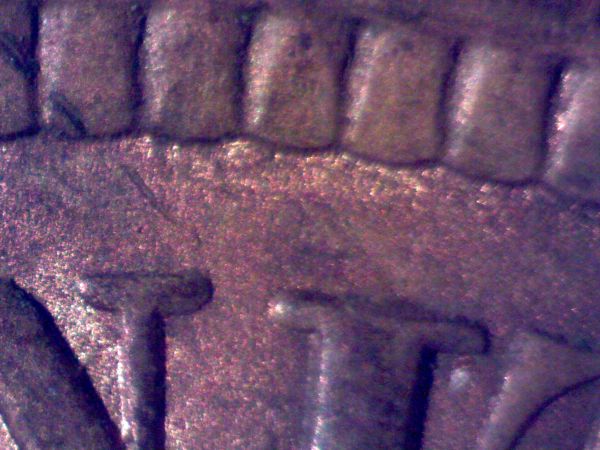
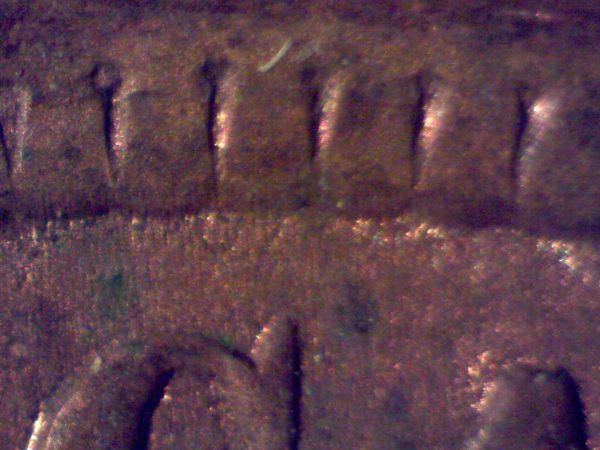
Indian Head cents is what is known as "die striations" or "die lines". At first glance, some proof
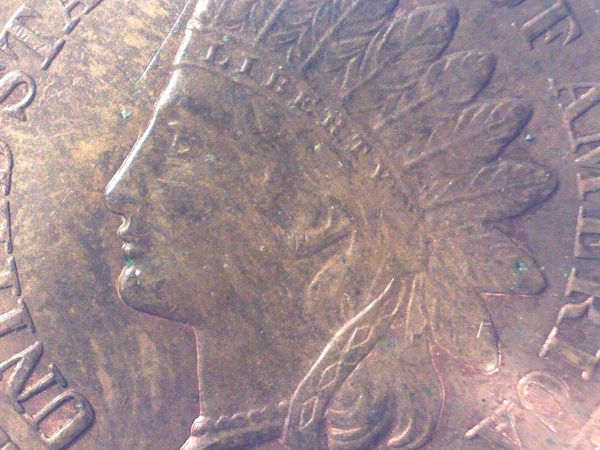
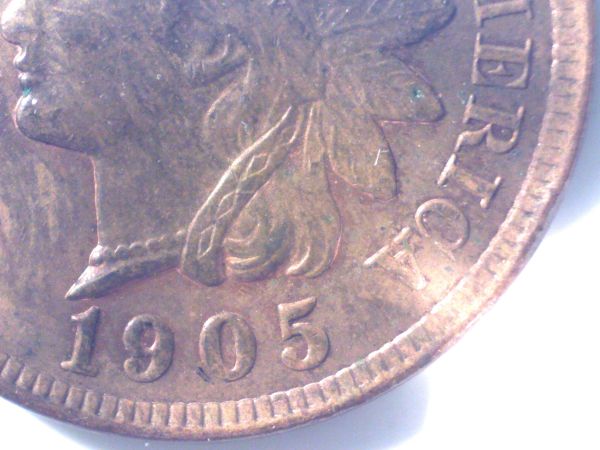
Indian Head cents made between 1903 and 1909 appear to have fine hairlines on either the obverse or reverse of the coin, and sometimes on both sides. Careful examination will reveal that these lines are fine parallel lines on the entire surface of the field and seem to actually run "under" the devices and lettering. In contrast, hairlines that occur after production of the coins are "broken up" by the lettering and devices - that is the hairlines can't usually run right to the very edge of the devices and lettering and then pick up again exactly at the opposite edge because the devices themselves create a "bridge" effect so that the "wipe effect" stops a little in front of the edge and then picks up a little further past the opposite edge as it continues across the coin. Although "die striations" or "die lines" have a similar appearance to hairlines, they should not affect the grade or value of the coin - but because of the similar look, coins with "die striations" or "die lines" are oftentimes mistakenly given a lower grade by the grading services because they are mistaken for hairlines. Two dates that often show these "die striations" or "die lines" are 1905 and 1907. When looking at these dates remember to account for this mint made characteristic. Once you've seen it, and contrasted it with post production hairlines, you will be on your way to acquiring a level of expertise needed to accurately grade proof
Indian Head cents.
In order to collect proof
Indian Head cents, there are three essential ingredients, without which you will not be able to complete a nice set of these beautiful coins: Knowledge, Grading and Value - with the last element being the easiest of the three if you have mastered the first of the two requirements.







 Posted 09/27/2013 02:19 am