| Author |
 Replies: 15 / Views: 2,724 Replies: 15 / Views: 2,724 |
|
|
Pillar of the Community
Egypt
3470 Posts |
Pardon my ignorance, what does "Decimal & Pre-Decimal" Coins means.
I know these might be a well known terms but I wonder if anybody could explain it to me.
Thanks
|
|
|
|
Rest in Peace
Australia
661 Posts |
Hi,
Prior to 1966 Australia used the English system of Pounds, Shillings and Pence. Sometimes referred to as the Imperial system.
From 1966 we have used a new currncy based on the decimal system.
Too easy.
regards,
|
|
Pillar of the Community
 Egypt
3470 Posts |
Thanks for the info muckeye
|
|
Pillar of the Community
Australia
1262 Posts |
....and the english system was based on 12 pennies to the shilling and 20 shillings to the pound. The decimal system is 100 cents to the dollar.
|
|
Pillar of the Community
United Kingdom
2217 Posts |
(bm - there were originally 12 pennies or pence to the shilling but just prior to decimilisation there were only five in one 'bob')
For eg-
Re. the decimalisation of British coinage - occurred 1971 onwards but they were already making 10p and 5p from 1968 with the words "new pence" on the reverse (denomination side)
We used to have; farthing (1/4 pence), the half-penny, penny, two-pence (pence is plural of penny), threepence, shilling (5 pence [spot the error! -I'm supposed to be talking about predecimal coins here]), sixpence, and florin (10 pence or two shillings), crowns (five shillings or twenty-five pence [again! see I didn't know what I was talking about!]), halfcrowns (12.5 pence!) and decimal(circulation) pounds weren't invented until 1982
So you can see why we decided to scrap the decimal system!!!?
Going a little further...perhaps too far, sorry if I bore you...initially, there was a decimal half-penny, but it was decided this was too small a unit of currency and so we scrapped those in the late 1980's.
The 5 pence, 10 pence and 50 pence were made slightly smaller since around 1992 and the 2 pence and 1 pence used to be made of copper originally but we replaced them with a copper-coated stainless steel coin around the same time as the down-sized 5, 10 and 50 pence pieces. These copper pennies and 2 pence pieces are still in circulation amongst the newer, more base metal steel-core versions.
The 20 pence coins were initially produced at the same time as the £1 coins were in 1982 and these two coins are the only decimal coins left entirely unchanged which are still made today for circulation.
Finally, the £2 coin was began about 1997 and is the newest denomination - these are bimetallic and very attractive coins which are also produced in commemoratives for circulation with lower mintages....
I've sent you a PM though I don't know if you'd still be interested now that I've bored you.. :>/
** made an error above and I've explained it below
Edited by NumisMattyUk
07/15/2007 07:53 am
|
|
Rest in Peace
Australia
661 Posts |
That was interesting, I've not read anything on the introduction of your decimals before.
Thanks.
regards,
|
|
Pillar of the Community
Australia
1360 Posts |
|
|
Pillar of the Community
United Kingdom
2217 Posts |
Not too complicated was it? :P
|
|
Pillar of the Community
United Kingdom
2217 Posts |
I think I have to apologise there slightly, I have erred.
We use the term 'bob' to refer to a 5 pence piece nowadays and this was always used to refer to a shilling. the problem is, a shilling was always 12 pence, or 1/20th of a pound (yes, 240 pence per pound!) - nowadays of course we have 'decimal pounds' which have 100 pence. The shilling was replaced by the 5 pence piece, also 1/20th of a pound but of a different number of pennies! and was of identical size and weight to the previous 'bob', which was the shilling...
Because we still use the term 'bob' for a unit of 1/20th of a pound, I confused this with the old shilling which was always 12pence! A five pence coin did not exist just before decimilisation...
|
|
Pillar of the Community
Canada
1106 Posts |
|
|
Pillar of the Community
United States
819 Posts |
Quid, I believe, is the slang-term for a pound.
Though, where are the groats and half-groats on the list?
|
|
Moderator
 Australia
16982 Posts |
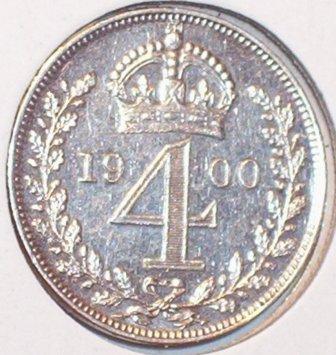
The groat, or fourpence, and it's half, the twopence (or tuppence), were both replaced by the threepence and disappeared from general circulation in Britain in the 1600's, except for a brief revival during the early 1800's. Very few, if any, of either of these denominations ever made it to Australia. The copper "cartwheel" tuppence was never called a halfgroat, the name tending to be used only for silver coins. Fourpence coins of the 1800's were also nicknamed "joeys" after Joseph Hume, the British politician who lobbied for their reintroduction. Britain continues to issue these denominations in the Maundy Money sets. Don't say "infinitely" when you mean "very"; otherwise, you'll have no word left when you want to talk about something really infinite. - C. S. Lewis
|
|
Pillar of the Community
Egypt
3470 Posts |
|
|
Pillar of the Community
Australia
9774 Posts |
|
|
Pillar of the Community
United States
819 Posts |
Ooooh, shiney. That's the Maundy money format, isn't it?
|
|
Pillar of the Community
Australia
2830 Posts |
G'day, ElleKitty is correct.
The maundu coins have very simple reverses, with the figures 1, 2, 3, or 4.
The circulating groat of the Victorian era had a seated Britannia: quite a pretty coin.
Part of the fascination with maundy coins is the theory that, however briefly, they were in the fingers of the relevant Queen or King. That's not true every year, but a little newspaper research ought to clarify the point, year by year.
Peter in Oz
|
| |
Replies: 15 / Views: 2,724 |
|







 Posted 06/13/2007 7:10 pm