Happy Columbus Day! In recognition of the day, I thought I'd share a few thoughts concerning the first US commemorative coin...
It is widely accepted that no verified actual portrait of Christopher Columbus was available in 1892 for use as the model for the new World's Columbian Exposition's "souvenir coin." Many paintings of Columbus existed at the time, however, as he was certainly a popular figure from history.
The US was not the only country staging a "Columbian Exposition" in 1892 and 1893. Spain was host to the Columbian Historical Exposition which was held in Madrid, Spain from October 31, 1892 through January 31, 1893. The Madrid Columbian Exposition was far more academic in nature vs. the Chicago Exposition; there were no games, rides, shows, etc. in Madrid. The Exposition was held in the buildings that would become Spain's National Library and Museum.
The United States was a primary exhibitor at the Madrid Exposition. Included among its exhibits was a gallery of 77 portraits of Columbus; originals and copies were displayed. Per the official Report of the event, the portraits were presented not as "works of art" but "solely for their historical interest, and to furnish a complete exhibit of the varied conceptions which artists in all countries, for four hundred years, have had of the appearance of the genius who discovered America."
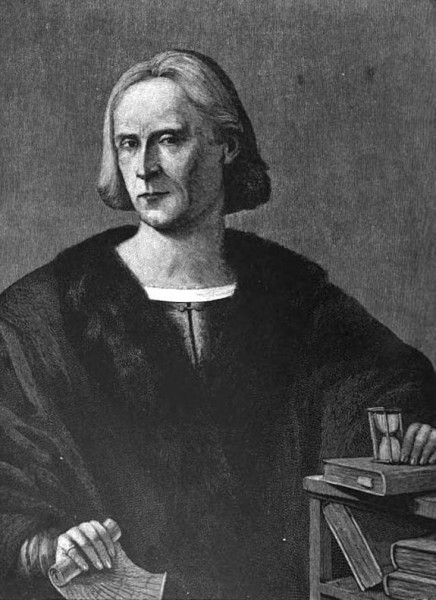
In describing the various portraits that were included, the Report calls out one in particular as the model for the portrait of Columbus on the souvenir half-dollar; it was the portrait by Lorenzo Lotto. Of the Lotto painting, the Report states "This portrait was selected as the model for the face of Columbus upon the World's Columbian Exposition souvenir coin, and was awarded a silver medal at the Columbian Historical Exposition in Madrid as being the most authentic likeness of the discover."
Following is a copy of the black-and-white image of Lotto's work that was included in the Report. One can easily imagine it serving as the reference for Barber while he worked on the coin's obverse model.
It is possible (even likely), however, that Lotto's portrait was just one of the Columbus references Barber used. Some have suggested that a contemporary commemorative medal designed by I. C. Lauer (of Nürenberg, Germany) was a likely source for Barber. I show a reverse image of the medal's obverse below. Once again, I think it is fairly easy to imagine how the portrait of Columbus on the medal could have "inspired" Barber's design.

Regardless of the specific source(s) used,
Charles Barber created a Columbus portrait that is now embedded in the "mind's eye" of every coin collector who has ever seen it!
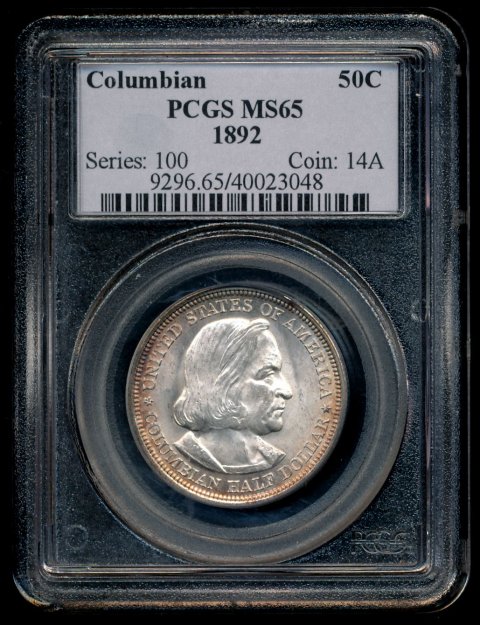
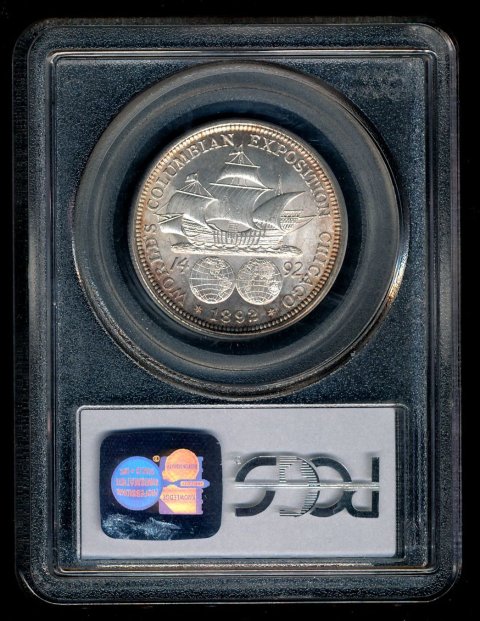
Here's my example of the 1892 Columbian half-dollar for reference.







 Posted 10/15/2013 11:36 am





