| Author |
 Replies: 13 / Views: 1,536 Replies: 13 / Views: 1,536 |
|
|
Pillar of the Community
1121 Posts |
|
|
|
|
Bedrock of the Community
United Kingdom
18783 Posts |
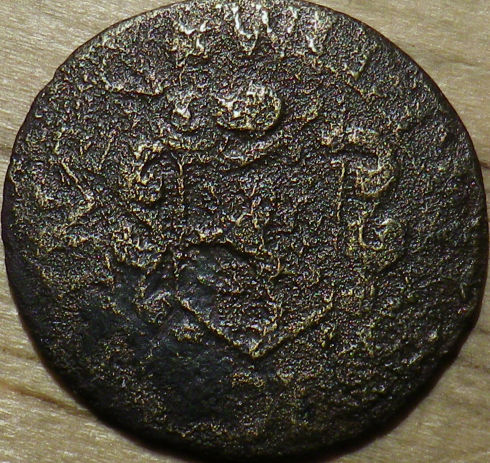
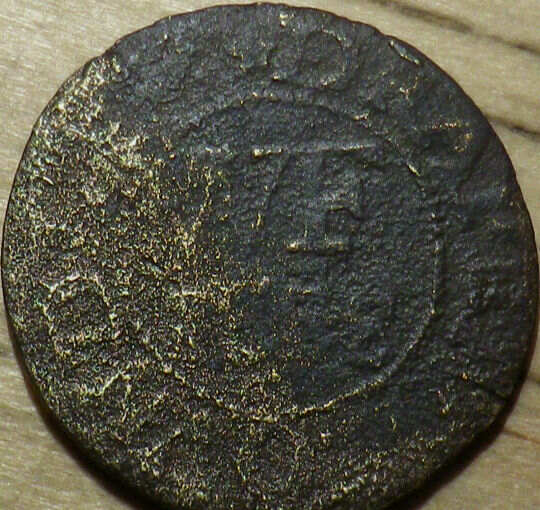
The first one looks like a British 17th-century token to me.
|
|
Pillar of the Community
United States
645 Posts |
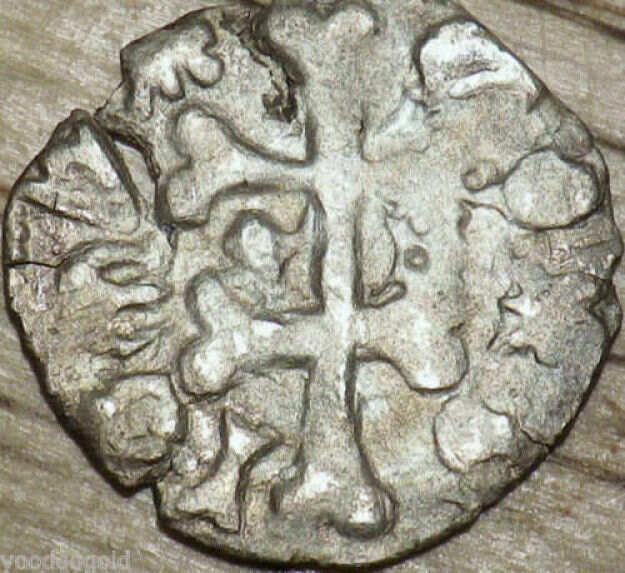
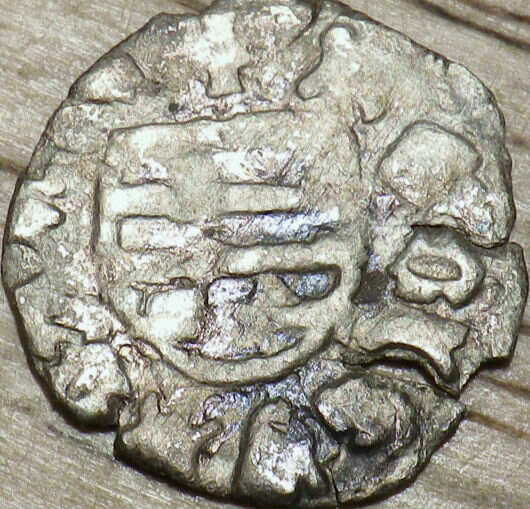
2nd is a Hungarian Denar. Possibly Sigismund(1386-1437)?
|
|
Pillar of the Community
United States
3253 Posts |
Just some thoughts on the first coin, which haven't led me anywhere yet:
There are lots of coats of arms with a lion rampant, but the look of this coin (jeton?) makes me think it's the arms of Holland. Though on the official coinage at least, the shield is crowned, while this has a helm, with mantling down either side. If the coin is Dutch, then, the WF (if it doesn't just refer to the maker) might stand for Willem Frederik, Prince of Nassau-Dietz from 1654-1664. Or perhaps they are the initials of the Dutch province of West Friesland, which was governed by Holland in the 17th century, though their official coinage seems to have borne the West Friesland arms (two lions passant).
Would be neat to see some Friesian coinage on the forum. In Germany, the Friesians are the butt of jokes, much like Polish jokes in America. One joke from the 1980s:
During a football match between Friesia and Bavaria, the 5:00 whistle at the town factory blew. The Friesian players all thought that it was the end of the game and went home.
Half an hour later, the Bavarians scored their first goal.
Ba-dum-BUM!
|
|
Pillar of the Community
 1121 Posts |
Hi, Philadelphian. I like it.
Have your thoughts led you anywhere yet?
There could be a 'cross' or a 'star' under the rampant lion's chest. Also, under the letters 'WF' there could be the date '1338'.
I don't know if this ties in with any of your thoughts?
Regards, Topcat7
|
|
Pillar of the Community
United Kingdom
739 Posts |
Quote:
The first one looks like a British 17th-century token to me. I think I agree with NumisRob. Richard Williams and Will Franklin used to make tokens in the 17th Century and marked them WF. What size is it please ? |
|
Moderator
 Australia
16994 Posts |
Quote:
...there could be the date '1338'. It can't be "1338" because "Western" numerals were only just starting to become popular then, and certainly hadn't appeared on coins or medals. If it is, as it appears to be, an English token from the 1600s, then the date is likely to read "1668" or perhaps "1658". As for what it says, I can clearly read the English word "DRAPER" in the bottom pic, and a word (or part thereof) that reads "OVNDL". On the other side, the inscription seems to start with "WIL or perhaps "WILT". Using that information, a bit of Googling turned up this website which lists a token that is a very close match for yours: scroll down to the one listed as "W95". It is from the town of Oundle, Northamptonshire. There's no picture but it is described as: Quote:
Obverse: Arms - a lion rampant; WILL FILBRIGG LINEN
Reverse: W F 1658; DRAPER OF OVNDLE Sounds like a good match to me. Unfortunately, W95 is one of the varieties omitted from the "Token Book" by Galata Press - for towns with a large number of token issuers they only list the more distinctive or interesting types and Oundle had 16 token issuers in the 1600s - so I can't give you a market value for the specific type. Don't say "infinitely" when you mean "very"; otherwise, you'll have no word left when you want to talk about something really infinite. - C. S. Lewis
|
|
Pillar of the Community
United States
3253 Posts |
Told you my thoughts weren't leading me anywhere.
Schooled again by Sap!
|
|
Pillar of the Community
United Kingdom
739 Posts |
Well done Sap now you have stated the letters I can see them but why a rampant lion for a cloth seller ?
|
|
Pillar of the Community
United States
3253 Posts |
The arms of Felbrigg (of Norfolk) were a red lion rampant on a gold field. Perhaps this draper was descended of that armigerous family, or imagined himself to be.
Edited by philadelphian
10/17/2013 12:57 pm
|
|
Pillar of the Community
United Kingdom
739 Posts |
|
|
Pillar of the Community
United States
3253 Posts |
That looks like our man, rooneydog! The arms are probably the addition of modern family members doing their genealogical research, though. From Northamptonshire Notes and Queries Vol. 2, 1888: Quote:
73. O. WILL . FILBRIGG . LINEN = Arms: A lion rampant. id." R. DRAPER . or . OVNDLE :: w . r. 1658. The arms on this token are the same as those borne by the family of that name seated at Felbrigg, co. Norfolk. Had the Garter King at Arms seen this token the issuer would probably have been " disclaymed." For those Yanks who may not know, the Garter King at Arms was, and still is, the kingdom's arbiter of who has the right to claim a given set of heraldic arms for display. Edited by philadelphian
10/17/2013 4:36 pm
|
|
Pillar of the Community
United Kingdom
739 Posts |
Edited by rooneydog
10/17/2013 4:58 pm
|
|
Pillar of the Community
1121 Posts |
Firstly, to answer 'Rooneydog', the coin is 15 mm in diameter.
Secondly, I am 'blown away' by the information that you (collectively) have given me about a coin (token) that I was getting no-where with.
[I feel as I did when I was 16 years old (50 years ago) and I had moved out of home, and after a couple of weeks I rang my Dad and asked him "How do you boil an egg?"]
I am learning that all that is round, metal, has pictures and letters on it may NOT be a coin. This would be the third 'token' that I have 'accumulated' in my travels.
No-one told me that collecting coins (and banknotes) could be so addictive. Perhaps I should have been warned.
I think that it is great that the more knowledgeable among us assist, those of us who are knowledge 'challenged', so readily.
Again, my thanks to all; I don't think that you have had the last 'query' from me.
Cheers,
Topcat7
|
| |
Replies: 13 / Views: 1,536 |
|









 Posted 10/15/2013 8:00 pm





