Coin Community Family of Web Sites Join Thousands of Coin, Bullion, & Money Collectors
300,000 items to help build your collection! Coin, Banknote and Medal Collectors's Online Mall Join Thousands of Coin, Bullion, & Money Collectors Royal Canadian Mint products, Canadian, Polish, American, and world coins and banknotes. Specializing in Modern Numismatics Vancouvers #1 Coin and Paper Money Dealer Shop for APMEX Bullion on eBay!


Username:
Password:
Save Password
Forgot your Password?


This page may contain links that result in small commissions to keep this free site up and running.

Welcome Guest! Registering and/or logging in will remove the anchor (bottom) ads. It's Free!

8 Unknown Coins From Dorpat, Livonia, Sweden, Etc

To participate in the forum you must log in or register.
Author Previous TopicReplies: 4 / Views: 2,523Next Topic  
Valued Member

United States
143 Posts
 Posted 10/20/2013  9:21 pm Show Profile   Bookmark this topic Add Stan to your friends list Get a Link to this Message Number of Subscribers
Hey guys,

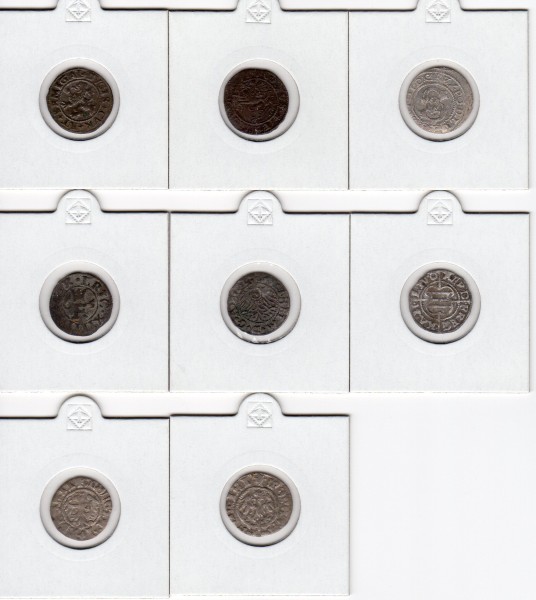
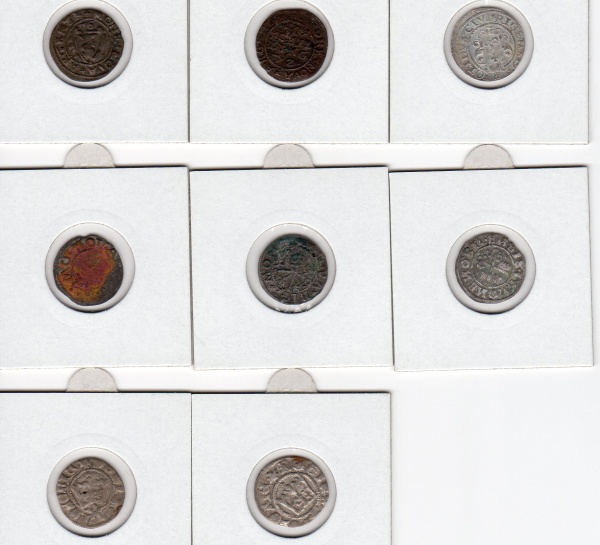
Got 8 coins here that I'm having a hard time identifying. I was told they're from a few different places: Livonia, Dorpat, Sweden, but I'm trying to catalog them and having trouble with identification. I can't even the dates for some of these. All info will be greatly appreciated.

Let's number them as 1-8 from top left going right and down.


8-Unknown-Coins-From-Dorpat,-Livonia,-Sweden,-Etc


8-Unknown-Coins-From-Dorpat,-Livonia,-Sweden,-Etc
Pillar of the Community
Russian Federation
5172 Posts
 Posted 10/21/2013  03:05 am  Show Profile   Bookmark this reply Add january1may to your friends list Get a Link to this Reply
These photos are pretty darn tiny. I doubt anyone who isn't an expert could say much from these - certainly not the date!
#3 (top right) is the only type I could even identify (Free City of Riga under Sigismund III; Numista says the date is 16XY, where X and Y are left and right of the huge letter S respectively).
Valued Member
United States
329 Posts
 Posted 11/03/2013  08:01 am  Show Profile   Bookmark this reply Add wjl to your friends list Get a Link to this Reply
need better pics but #2 appears to be schilling minted by Livonian Order, Jan Hadkevich, 1572. #6 is a Reval schilling of the Livonian Order Wolter v. Plettenberg (ca. 1532) I see a Riga schilling. The last two appear to be 1/2 groschens of Casamir IV Jagiello (Polish). Dorpat was a bishopric in Estonia that served as a mint for the Livonian knights.
Edited by wjl
11/03/2013 08:06 am
New Member
Estonia
4 Posts
 Posted 01/01/2014  04:57 am  Show Profile   Bookmark this reply Add vanakala to your friends list Get a Link to this Reply
Nr 1- Duchy of Courland, schilling (15)76
Nr 2-Dahlen/Dole schilling (15)72, you can also call it Hadkiewitz if you wish
Nr 3 Riga under Poland, schilling (solidus), Sigismund III. around 1600, date not clearly visible, (15)95?
Nr 4-Reval under Sweden, Erik 14, schilling (15)65
Nr 5-Riga schilling (15)63, Archbishop Brandenburg
Nr 6-Riga schilling, von Brüggenei, master of the Livonian Order, ca 1535 do not clearly see the date, but it is there
Nr 7-8 1/2 groschen, Poland

None of them is particularly valuable today.

As I often see some misconceptions about the history of these countries, here are some comments:
The Free City of Riga had nothing to do with Sigismund III, it was the period before the Polish rule that only started in 1581 in Riga, although the surrounding territory was controlled or dominated by Poland already from 1561-63.
It is true that Dorpat was a bishopric once, but it was an independent medieval country, and was neither ruled by Livonian knights who had their own state, nor used as a mint for them. They issued their own bishopric coinage (none of them are in the pictures) and the Livonian knights had their own separate coins.
It is true, however that both of them belonged to the Livonian Confederation along with some other feudal states and this confederation was dominated by Livonian knights, but that's how far it goes. It was never a single country. The Livonian knights did not have much direct power over the other states, altough as the strongest member in the confederation, they undoubtely had their influence and say, but it was never as automatic as would be expected from a ruler. All coins issued by the member states could circulate freely in the whole Confederation, similarly as is the situation with euro coins today, but this also does not make the EU a single coutry. The Confederation ended in 1561, however, and its territory was divided among neighbouring Poland, Sweden, Denmark, and temporarily also Russia and all of them issued their own separate coinage, some of which can also be seen on the pictures.
If you have deeper interest in them, I can recommend some special catalogues, as some of them are not covered by Krause, which I would not recommend anyway for these coins, because of several errors.

Valued Member
United States
143 Posts
 Posted 01/12/2014  7:46 pm  Show Profile   Bookmark this reply Add Stan to your friends list Get a Link to this Reply
Thank you very much for the info vanakala!
  Previous TopicReplies: 4 / Views: 2,523Next Topic  

To participate in the forum you must log in or register.


Disclaimer: While a tremendous amount of effort goes into ensuring the accuracy of the information contained in this site, Coin Community assumes no liability for errors. Copyright 2005 - 2026 Coin Community Family- all rights reserved worldwide. Use of any images or content on this website without prior written permission of Coin Community or the original lender is strictly prohibited.
Contact Us  |  Advertise Here  |  Privacy Policy / Terms of Use

Coin Community Forum © 2005 - 2026 Coin Community Forums
It took 0.2 seconds to rattle this change. Forums