| Author |
 Replies: 11 / Views: 1,547 Replies: 11 / Views: 1,547 |
|
|
Pillar of the Community
 United States
4616 Posts |
Call me Mr. B. Fuddled... 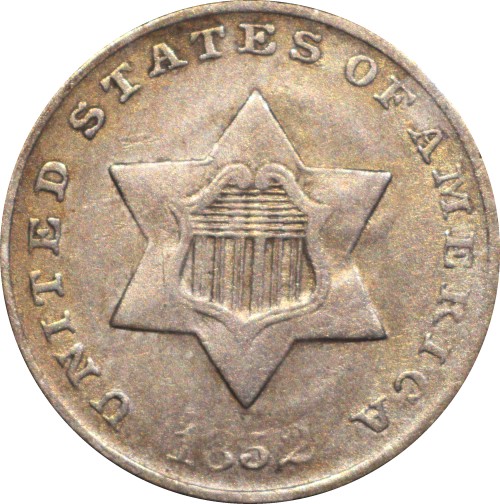 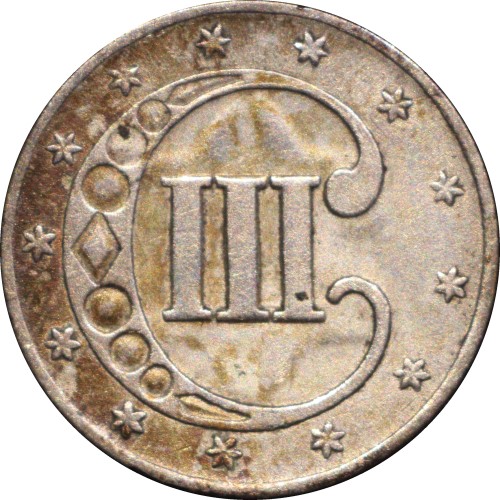 You can see the outline of the C on the obverse and the outline of the star on the reverse. Yes, the planchets on the 3cs are thin, but this is of light but normal weight (0.680+-0.002g vs standard of 0.700 IIRC). -----Burton 50+ year / Life / Emeritus ANA member (joined 12/1/1973) Life member: Numismatics International, CONECA Member: TNA, FtWCC, NETCC, EveryCountry (online) coin club Owned by three cats and a wife of 40+ years (joined 1983) Author: 3rd Edition of the Sample Slabs book, https://www.sampleslabs.info/ |
|
|
|
Pillar of the Community
United States
1436 Posts |
|
|
Moderator
 United States
56855 Posts |
Not a clash but ghosting This is essentially all the same thing, but it is not a die clash at all. Die clash marks are almost always sharp and distinct. This is a ghost-like feature caused by repeated strikes that causes more wear on the die where the features are on the opposite side. It's essentially die wear. The missing top of the wheat stalk on the left side is probably grease and other muck filling in the die. The obverse die paired with this reverse does not appear to have gone through nearly the number of strikes, so it is likely that this reverse die was paired with another obverse die at some point earlier in its life John1  |
|
Pillar of the Community
United States
3453 Posts |
That is really cool. I do not remember seeing one that clearly ghosted before now (new term I learned - thanks John1!). Nice find  . |
|
Pillar of the Community
 United States
4616 Posts |
I'll buy ghosting... something to research (happy face) but what "wheat stalk"?
There is something about '52s. Of course, being 43.7% of the entire mintage of the series, there is bound to be things there... but I now have a nice one, a damaged planchet, a die clash and a ghost.
THANKS!
-----Burton 50+ year / Life / Emeritus ANA member (joined 12/1/1973) Life member: Numismatics International, CONECA Member: TNA, FtWCC, NETCC, EveryCountry (online) coin club Owned by three cats and a wife of 40+ years (joined 1983) Author: 3rd Edition of the Sample Slabs book, https://www.sampleslabs.info/ |
|
Moderator
United States
23522 Posts |
You have quite the keeper there. Ghosting is a pretty rare phenomenon - dies rarely lasted that long, and there's a component of improper die annealing required for it to even be possible. This is about as nice an example as I've ever seen, and (theoretically) if you found the right buyer you'd get a substantial premium for this coin. The proof of the pudding is in the date, here - its' weakness is due to the ghosting of the reverse "C" causing the die to be sunk in that area.
|
|
Moderator
United States
56855 Posts |
wheat stalk"? Sorry,that was taken from another post on LWC by coppercoins. John1 |
|
Bedrock of the Community
United States
12437 Posts |
Progressive Indirect Design Transfer, a type of die wear
|
|
Pillar of the Community
United States
931 Posts |
This is a very interesting coin. I have never heard of the "ghosting" term before. But something else is interesting on this coin. The 'C' which is showing on the obverse is not inverted like I would have expected with a die clash (but we know it is not a die clash). Upon close inspection, the large knob of the 'C' is on the top on the obverse, which if flipped would be on the bottom. Is this what ghosting does?
|
|
Pillar of the Community
United States
4616 Posts |
Makes some sense... according to Flynn & Zack:
1851 5,447,400 minted, 40 obverse and 36 reverse dies
1852 18,663,500 minted, 109 obverse and 94 reverse dies
so the 51 dies minted on average 135-150K coins, while the 52s did 170-200K per die.
That's a lot of strikes through a 1.55mm planchet. Plus the 75% silver / 25% copper alloy of the type 1s is a lot harder than the 90/10 of types 2 and 3s.
-----Burton 50+ year / Life / Emeritus ANA member (joined 12/1/1973) Life member: Numismatics International, CONECA Member: TNA, FtWCC, NETCC, EveryCountry (online) coin club Owned by three cats and a wife of 40+ years (joined 1983) Author: 3rd Edition of the Sample Slabs book, https://www.sampleslabs.info/ |
|
Pillar of the Community
United States
3253 Posts |
Could this be the artifact of extra strike force used on the harder metal?
Edited by philadelphian
10/22/2013 08:01 am
|
|
Pillar of the Community
United States
3453 Posts |
I found some additional information regarding Ghost Images and Progressive Indirect Design Transfer. From Mike Diamond's Error Check List http://hermes.csd.net/~coneca/conte...hecklist.pdf Quote:Ghost images
- Progressive, indirect design transfer
- Worn clash marks
- Thin planchets
- Split planchets
split-before-strike
split after-strike
- Coins thinned by strike(s)
- Weak strikes
- High pressure strikes
- "Greasy ghosts"
- Surface film afterimage
- Surface film transfer
- Split-line afterimage
- Other causes
And from Error Variety Ready Reference: http://www.error-ref.com/progressiv...ansfer-.htmlFrom the description, the 3cS looks like PIDT like biokemist said but from Mike's document, there are other methods of ghosting. Good stuff!  |
| |
Replies: 11 / Views: 1,547 |
|










 Posted 10/21/2013 12:35 pm


