| Author |
 Replies: 11 / Views: 2,863 Replies: 11 / Views: 2,863 |
|
|
Pillar of the Community
United States
1372 Posts |
I am going to make a prototype rig for taking coin pics. Most of the copy stands have a single rail, the one that the camera slides on. I am going to build a 3 rail stand, adding a lighting ring that will featured 2 LEDs (basically at 10 and 2 o'clock) but in a ring that will rotate from side to side, allowing for lighting from different positions.
Maybe something like this already exists ... I don't know. All I need to do is get the right lights to mount in the ring. I can use 360 degree electrical contacts (basically a big copper washer) inside the ring and then it would be able to rotate 360 degrees and wires wouldn't be a concern. The entire ring assembly would slide on the 2 rails to move it closer to, or farther away from, the coin.
Ever see anything like this?
Any advice on lights to use? How many Lumens...UV, natural, or perhaps a mix of both "cold" and "warm" lights with a switch to change from one to the other or both together. A dimmer could also be incorporated into it.
Chance Edited by Chancellor Sutler
10/26/2013 9:28 pm
|
|
|
|
Moderator
 United States
23522 Posts |
Don't. You will limit your adjustability too much. The reason we so predominantly prefer gooseneck-style lighting is that near-infinite adjustability is of high importance when adapting to differing coin finishes. This is not even remotely a one-size-fits-all arena. A difference of 5 degrees in angle could be the difference between a great shot and a useless one - a prime example is in the illumination of slabbed coins. A few degrees too high, and the slab reflects directly into the lens. A few degrees too low, and the angle blows the luster and/or contrast of the coin. There are situations - detailing die cracks, for instance - when you might want your lighting nearly horizontal. If you venture into axial lighting schemes - a necessity for toning - the lighting must be pointed horizontally. I mentioned my "thermal weapons" in another thread - the 50w Halogen lighting I formerly used with coins. This is what they are: 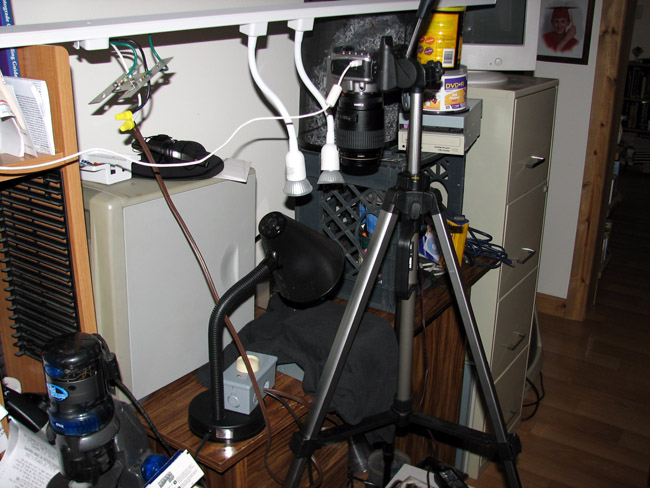 It's an adapted track lighting rig, with gooseneck fixtures. Here's my current rig using Jansjos - you can see the halogens still set up in the background (the gooseneck design allows me to bend them through 180 degrees and still bring to bear on the coin with adjustability): 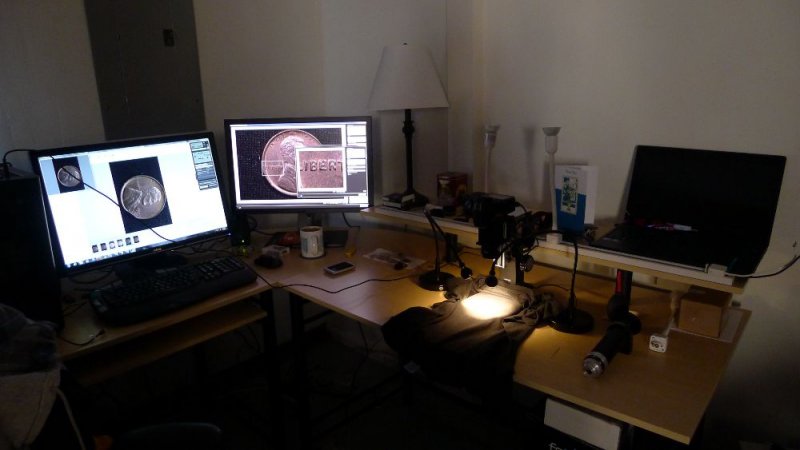 Buy something portable, and goosenecked. You will thank yourself down the road for that infinite adjustability. |
|
Moderator
United States
23522 Posts |
This is a deliberate separate post to address color temperature.
I regard the Jansjos - 40-watt equivalent, which translates to (supposedly) about 450 lumens each - as about the minimum amount of light necessary to effectively shoot a coin. A single one requires compromises in exposure times which could interfere with a less-than-perfect camera/optics implementation. So use that number as a "minimum" and understand that you can solve the problems of too much light far easier than you can the opposite.
As regards the color temperature of the light, generalize to assume that the larger the departure from the 5000-5500K of daytime sunlight, the larger the correction your camera must make in-camera to compensate. This is illustrated by the fact that some makes do a far better job than others of compensating for incandescent light (2800-3000K) in their automatic routines (I'm looking at you, Canon).
With that said, effectively implementing Custom White Balance in your camera makes all this utterly redundant. Worry far more about the size of your light source (the smaller the better; opposite of lumens you can compensate for too-small far easier than too-large) and its' adjustability. Furthermore, compensating for color correction is pretty much trivial in postprocessing, among the easiest of operations.
|
|
Pillar of the Community
 United States
1372 Posts |
You could mount the lights inside the ring to shoot perpendicular to the surface. If the lights were swivel units, I think you could make a myriad of adjustments.
I am going to get some goosenecks for now though, so I can start making some progress.
Thanks .........
Chance
|
|
Moderator
United States
23522 Posts |
Typing simultaneously.  Quote:
You could mount the lights inside the ring to shoot perpendicular to the surface. If the lights were swivel units, I think you could make a myriad of adjustments.
I've run into occasions when I set the lighting less than 4" from the coin, and other occasions when I've set it 18" or more above the coin. Will a fixed rig have this capability? |
|
Pillar of the Community
United States
1372 Posts |
Not specifically ... but if the distance was increased to decrease the intensity of the lighting, swiveling the lights and/or dimming them a bit may get you to an acceptable compromise.
Chance
|
|
Pillar of the Community
United States
4051 Posts |
I spend more time getting lighting right than anything else. I have at least 20 different lighting techniques I've developed for different situations (not joking), and pretty much all I shoot is BU Lincoln Cents! To be fair, about half of these are for higher magnification shots, which are extremely picky to angles and such to get just the right shadow detail to show what you want. Different lenses require different techniques due to their peculiarities. Pretty much, though, the Jansjos can do most everything you need to do, except perhaps proofs (which I have not yet mastered) by using the appropriate type of diffusion. My recommendation is to set up 2 Jansjos in some rigid mounting so that you can easily place their heads from 3" to 6" from the coin, and have another Jansjo ready to bring in for those tough jobs, and be happy IKEA made these little jewels available to use for cheap...Ray
Contact me for photographic equipment or visit my home page at: http://macrocoins.com |
|
Moderator
United States
23522 Posts |
Ray, the solution for Proofs is - intuitively to me - continuous circumferential lighting. When the coin presents overwhelming mirrors from every angle, obviously you have to use every angle.
Chancellor, it's not about reducing intensity with distance. You reduce intensity with exposure. It's about leveraging your light's inherent characteristics of spread (every light offers a certain angle through which they spread their illumination), to reduce the percentage of that light's total capability applied to a single certain area of the coin's surface. It's kind of a diffusion process, understanding that diffusion is of variable necessity and also (unrelated) of variable effect on a given coin. You can leverage your proposed static (by comparison) constructed rig with the application of ever-more-sophisticated, constructed diffusion addons, or you could leverage the inherent characteristics of the portable light you're using to achieve the same end without busting your butt to build something to compensate.
Seems kinda intuitive to me.
|
|
Pillar of the Community
United States
1372 Posts |
It probably is making too much of something that (over time) becomes more simple as your understanding improves. I still think it would be cool to build it. Think of it as though the coin were getting an MRI. It could be moveable, and the light ring be fixed. That would require far less travel to subject the coin to a bunch of different lighting angles. Like I said ... back burner that one. I'll get some gooseneck LEDs. We don't have an IKEA ... heck, were so far off the beaten path that I have to drive 8 miles to get gasoline. But there are lots of 'em on ebay, and the mail runs daily (so I don't have to) Chance |
|
Pillar of the Community
2087 Posts |
I tried the jansco lights, following recommendations here...as someone has already noted they are barely adequate: I now use this: http://www.ebay.com/itm/29095318516....m1438.l2649 ( I am not recommending the seller just using the listing to illustrate the product) the one thing that lets this example down is that it is battery powered |
|
Pillar of the Community
United States
5825 Posts |
I prefer a camera stand to a tripod. For me there is almost always one leg of a tripod in the way, either in the image or casting a shadow. As for lighting I use OTT-LITE's with their "white" bulb. A slight tweak of the "white balance" gets the lighting correct. Here's my setup (ignore the surrounding mess):  |
|
Pillar of the Community
Canada
4944 Posts |
kanga, do you remember where you bought that stand?
I would be interested in buying one similar to that.
|
| |
Replies: 11 / Views: 2,863 |
|









 Posted 10/26/2013 10:17 pm


