| Author |
 Replies: 26 / Views: 4,205 Replies: 26 / Views: 4,205 |
|
Valued Member
Canada
155 Posts |
I have been looking for a few coins from the Queen Anne period, and have come across coins described as "maundy".
Can anyone explain what this refers t? Typically they are threepence or fourpence pieces.
Thanks
|
|
|
|
Pillar of the Community
United States
3486 Posts |
On the Thursday before Easter the Royalty of England/Great Britain has passed out these coins to pensioners in lieu of other traditional Easter week traditions. They are and have been legal tender, but are immediately snapped up by coin dealers. The number of packets = the age of the Monarch. A full set of Maundy Money is comprised of a 1, 2, 3 and 4 pence piece. God Save the Queen! Edit: It is my understanding that after the conversion to the decimal system the original "pence" denominations were retained. 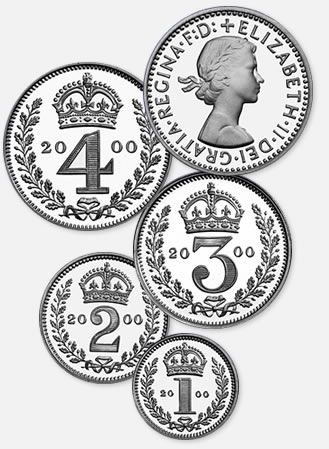 Edited by matthewvincent
12/01/2013 4:40 pm
|
|
Valued Member
 Canada
155 Posts |
|
|
Bedrock of the Community
Australia
21792 Posts |
If you want to buy scarce coins for a reasonable cost and with a fantastic historical heritage, Maundy coins are a good way to go.
Typically, only 2,000 or so of each denomination are minted each year, except in late Victorian and Edwardian times when up to around 8,000 or so were minted for each denomination, each year.
|
|
Valued Member
Canada
155 Posts |
Thanks for the info. How can I tell the difference between a Maundy coin and the others? Do the Maundy coins have a distinctive feature, i.e. the numeral "2", "3" or "4" in the centre of the coin?
|
|
Bedrock of the Community
Australia
21792 Posts |
As a result of the low number struck off each die, the detail on the coin is exceptional.
Maundy coins are struck from .925 silver.
The reverse design is characterized by a crowned numeral of value.
The coins are handed personally by the Monarch each year, (currently Elizabeth 11 or her Royal Almoner), to poor people, in lieu of washing of the feet, in commemoration of Jesus washing the disciples' feet.
|
|
Moderator
 Australia
17006 Posts |
Quote:
How can I tell the difference between a Maundy coin and the others? Do the Maundy coins have a distinctive feature, i.e. the numeral "2", "3" or "4" in the centre of the coin? Basically, no, there is not usually a significant difference in design. The coinages pictured above (silver 1, 2, 3 and 4 pence) were struck in every year for Maundy purposes. They were also struck occasionally for circulation. Sometimes the circulation types had different designs - the circulation 4 pence, for example, depicted Britannia rather than the denomination-in-wreath - but in most instances, it is simply a matter of looking up the catalogues to see if they were struck for circulation in that year or not. In summary: 1 pence: these were basically Maundy-only coins. I don't believe any silver pennies were struck for circulation after 1700, certainly none after 1800. 2 pence: they were struck for circulation in British Guiana (South America) in the 1810s and again in 1838, 1843 and 1848. All other years are Maundy coins. 3 pence: struck for circulation in Britain most years; it is often impossible to tell a "Maundy" threepence from a "normal" threepence, up until 1928 when the reverse design of the circulation threepence was changed. 4 pence: Issued for circulation prior to 1801. Struck with Britannia design for circulation both in Guiana and in Britain itself. Don't say "infinitely" when you mean "very"; otherwise, you'll have no word left when you want to talk about something really infinite. - C. S. Lewis
|
|
Pillar of the Community
United States
3486 Posts |
|
|
Valued Member
Canada
155 Posts |
Fascinating. I never had a clue about this interesting tradition. Too bad the Queen couldn't also hand out a few extra jewels from the Royal Collection. :)
|
|
Pillar of the Community
United States
3486 Posts |
"Well, carleroo, that SIMPLY isn't done.
Must adhere to tradition and all. Pip, pip, cherio!"
[Queen Liz to guards: 'send that carl fellow to the tower. We simply do not tolerate such talk.]
Take off her fancy clothes and she would fit into the line of pensioners quite nicely.
|
|
Valued Member
Canada
155 Posts |
Yes, Old chap. In the old days, that kind of talk would send me to the Tower.. My preferences would be as a visitor so I can see all the Royal Trinkets at close quarters.
Regards,
|
|
Valued Member
Canada
155 Posts |
By the way. What's a groat? I also see that they are similar to the Maundy coins?
|
|
New Member
United Kingdom
34 Posts |
A groat is fourpence. i.e a third of a shilling
|
|
Pillar of the Community
United Kingdom
4208 Posts |
Fun fact, as the old Threepence design is identical to the maundy coinage (which is legal tender) it means that when decimal day happened, the old silver 3d remained legal tender.
Buy a freddo with 5 of those and see what kind of look you get.
|
|
Valued Member
United States
293 Posts |
Nice job to matthewvincent for his fine explanation. I've seen one of these manudy sets before I believe one Queen Victoria's and it was fascinating. I take from what matthewvincent said that the number of packets = the age of the monarch is number that the monarch personally hands out?
|
|
New Member
United Kingdom
3 Posts |
If you want to buy them the smallest ones seem to be the most popular. Keep away from the 3d unless you are completing a set. They are not distinguishable from ordinary silver 3d which exist by the millions.
Ditto in some years silver 2d were issued for circulation in the colonies, so are reasonably common.
|
| |
Replies: 26 / Views: 4,205 |







 Posted 12/01/2013 4:48 pm





