| Author |
 Replies: 475 / Views: 53,468 Replies: 475 / Views: 53,468 |
|
|
|
Moderator
  United States
23731 Posts |
It's still a nice coin and one I would like to have.
|
|
Moderator
United States
23731 Posts |
What do you think about this one? 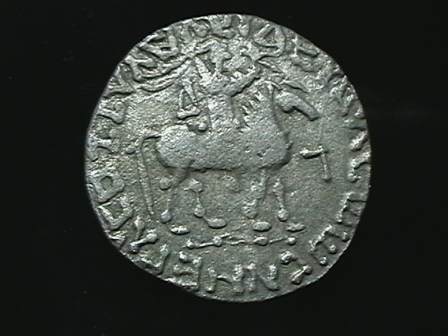 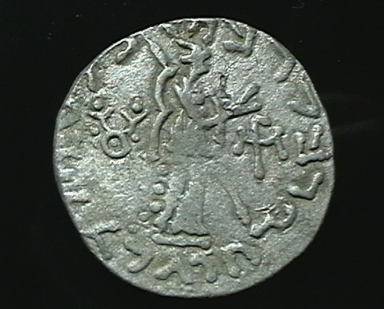 |
|
Pillar of the Community
United States
3495 Posts |
I am speechless ..... I am without speech.
I really have no clue what it even is ! The legend does not look Greek but it certainly isn't Latin either. The style appears to be copying a Classical type of emperor on horse back with a goddess and children perhaps in the field ?
I am guessing it is bronze but other than that .....
Count me clueless
|
|
Moderator
United States
23731 Posts |
Sorry about that it's an AR Tetradrachm of the Indo-Scythian king Azes II 35 BC- 5 AD. 24mm x 9.61 grams Taxila Sirsukh mint. Mitchiner 867.
|
|
Pillar of the Community
United States
3495 Posts |
My hunch was going to be Black Sea area as it seemed to have elements of Classical well mixed with something 'wild'.
I really don't have experience with these 'thangs' so grading is tough.
But as this thread seems to have become a dialogue between you and I with some occasional input from down under I will speculate that it is almost a VF. But this is based purely on my assumptions about what is to be expected.
|
|
Moderator
United States
23731 Posts |
I thought this would be an interesting thread with a lot more input than you, I and Sel. Maybe it's just the approaching holidays and everyone is busy. Any way when I bought it the dealer had it graded as VF. So you are right on.
|
|
Pillar of the Community
United States
5155 Posts |
I am familiar with the type. Many of these coins are very porous and certainly off struck, You have nearly all of the legend on both sides so in my book that's important you do have wear on both sides. The coin is very common but even this VF+ (my grade) is an XF and rare for the type. Truly a great examples with beautiful and clear monograms.
|
|
Pillar of the Community
United States
3229 Posts |
Could be the holidays. For me I have been researching ancient grading and too much non-numismatic stuff.
As for your AR Tetradrachm of the Indo-Scythian king Azes II: I will grade it VG details granular surfaces.
The Caracalla: Fine details chemically cleaned.
The Commodus: VF cracked and damaged, attractive toning, nice portrait details
Hope I don't sound harsh with grading. I have joined the Early American Coppers club and they are known for honesty that some take as being harsh. But a coin is what it is and I believe in the end that honesty makes the hobby better.
|
|
Pillar of the Community
United States
3229 Posts |
Marc Anthony Denarius: VG
|
|
Moderator
United States
23731 Posts |
Tj thanks for your input, that's why
We started this thread so that we can all learn about grading ancients.
|
|
Pillar of the Community
United States
3495 Posts |
I am somewhat surprised by the "cracked and damaged" assessment !
Flan cracks start becoming more common from the late 2nd century onward. A direct consequence of the recycling of the older coinage and insufficient 'new' alloy being added to the mix (evaporation of zinc content and too much lead I am told). Personally I like a nice crack as it is a good indicator of the coin being authentic (while I certainly agree 2 may be one too many !)
But damaged is a bit of a stretch. Some minor scraping is allowable in certain cases and while not desirable it should not be confused with 'tooling' which is the actual remaking of the surfaces. The patination on this coin is very thick on the fields and the scraping has not penetrated the surface layer. I am unsure but perhaps you are using the rules of your Early American Coppers grading which prohibit anything which alters a coin in anyway other than removing the 'dirt' by washing. On ancients the 'dirt' is literally petrified onto the surface and can usually only be removed by some method of soaking and abrasion (preferably with a toothbrush or toothpick).
But I don't take it personally !
|
|
Bedrock of the Community
Australia
21792 Posts |
I would agree that the tetradrachm of Azes 11 has been chemically cleaned. This piece, when it was first recovered, would have been completely unidentifiable. Nevertheless this coin also suffers from a weak strike, because most of the details are rather flat. If had been well struck, and even with the rather harsh chemical cleaning, the details would have had more relief and shape to them.
The question: Do you include the weak strike as part of the grading? I assume there would be divided opinions on this.
How do you grade it? I am in two minds
1. VF, weak strike both sides, chemically cleaned
or
2. G.
I prefer '1.', because it more accurately describes the coin.
|
|
Pillar of the Community
United States
3495 Posts |
Lets try out a lower grade sestertius I did not pay much for this one but just couldn't pass this one by. Antoninus Pius Sestertius Rv. IMPERATOR II Britannia seated left (holding shishkabobs) 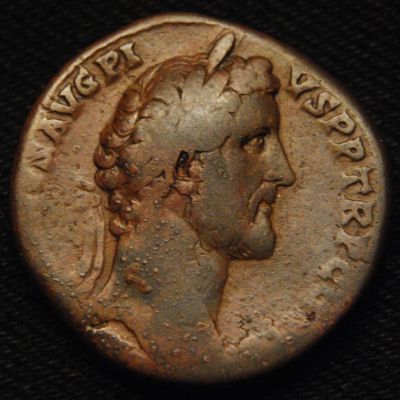 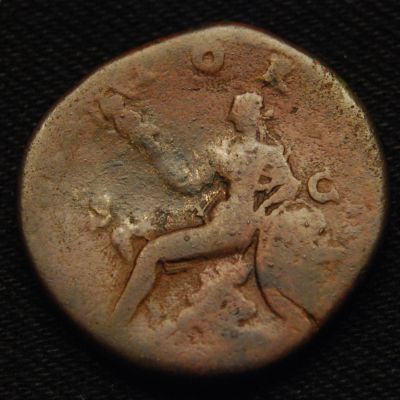 I am very curious as to what the consensus is on this one |
|
Pillar of the Community
United States
5010 Posts |
ok, let me give this a shot. using the NGC scale TJC provided in his post, I would say ....very good? reverse is flat but you can see the outline of the design, obverse is just a bit worn on the high points, legends a little sketchy. so obverse fine, reverse good, shoot the middle.
how did I do?
|
|
Pillar of the Community
United States
5155 Posts |
With both sides worn and with decent legend I would say F. I believe that once the ear becomes indistinguishable from the hair it has reach a nice F.
|
| |
Replies: 475 / Views: 53,468 |





 First Page
 Previous Page


 Posted 12/20/2013 4:02 pm





