Quote:
Relatively speaking, reales minted in Spain during this period were lower in mintage than those minted in the American colonies...
I have barely seen any of these in the states, and only a few pricey examples while in Spain.
That has to be broken down...
Hard to categorize all "reales" together as one big category... Has to be looked at by denomination, and of course, all the colonial mints can't be considered similarly.
One thing you can say "generally speaking" is that overall for the portrait reales series - PROPORTIONALLY (ratio of the denominations produced as a total of each mint's output, colonial or homeland), the mainland produced a rather low amount of 8 Reales coins compared to the colonial mints like Mexico, Lima, etc. (even in light of swamperbob's bullion restrikes of particularly Mex. mint 8R).
However, for the 4R denomination... again, as a proportion of the total surviving reales coinage (of all denoms.) you come across in the market by mint... you find more 4R from the mainland mints (primarily the more common years of Madrid/Seville) than from the colonial mints. Even factoring in that the colonial-minted 8R was a preferred international trade coin and produced in large numbers b/c of that (or maybe as an outgrowth of the colonial 8R becoming so ubiquitous?), it would seem that the mainland Spain 4R was much more of a "workhorse" coin in everyday usage within Spain itself than the colonial 4R was on this side of the ocean. I'd say it sort of approaches how heavily-used the U.S. bust halves were employed, though not quite to that degree.
Beyond that... no, you don't find many mainland Spain 4R or 8R floating around the U.S. market. For the most part, those denoms. were never used in the New World in any large numbers - in terms of availability, you should almost consider them the same way you would any other European coinage rathen than as the Old World sibling of the colonial reales. Now, the smaller denoms. (especially the 2R) clearly seem to be more plentiful in the Americas (including here) in modern times, which partially reflects that the smaller change was used in certain Spanish-American colonies to some degree (especially in places without their own mints... and after the early 1820s when those more prominent colonies which did have their own mints became independent). Occasionally, some "head pistareens" even crept into the early U.S. - you occasionally see reports of Spain 1R or 2R being metal detected in the eastern States (excluding formerly Spanish Florida).
Now, PRICE...
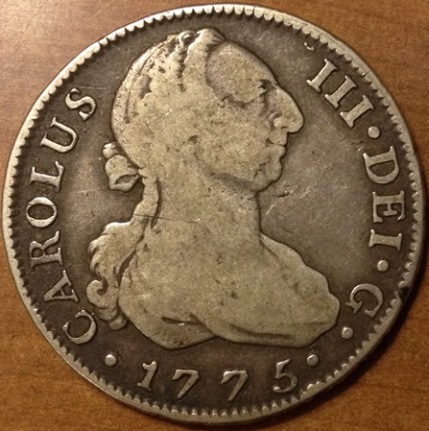
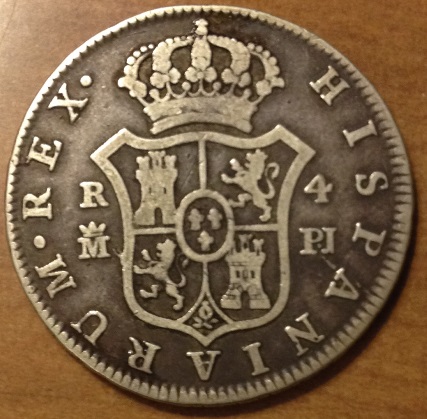
Current Krause price for most "average"-date Charles III Madrid 4R (which 1775 is included under) is given as $50 in VG, $125 in VF... Note that the exception is the 1788 assayer MF piece, which is shown at only $20 in VG and $55 in VF. All else being equal, I think that the price given for that 1788 is a bit low (though it definitely is the most common date, it's not like the most average dates are THAT much scarcer)... and partially related to that, the price for the non-1788 "commons" is slightly high.
One thought straight away - if you saw prices higher or even considerably higher than that at dealers in Spain... you saw overpriced dealers. The Spanish auctions regularly have examples of this quality in their secondary "mail bid" only (no live bidding) auctions and they do not reflect that...
I will say that I find that prices achieved on
ebay for peninsular Spain bust 4R seem to fluctuate more than most types (even factoring in whether they come from Spain vs. the U.S./other). Also, you have to factor in (or out) some typical half-the-story BS from sellers, like "4R in general are much rarer"... people who hype the whole pirate/colonial/piece of eight schtick, etc...









 Posted 01/19/2014 11:03 pm





