| Author |
 Replies: 8 / Views: 1,602 Replies: 8 / Views: 1,602 |
|
|
Valued Member
United States
110 Posts |
This must've happened during the striking, since the reverse is intact... 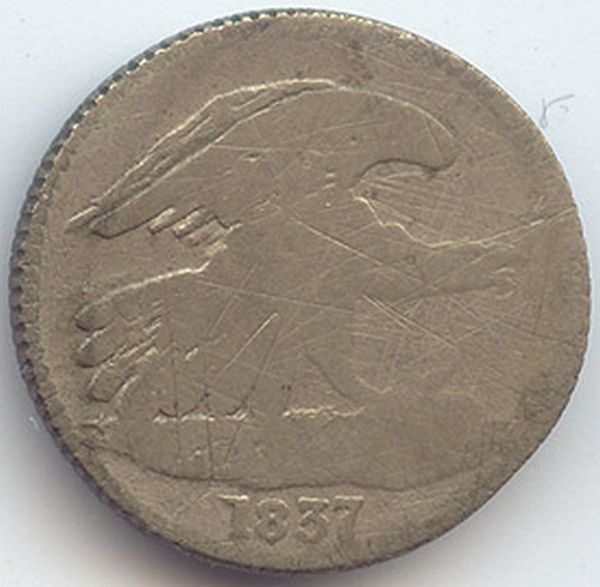 It looks like the token was struck, then a blank planchet was fed on top of it, a bit off center so an area from about 8:00 to 12:00 was not damaged when it was struck again. There's a narrow "crescent moon" of undamaged surface, and on the southeast portion of the coin it expanded outward a bit from the pressure. It's even possible that the scratches on the obverse are from a screwdriver or similar tool that was used to pry the jammed token loose from the coin press. One other reason I think it was damaged on the press is that the reverse remained undamaged (the messed up ONE CENT is constant on this variety, from a crumbling die). 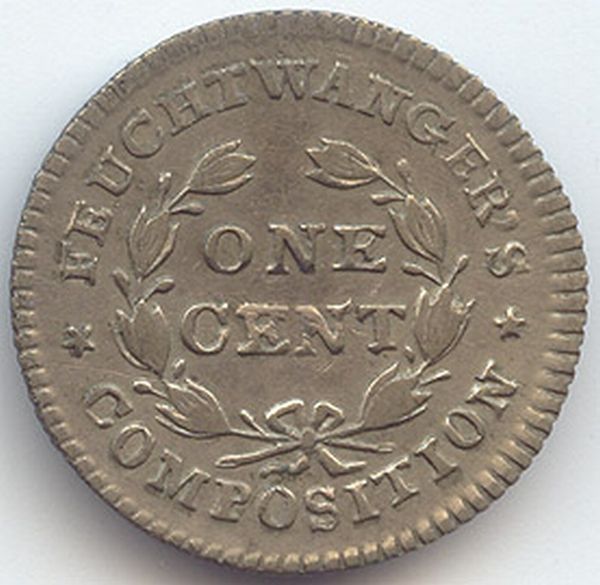 Note also how the coin metal extruded out and produced the elongated denticles at the rim on the reverse. That too had to happen during minting. The token is one of the more common Feuchtwangers, Breen 6-I. -Duncan |
|
|
|
Valued Member
 United States
110 Posts |
I should add that I'm wondering if I am correct in assessing this token, and also wondering what this type of error is called.
|
|
Pillar of the Community
United States
2760 Posts |
|
|
Valued Member
United States
110 Posts |
Hmmm... I hadn't considered grease.
I guess I would've expected grease to spread over the face of the planchet, rather than the metal extruding as much as it did. That, and the eagle seems to be mushed out a little oversized, which led me to think it was struck once, then flattened. I'll look for an undamaged image for comparison.
I paid $45.00 for it, the online seller probably figured it was heavily worn.
-Duncan
|
|
Valued Member
United States
110 Posts |
Here's an undamaged 6-I obverse: 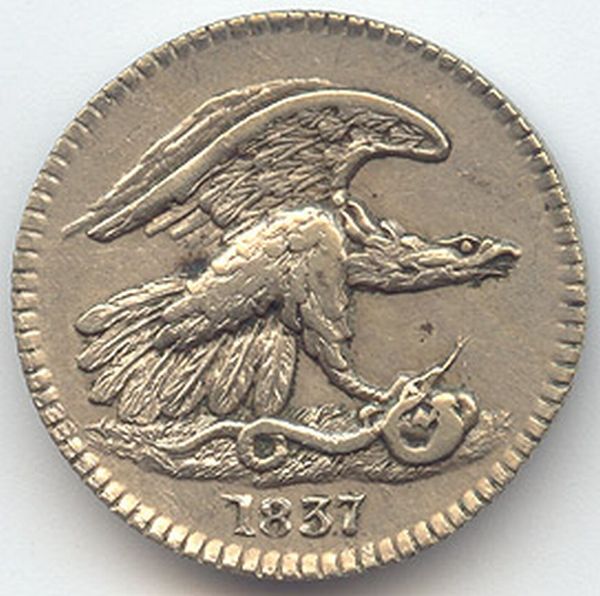 On the damaged obverse I see widening in things like the eagle's lower leg, the eastern point of the wing, and a neck on steroids. -Duncan |
|
Pillar of the Community
United States
4432 Posts |
I'm simply seeing PMD on this one, but the price was right for this "ahead-of-its-time" Hard Times token. |
|
Valued Member
United States
110 Posts |
Thanks.
But I'm really not so sure, which is why I bought the token. There are a lot of ways a coin or token can be damaged like this after minting, but not without damaging both sides.
I've collected a few counterstruck tokens, for example, and there are always flat spots on the other side of the coin. My belief is that the simplest explanation is best, unless there are other indicators. In this case, the coin struck a second time, with a blank planchet fed into the press on top of it, is a simple and easy explanation for what can be seen. And that's not an unusual event at all. So what clues exist to support or refute that idea? The main clue I see is the slight egg shape of the token, plus the way the denticles stretched across the reverse die during the second strike. How could that happen after minting? That's where the heaviest damage on the obverse happened, so an after-minting impact in that area should've obliterated those denticles, and instead they are extruded and sharp.
The obverse really doesn't tell us too much, because a hammer blow (for example) could cause similar damage. But the reverse of the coin tells us that didn't happen.
Anyway, I like it, and it's not for sale, so it's just a conversation piece, nothing more.
|
|
Moderator
 United States
23522 Posts |
I have a hard time seeing something so catastrophic happening to the obverse postmint, with no corresponding damage whatsoever to the reverse. The actual mechanism is unclear, but my gut says it happened during the strike.
|
|
Valued Member
United States
110 Posts |
Thanks SD!
During the Hard Times era, quality control was not very strict at all - depending on the variety, there were clipped planchets, die breaks, poor strikes, and even spelling errors.
With these Feuchtwanger tokens, it was not unusual to see tokens with severe cracks in the planchets, which was very unusual if these tokens were intended to promote the use of Feuchtwanger's composition for our coinage.
If this example was struck with a second planchet on top of it, as I suspect, it might have been considered "good enough" and intentionally allowed into circulation, but that extra planchet would've been a real beauty! Even though off center, it would've received an obverse impression on one side and the reverse would've been a mirror image of the mashed obverse of my token, so a double headed coin.
-Duncan
"Price is no object as long as it's cheap."
|
| |
Replies: 8 / Views: 1,602 |
|







 Posted 01/16/2014 8:02 pm





