| Author |
 Replies: 10 / Views: 3,260 Replies: 10 / Views: 3,260 |
|
|
Valued Member
United States
135 Posts |
Marks? Bonds? Noticed they said something about "Conversion Office". Any info appreciated! 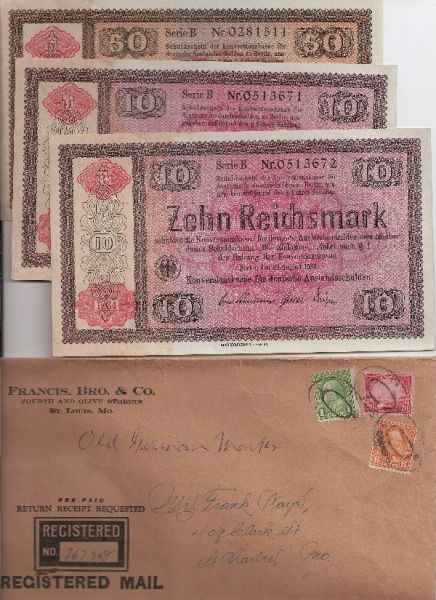 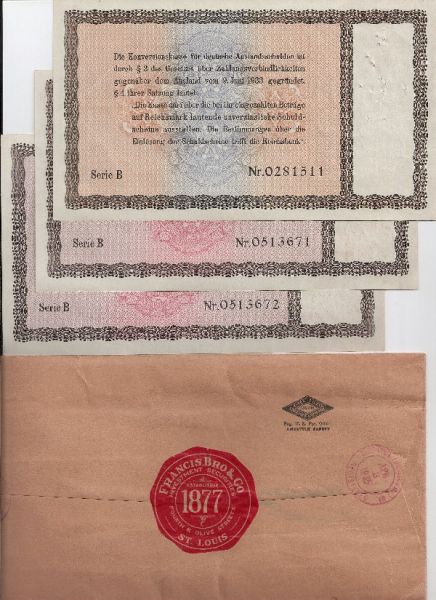 |
|
|
|
Valued Member
Australia
192 Posts |
These are notes issued by the Conversion Fund for German Foreign Debts in 1933-34. These particular ones were issued in 1934, and judging by the envelope, were sent to that St. Louis company to pay off a debt.
Edited by Ark
01/22/2014 11:40 pm
|
|
Valued Member
 United States
135 Posts |
Cool. The company in St. Charles was Waye Monument Co., owned by Frank Waye at the time. I thought it was neat that they were in the envelope marked 1935 with the old stamps and all. These notes are in pristine condition as well. I just need to find the best place to sell them..
|
|
Pillar of the Community
United States
746 Posts |
Here is what these were used for. It is a bit of a long story.
After the hyperinflation in Germany of 1923, foreign investors refused to invest in German industrial and government bonds denominated in German marks. They lost a lot of money in the hyperinflation. Instead, external German debt had to be in the hard currencies of the west: pounds, dollars, francs, guilder, Swiss francs, etc.
Through the later 1920s there were a series of bond issues from German industries and German government entities (cities, states, etc.) that were taken in these foreign currencies. What was initially good for the bond issuers -- receiving hard currency -- turned into a problem as interest and principal payments became due as these also had to be paid in these currencies. The effect of this and the worldwide depression of the early 1930s created difficult economic conditions in Germany.
A series of monetary reforms began in late 1932 under the direction of Reichsbank president Hjalmar Schacht that included making the reichsmark inconvertible and prohibiting its export from Germany. As part of these reforms, the German government set up the Koversionskasse fur Deutsche Ausslanschulden (Conversion Office for German Foreign Debt).
The bond debtors were required to pay to the Konversionskasse the interest and principal payments due on their bonds. The Konversionskasse then paid the bondholders partly in the foreign currency and partly in these scrip notes. These notes could be used to pay customs duties or could be converted into foreign currency at a discount by the German Golddiskontbank. This began in 1933. By the end of 1934, the Germans ended the charade altogether and put a moratorium on the payments of all external debt except for payments on the Dawes and Young Loans. (These were negotiated by international treaties and the involvement of foreign governments prevented the Germans from defaulting on these loans).
By the mid-1930s, these scrip were useless to the holders. The value of the foreign denominated bonds collapsed in the international markets and the Germans began buying back their own bonds at a substantial discount. Overall, it was a pretty clever scheme and they almost got away with it. This little thing called WWII got in the way.
After WWII, the foreign bondholders demanded the post-war German governments make good on the pre-war bonds. An agreement reached in 1952 set the framework for this and the pre-war external debt was re-funded by a series of bonds issued by the West German government. This allowed the West Germans to re-enter the foreign bond markets. The terms of the agreement put off certain payments until after the reunification of Germany. In the early 1990s, the German government began to make those payments. The final payments were made a few years ago. Compensation for these scrip notes was also part of the 1952 agreement.
You will find references on the internet that say these notes were used to pay German Jews for confiscated property. This is not entirely true. German Jews who left Germany in the mid-1930s were given these notes as compensation for their reichsmark denominated financial instruments. In other words, if an émigré held German RM bonds or bank accounts, these were turned in and these notes issued in their place when they left the country. This was required because of the prohibition on exporting the RM or RM denominated securities.
A large hoard of canceled scrip certificates came on the market about five years ago when the canceled bonds and certificates still in the possession of the Bundesbank were sold in Germany.
Most examples sell for $20-40.00. If the envelope were from the Koversionskasse itself this group could fetch upwards of $250.00.
|
|
Valued Member
United States
135 Posts |
|
|
Valued Member
Australia
146 Posts |
sabre2th that is a nice set of notes you have there and great information about them lettow
|
|
Valued Member
United States
135 Posts |
|
|
Valued Member
Australia
146 Posts |
When and where are you looking to dispose of them sabre?
|
|
Valued Member
United States
135 Posts |
When is anytime, where, I have no idea..
|
|
Valued Member
United States
135 Posts |
Well, after hanging onto these for over a year, have decided to let them go. Will be listed on ebay in just a bit unless someone knows a better place? Tom |
|
Valued Member
Canada
94 Posts |
Darn! I wish I had seen this thread sooner. I would have loved to get my hands on those notes.
|
| |
Replies: 10 / Views: 3,260 |
|








 Posted 01/23/2014 3:32 pm


