|
This page may contain links that result in small commissions to keep this free site up and running.

Welcome Guest! Registering and/or logging in will remove the anchor (bottom) ads and the security checks. It's Free!
To participate in the forum you must log in or register. | Author |
 Replies: 6 / Views: 1,474 Replies: 6 / Views: 1,474 |
|
|
Pillar of the Community
United States
842 Posts |
I am browsing the old RIC volumes double checking all of my attributions that I got online. I hit a spot that is very confusing and I am hoping someone can tell me if my current assumption is correct. It looks to me like some mint mark combinations over lap with each other, thus making some coins with specific mint marks have two valid RIC numbers. I have RIC 17b (R•PRIMA) and what I have classified as RIC 24b (R•QVARTA). Do I call both coins RIC 17b and/or RIC 24b? 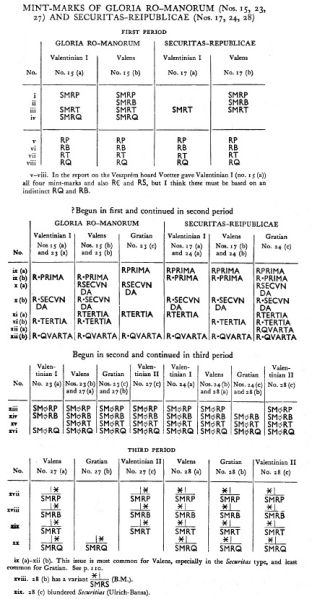 Additional info: 1st Period- Feb. 25, 364 to Aug. 24th, 367 2nd Period- Aug. 24th, 367 to Nov. 17th, 375 3rd Period- Nov. 17th, 375 to Aug. 9th, 378 Edited by ancientcoinguy
01/23/2014 11:17 am
|
|
|
|
Pillar of the Community
United Kingdom
4208 Posts |
While I'm not familiar with the paper version of RIC, I'm guessing that the two numbers are here referring to a legend break or bust design. A coin shouldnt be applicable to 2 RIC numbers, as far as I know.
|
|
Pillar of the Community
 United States
842 Posts |
I feel like I am going mad. RIC 17b, 24b, and 28a all have the same legends, same images, same everything. I even found a note on Wild Winds Quote:
Twelve different mint marks are known, some of which were used for the later, identical issue 24b. RIC 17b includes mink marks SMRP, SMRB, SMRT, RP, RB, RT, RQ, RPRIMA, R•PRIMA, R•SECVNDA, R•TERTIA, and R•QVARTA. RIC 24b includes RPRIMA, R•PRIMA, R•SECVNDA, R•TERTIA, R•QVARTA, SM(leaf)RP, SM(leaf)RB, SM(leaf)RT, and SM(leaf)RQ. RIC 28a includes SM(leaf)RP, SM(leaf)RB, SM(leaf)RT, SM(leaf)RQ, and the mint marks SMRP, SMRB, SMRT, SMRQ with a star in the left field. If the mint mark is one of the green ones, the coin is RIC 17b and RIC 24b. If the mint mark is one of the blue ones the coin is either RIC 24b or RIC 28a. I do not know why the authors of RIC set it up this way. 24b has no reason to exist. Edited by ancientcoinguy
01/23/2014 1:56 pm
|
|
Moderator
 United States
23731 Posts |
While RIC is an excellent reference it is full of errors and can be very confusing IMO. I can understand where the differences in the mint mark would be a separate number, but when the coins are identical including the mint mark than there should be no difference in the RIC number. This I can only chalk up to being one of RIC's many mistakes.
|
|
Pillar of the Community
United Kingdom
4208 Posts |
That is odd...I think you should pencil in next to 24b that its erroneous and use the other RIC number.
|
|
Pillar of the Community
United States
567 Posts |
There's not an error here, it's just a confusing set of charts to read, but it makes sense eventually.
RIC Vol 9, p. 114-115 (what you have shown above) give the mintmarks associated with each group.
There is overlap between obverse legend types so you first have to classify the coin by the mintmark on pages 114-115.
The further by bust type to get the correct attribution.
It's easier if you substitute "group" for "period" in the headings - makes more sense that way to understand the charts. Your confusion probably stems from them saying that there was overlap between the different periods, but in actuality they're classifying them by groups. So using 'groups' instead of 'period' makes more intuitive sense when trying to understand this section from pages 114-136.
So your R QVARTA is correctly attributed to RIC 24a, since it has a mintmark from the 2nd group, you can confirm by checking the bust type. Rome 24 lists bust types 1(A), 2(A), and 3(A) where 17 only lists 1(A) and 2(A). So if it's 3(A) it's definitely 24, although the mintmark should suffice.
Same goes for the other one, but it should be 24b not 17b since the mintmark R PRIMA is included in the second group, also assuming you have bust type 2(A).
|
|
Pillar of the Community
United States
549 Posts |
RIC IX (Valentinian and later) has many indistinguishable types with two different numbers. It makes sense if you think about the cataloging problem. Suppose an issue begins under emperor A and continues after emperor B is elevated and the elevation is celebrated with a new type. So, now there are two distinguishable time periods (before and after). If the continuing type is listed for emperor A in the first period, should it be cataloged with only that one first number? But that would make it seem to not belong to the second issue and make it unlisted in an issue where it was still issued. So, they catalog it in the second period with a second number within that second issue, even though the coins of that type from the first and second periods are indistinguishable. A timeline of the events of RIC IX is here: http://esty.ancients.info/ricix/timeline.html as part of my larger site: http://esty.ancients.info/ricix/ |
| |
Replies: 6 / Views: 1,474 |
|
To participate in the forum you must log in or register.
Disclaimer: While a tremendous amount of effort goes into ensuring the accuracy of the information contained in this site, Coin Community assumes no liability for errors. Copyright 2005 - 2026 Coin Community Family- all rights reserved worldwide. Use of any images or content on this website without prior written permission of Coin Community or the original lender is strictly prohibited.
Contact Us | Advertise Here | Privacy Policy / Terms of Use
|
| Coin Community Forum |
© 2005 - 2026 Coin Community Forums |
| It took 0.23 seconds to rattle this change. |
 |
|
| |
| |





 Posted 01/23/2014 1:52 pm


