| Author |
 Replies: 9 / Views: 7,301 Replies: 9 / Views: 7,301 |
|
|
Pillar of the Community
United States
3486 Posts |
It is not listed in the glossary.
What is it and what causes it?
I'll pass on the answer to the moderators and ask them to include it.
Thank you.
|
|
|
|
Bedrock of the Community
United States
12437 Posts |
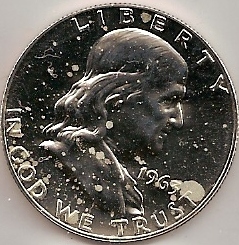
Milk spots are white patches sometimes seen on silver bullion coins, caused by residual planchet rinse solution. The spots are not usually visible on a freshly struck coin, they will form over time.
|
|
Valued Member
United States
89 Posts |
|
|
Pillar of the Community
United States
8137 Posts |
Is there any way to remove them?
|
|
Valued Member
United States
89 Posts |
I don't know of a way without actually damaging the coin in some fashion.
|
|
Pillar of the Community
United States
1037 Posts |
To my knowledge, there is no way to remove milk spots. If there is a way, I'm sure it will do considerable damage to the coin.
As mentioned above, the planchets are not totally rinsed off before being stuck. Combined with the force of the strike the left-over residue is embedded into the coin.
|
|
Bedrock of the Community
United States
20037 Posts |
As I recall PCGS has a substantial reward for anyone that can find a method of removal.
I've toyed with them a little without success. IMO, they are permanent and cannot be removed without damaging the surfaces.
Lincoln Cent Lover!VERDI-CARE™ INVENTOR https://verdi.care/
|
|
Valued Member
United States
337 Posts |
Since this happens from the mint could these one day maybe be considered errors?
|
|
Valued Member
Canada
158 Posts |
I doubt it.....the Royal Canadian Mint is famous for milk spots on their Maple Leafs, Wildlife Series coins, and a few other ones as well. Every one of mine have them, I would think a RCM product without milk spots would be considered the error!  |
|
Moderator
 Australia
16982 Posts |
As I understand it, milk spots are formed when droplets of a salty solution - any salty solution - are splashed onto the coin and allowed to remain there. They are not formed purely or solely as a result of solutions sprayed onto the coin by the mint, so they cannot be considered mint errors.
In a sense they are similar to the "carbon spots" that form on copper coins, but the chemistry is different. For carbon spots, the causal agent is sulfur, typically derived from sulfur-containing enzymes in saliva and delivered to the coin surface when somebody carelessly sneezes, coughs or spits-while-talking over their coins. Milk spots are more likely to be caused by chloride, so things like sea-spray, brackish water, hydrochloric acid, sweat and tears can all cause them.
Chloride reacts with pure silver to form silver chloride, also known as "horn silver", a compound which is notorious for being difficult to remove from silver once it forms there. Anything aggressive enough to remove horn silver from a coin is going to damage the remainder of the coin surface too.
Don't say "infinitely" when you mean "very"; otherwise, you'll have no word left when you want to talk about something really infinite. - C. S. Lewis
|
| |
Replies: 9 / Views: 7,301 |
|





 Posted 02/28/2014 1:53 pm