| Author |
 Replies: 10 / Views: 5,783 Replies: 10 / Views: 5,783 |
|
|
Valued Member
United States
263 Posts |
I found this three pence in the bargain bin at my local coin store. It appears to be normal except that it is stamped "copy". Any ideas why? Maybe I'm missing something since I see US coins more often than UK coins? Thanks 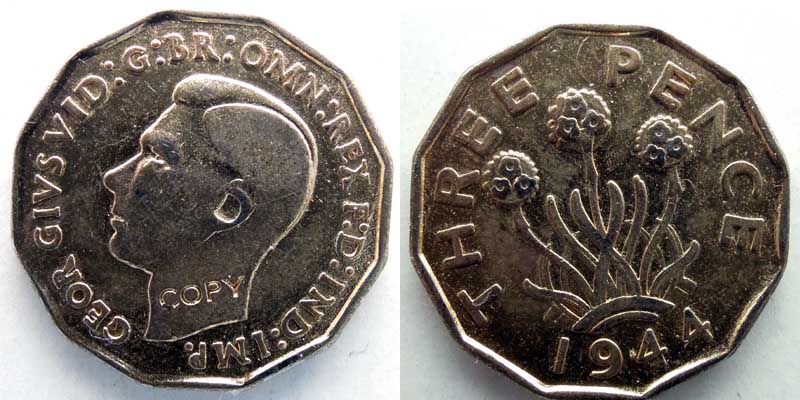 |
|
|
|
Pillar of the Community
Canada
2805 Posts |
|
|
Valued Member
 United States
263 Posts |
Quote:
My guess... it's a copy. That did cross my mind, but it is just three pence. The amount of time and effort needed to make a copy surely is worth more than that? |
|
Pillar of the Community
Thailand
1509 Posts |
Yes it's a copy. Compare it to this, there's no gap in "GEORGIVS". 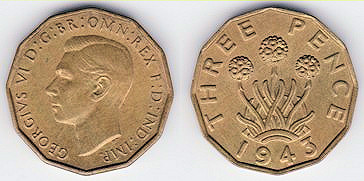 |
|
Valued Member
United States
263 Posts |
You're right. It looks like the ear is a little different too. I wonder why someone made this.
|
|
Valued Member
Australia
315 Posts |
The Chinese have fun making anything
|
|
Bedrock of the Community
Australia
21789 Posts |
Perhaps this not of Chinese manufacture.
I am thinking of the possibility that it was (mostly) produced for promotional purposes. Although it is imprinted 'COPY' after initial manufacture, I see the possibility that quite a few UN imprinted forgeries could have been produced as well.
I am also seeing the possibility that despite the fact that this one is imprinted 'COPY' to keep it legal, it may have circulated. It seems to have sustained some circulation wear.
Considering the fact that at various stages in British numismatic history, that forged coins were at least slightly tolerated in circulation, at least some of these UN imprinted '44 three pence coins could have been put into circulation, and may have escaped detection in circulation in wartime U.K. Even today, there seems to be a significant number of forged One Pound coins in circulation. Several pictures of forged One Pound coins have been posted in CCF forums.
May I ask:
How much does it weigh?
|
|
Moderator
 Australia
16985 Posts |
That's definitely a replica and, with COPY stamped on it, most likely a replica intended for open sale as such on the American market. Perhaps intended to be sold in a framed set similar to this one, so that "COPY" stamped into it would be on the back-side of the frame and therefore less noticeable. The key question is, of course, why would anyone make replicas - and make brand new dies rather than cast copies, since the legend lettering positions are so radically different - when perfectly genuine threepences can be had for not too much above face value? The only answer I can think of is that the set it was originally a part of was all-replica, and tossing in a few cheap-but-genuine coins would have confused things. I have seen sets of "Early Australian coins" which also included replicas of more modern common coins, for this reason. Don't say "infinitely" when you mean "very"; otherwise, you'll have no word left when you want to talk about something really infinite. - C. S. Lewis
|
|
Pillar of the Community
United States
1234 Posts |
Quote:
The amount of time and effort needed to make a copy surely is worth more than that? hehe, lookup Henning nickels  also check out this one... 'Saw this funny picture' https://goccf.com/t/1712763.5 cents per for PLASTIC copies  |
|
Valued Member
United States
263 Posts |
I found a regular three pence coin. The size and weight of this one is completely wrong. I guess it's play money like those plastic pennies, rather than a careful fake.
Darn. It would be fun to have a (properly marked to avoid any chance of confusion) fake.
|
|
Pillar of the Community
Canada
2805 Posts |
Maybe it was for educational purposes. Surely kids didn't learn the L/S/D system on their own...
|
| |
Replies: 10 / Views: 5,783 |
|







 Posted 03/02/2014 02:01 am





