












 Posted 03/30/2014 08:11 am


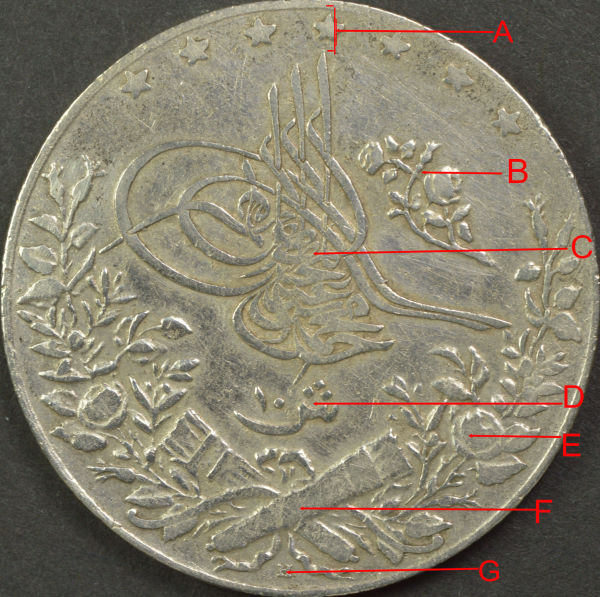
A: I do not think seven stars means anything specifically, other than "fill in the empty space with stars".
B: It's a flower. I'm not entirely sure what kind of flower or what it means, but it appears on the coinages of several Ottoman monarchs - I suspect to help differentiate the coinages of different rulers more easily. It was, apparently, an official ornament to the toughra. In AH1293 for example, after the overthrow of Sultan Abdul Aziz, his nephew Murad V came to the throne - and was himself almost immediately deposed just a few months later for being both insane and a radical democrat. His half-brother Abdul Hamid II succeeded him. The toughra of Murad V is plain; the toughra of Abdul Hamid II is always ornamented, either with a flower or (from his seventh year) the words "el-ghazi".
D: It's actually just the letter "sh", not the entire word "qirsh". Similarly, coins denominated in "para" just have the letter "p". These are abbreviations for the denominations, just as "c" is sometimes used for "cent" or "p" for British decimal pence. I do not know why they used the letter "sh" rather than "q" for the abbreviation for "qirsh"; perhaps because it was more distinctive. The small number, "10", above the letter indicates the denomination: 10 qirsh.
E: Again, I'm not sure if they are supposed to be specific flowers or, if they are, what they mean. This blog depicts the Ottoman official coat of arms, once they got around to inventing one; the arms has a bouquet of flowers but they are just described as a "floral motif".
F: I think they are quivers of arrows, rather than fasces. Perhaps indicative of the Turkish horseman heritage.
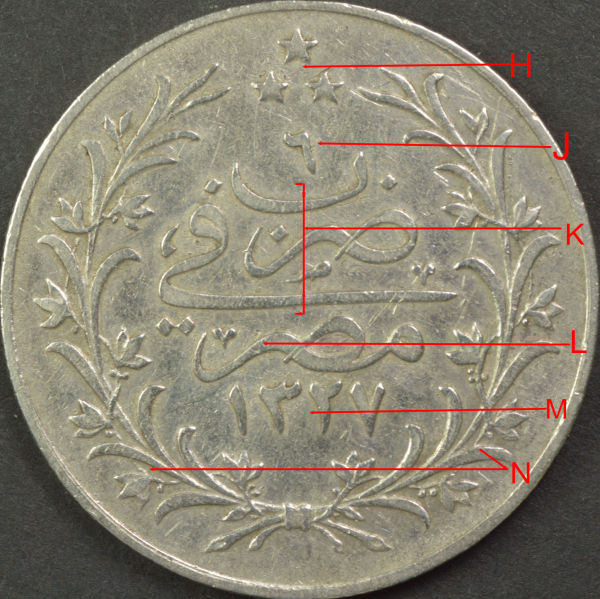
H: In this case, the number and pattern of stars does have meaning. A triangle of three stars was the distinctive emblem of the Khedivate of Egypt, as seen on their flag. Ottoman Turkish coins only have one star here.
K: These are the Arabic words "zuriba fi", meaning "struck in". They are meant to be read as a phrase with the mint-name (in this case, "zuriba fi Misr" - struck in Egypt).
B: It's a flower. I'm not entirely sure what kind of flower or what it means, but it appears on the coinages of several Ottoman monarchs - I suspect to help differentiate the coinages of different rulers more easily. It was, apparently, an official ornament to the toughra. In AH1293 for example, after the overthrow of Sultan Abdul Aziz, his nephew Murad V came to the throne - and was himself almost immediately deposed just a few months later for being both insane and a radical democrat. His half-brother Abdul Hamid II succeeded him. The toughra of Murad V is plain; the toughra of Abdul Hamid II is always ornamented, either with a flower or (from his seventh year) the words "el-ghazi".
D: It's actually just the letter "sh", not the entire word "qirsh". Similarly, coins denominated in "para" just have the letter "p". These are abbreviations for the denominations, just as "c" is sometimes used for "cent" or "p" for British decimal pence. I do not know why they used the letter "sh" rather than "q" for the abbreviation for "qirsh"; perhaps because it was more distinctive. The small number, "10", above the letter indicates the denomination: 10 qirsh.
E: Again, I'm not sure if they are supposed to be specific flowers or, if they are, what they mean. This blog depicts the Ottoman official coat of arms, once they got around to inventing one; the arms has a bouquet of flowers but they are just described as a "floral motif".
F: I think they are quivers of arrows, rather than fasces. Perhaps indicative of the Turkish horseman heritage.
H: In this case, the number and pattern of stars does have meaning. A triangle of three stars was the distinctive emblem of the Khedivate of Egypt, as seen on their flag. Ottoman Turkish coins only have one star here.
K: These are the Arabic words "zuriba fi", meaning "struck in". They are meant to be read as a phrase with the mint-name (in this case, "zuriba fi Misr" - struck in Egypt).
Don't say "infinitely" when you mean "very"; otherwise, you'll have no word left when you want to talk about something really infinite. - C. S. Lewis


