Okay, I've copied my postings on this, so hopefully pasting them here will work. I'm not so sure about the hyperlinks to photos, but we'll see.
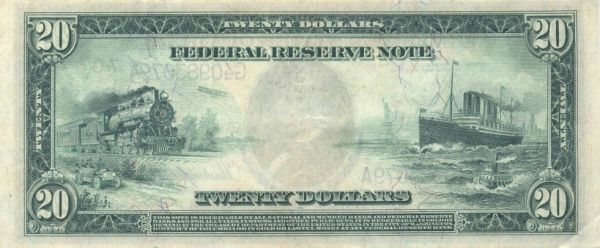
According to the book The Engravers Line by Gene Hessler, the engraver of this reverse of the 1914 $20 was Marcus W. Baldwin. The book lists the engraving title simply as "Land, Sea and Air" with no name of the ship given. No other information on the engraving is listed in the book.

Reverse of the 1914 US $20

Marcus W. Baldwin at work in his office.
Surprisingly, I found that only 15 four funnel ships were built. Of those, only two also had three masts, fore, midships, and aft: the SS Kaiser Willhelm II, and the SS Kronprinzessin Cecilie.
Both ships were taken/seized by the United States when it entered WWI, with the SS Kaiser Willhelm II being renamed the USS Agamemnon #3001, and the SS Kronprinzessin Cecilie being renamed the USS Mount Vernon #4508.
Of these two vessels, I would have to say that they are both equal contenders to be the inspiration of the liner depicted on the 1914 US $20.

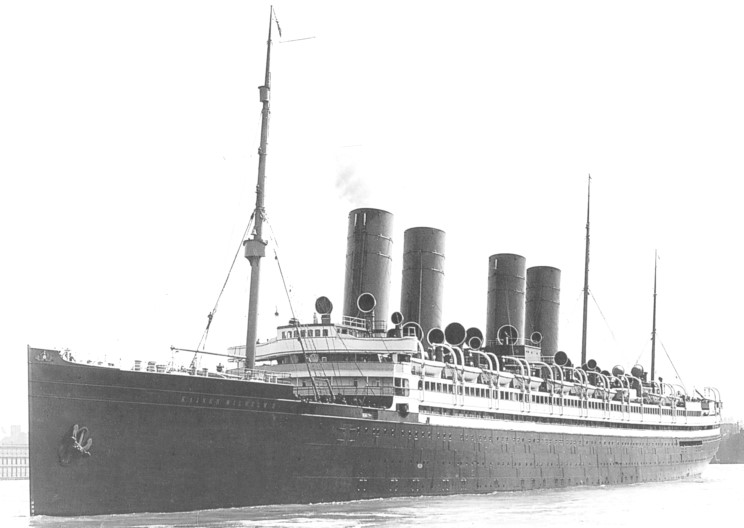
The SS Keiser Wilhelm II

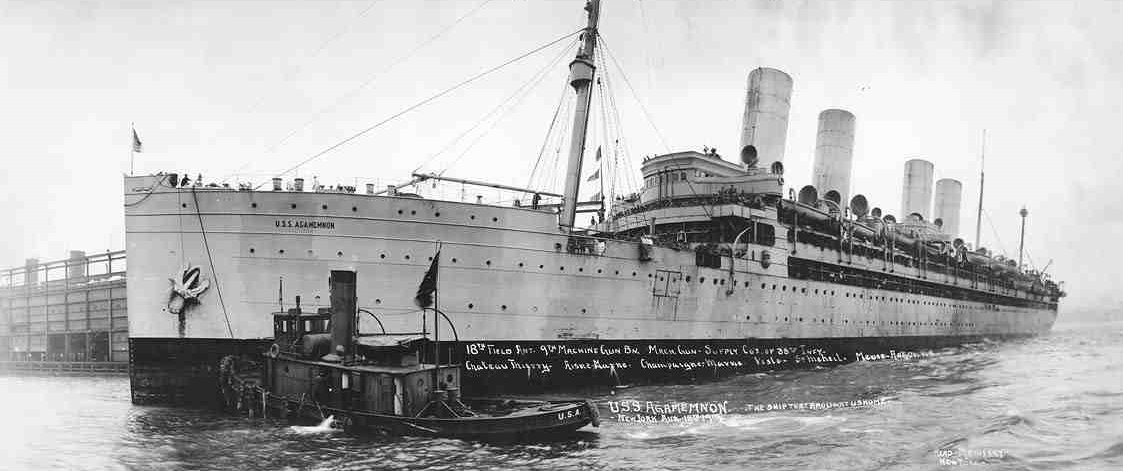
USS Agamemnon (The SS Keiser Wilhelm II)


Both above are of the SS Kronprinzessin Celilie

USS Mount Vernon (SS Kronprinzessin Celilie)
I did stumble on a picture depicting the SS Kronprinzessin Cecilie in New York Harbor:


Close up of the ship on the $20 and the SS Kronprinzessin Cecilie in New York Harbor.
For a while it was my opinion that the inspiration of the engraving for the vignette of the ship on the reverse of the 1914 U.S. $20 banknote was likely from an image of the (then) SS Kronprinzessin Cecilie. It does seem odd that the vignette would not show a ship that was undoubtedly American, but perhaps most people didn't know about it then either.
The note was surely designed well before 1914. But as the SS Kronprinzessin Cecilie was built in 1906 I think there was plenty of time for the image of the vessel to be the inspiration for the engraving. If not, then, all aspects considered, it is a remarkable coincidence.
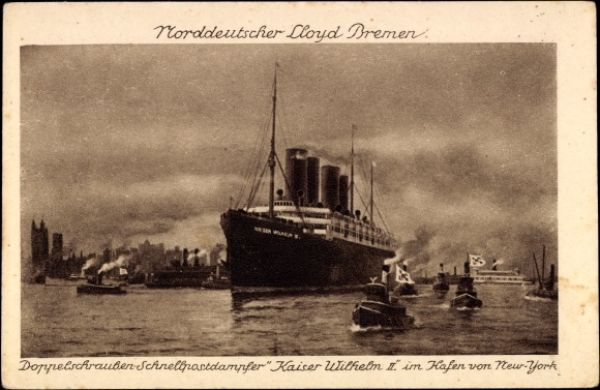
After a short while I was able to get the postcard in question, with the name of the ship being the Kaiser Wilhelm II. I did also find the same card with the ship named Kronprinzessin Cecilie, but not for sale.
When I had a chance to get a good, clear view of the ship, I could see the flags much better.
The flag on the bow of the ship is indistinguishable.
The flag on the forward mast is definitely the United States flag.
The flag on the midships mast is indistinguishable.
The flag on the aft mast is hard to tell, but I think it is the red and white flag "Hotel" meaning that the ship has a pilot on board - which would make sense, being in port.
So - What is a German ship in New York Harbor doing flying an American flag? Well, keep in mind that in this image, we cannot see the stern of the ship. This is where the German flag would have been flown. It is the place of honor on a ship. When a ship is in a foreign port, it is customary to fly the host nations flag from one of the masts. This simple gesture is what may have some thinking that it is an American ship (I certainly did at first).
If this image truly was the inspiration for the ship on the 1914 $20, the question as to whether the engraver (and others in the BEP) thought that this was a US ship, and placed it in the vignette could be explained by seeing the US flag flying, and not knowing that this is a simple courtesy, and not the country of origin.
It is also possible that the ships nationality may have been known, but was not much of a concern, thinking that this is a perfect example of trade/commerce/etc.
I've attached an image with a larger 300 DPI scan if anyone is interested.


For further consideration, there is also this 1923 issue of a 100 Miliadren Marks note that has copied the image of the 1914 $20. Sadly, I do not own a copy of this, but it can be seen at this site:
http://notaphilie.info/shop/popup_i...b5cd06149463









 Posted 04/02/2014 7:20 pm