| Author |
 Replies: 12 / Views: 6,967 Replies: 12 / Views: 6,967 |
|
|
Valued Member
United Kingdom
477 Posts |
I believe I have a Polish 1624 3 Polker from the Polish/Lithuania commonwealth. Any input would be greatly appreciated to verify my research :).   |
|
|
|
Pillar of the Community
Russian Federation
5186 Posts |
I have one of these that I thought was 1624 for months. Turned out to be 1626 - I was looking for the date in the wrong place  (this one is definitely 1624 though!) Other than that, as far as I can tell it indeed is a dreipolker/poltorak (no idea if naming it "3 polker" makes sense though). Fun fact about this type: that's SIGIS 3 on the top right here, which stands for Sigismund III - which makes this the only coin type I'm aware of (there are probably many I'm not aware of) where the regnal number is expressed as an Arabic numeral (basically everyone else used Roman, as in III). |
|
Valued Member
 United Kingdom
477 Posts |
Thank-you for the response, and I will add that fact onto the coins description. That is interesting, I love unique facts. This was a cool purchase :).
|
|
New Member
Poland
47 Posts |
It was minted in Bydgoszcz and the king's full name in English is Sigismund III Vasa.
|
|
Valued Member
United Kingdom
477 Posts |
Thank-you for that, I din't have a clue about a Mint. Now I need to learn more about Sigismund III Vasa.
|
|
Moderator
 Australia
16982 Posts |
The Polish-Lithuanian Commonwealth was fairly unique amongst European governments of the late mediaeval and early modern period, in being an electoral monarchy in practice rather than just in theory, as the kingdoms of Germany and Bohemia were. That is, whenever the old king died, the parliament of noblemen convened to decide who would be the next king. It was also unusual in the sheer size of the electorate, with some 100,000 noblemen theoretically allowed to vote - compared with just seven Electors in Germany, for example. Unfortunately, it did not take the other European nations long to realise that this system could be rorted for their own personal gain. At Election time, Poland's neighbours would send "delegations", ostensibly to lobby the noblemen but in reality to threaten violence and invasion if their candidate did not win. And you thought political lobbying in your country was out of hand.  Sigismund III Vasa was the son of King John III of Sweden but, since he was a Catholic and Sweden was officially Protestant, he could not inherit the throne. So he returned to his mother's ancestral homeland to try his luck there. His main rival at the 1587 Election was Maximilian III, fourth son of the Austrian emperor, Archduke of Further Austria and Grand Master of the Teutonic Order (which owned several cities on the Baltic coast). Austrian troops invaded in retaliation when Maximilian lost the election, but after a year of intermittent conflict the Austrians were soundly defeated by Commonwealth forces. He eventually became king of Sweden too in 1592, but concern at his militant anti-Protestantism saw popular revolt there and he was deposed from Sweden again in 1599. It was Sigismund III who was also responsible for initially converting the territory of what is now north-western Ukraine from Eastern Orthodoxy to a form of Roman Catholicism; in that sense, we are seeing the legacy of his rule even today in the current Ukraine Crisis. Don't say "infinitely" when you mean "very"; otherwise, you'll have no word left when you want to talk about something really infinite. - C. S. Lewis
|
|
Valued Member
United Kingdom
477 Posts |
Sap wow! This coin has turned out to be one of my favourite purchases, mainly due to the knowledge gained on here. What an intriguing history, and playing out to this day. Amazing stuff, I appreciate this input alot. I'm going to have everything mentioned above with the details of this coin. Fantastic input! From everyone, and I'm very impressed with this historic knowledge. Over here we still have Roman influence in the 'City of London', a city within London. It's very interesting, to see how it operates it's even mentioned in the Magna Carta. Yet only a small percent know about the cities origins, no surprise there  . |
|
Moderator
Australia
16982 Posts |
It should also be pointed out, if you were not yet aware of it, that the two halves of the Commonwealth - the Kingdom of Poland and the Grand Duchy of Lithuania - had separate governments and separate coinages, much like the situation in the Austro-Hungarian Empire a few centuries later. Your coin is from the Polish half, which is why you will find it listed under "Poland" in the catalogues. Although both halves of the country are mentioned in the king's titles on the obverse (REX P. = King of Poland, M.D.L. = Grand Duke of Lithuania), the Latin inscription on the reverse (MONE NO REG POLO = New Money of the Kingdom of Poland) and the pre-eminence given to the Polish Eagle rather than the Lithuanian Horse-and-Rider on the coat of arms both indicate that this is a Polish coin. Here's a Lithuanian coin from much the same time period. Don't say "infinitely" when you mean "very"; otherwise, you'll have no word left when you want to talk about something really infinite. - C. S. Lewis
|
|
Valued Member
United Kingdom
477 Posts |
Sap you are a wealth of knowledge, this coin is going to be my most historically understood coin I have. This is all very interesting, the value of this coin is in the knowledge gained-my favourite type of coin. Thank-you.
|
|
Pillar of the Community
Belgium
2895 Posts |
|
|
Valued Member
United Kingdom
477 Posts |
Wow Petrus, fantastic input thank-you very much. This coin is to definitely be the most well documented in my collection. Thank-you all so much, I knew a little about the coin enough to purchase it-but now I have a wealth of knowledge behind it. This is all very exciting, I love the knowledge gained.
|
|
Pillar of the Community
Belgium
2895 Posts |
Awalin, that is what coin collecting makes worthwhile. I must Always know as much as possible about the coin, the ruler, the period... Here you find a coin of the same period as yours, same ruler, but as king of Sweden (REX S and REG SVE = SVECLAE, Sweden)and Elbing mint (heart with two arrows) It can be 'Duke of' or 'duchy of'. I found a lot of contradiction in several books. New Money is indeed a better translation form latin 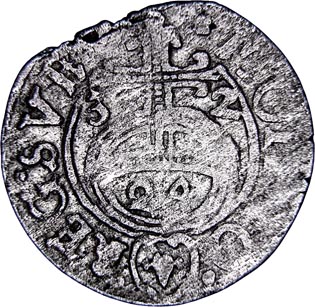 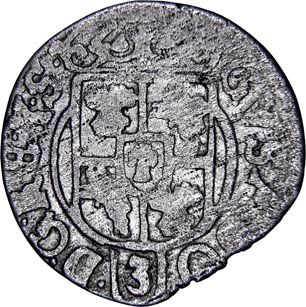 |
|
Valued Member
United Kingdom
477 Posts |
I think I'm going to have to re-think my collection catalogue. I have them numbered, and detailed to an extent. But not properly detailed with historic accounts surrounding the coins lifetime, which is something I want to do. I'm also working on a camera set-up for better photography(I'm taking ages with it), but I won't to store back-up images on U.S.B.'s with details aswell. So I can have a physical reference and a digital reference.
Thank-you for the help, and I'm looking forward to getting my archives started in a more detailed fashion :).
|
| |
Replies: 12 / Views: 6,967 |
|





 Posted 04/04/2014 12:13 pm





