| Author |
 Replies: 9 / Views: 2,105 Replies: 9 / Views: 2,105 |
|
|
Valued Member
United States
134 Posts |
Hello All, Just looking for some input on this 1856 $1 gold. I'm not very 'skilled' in the ways of gold coins, so need some help. Just wondering if this looks like a die clash, or if there is some other explanation for this anomaly on the right reverse. What really has me scratching my head is that it doesn't seem to 'line up' with anything, to me, from the obverse. Side note: This coin has MD all over the reverse details and lettering. Thanks for any feedback. Cheers. 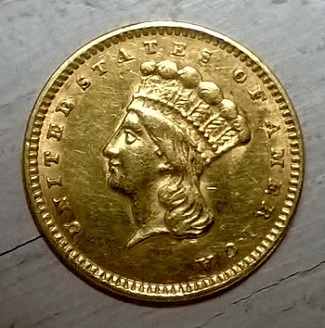 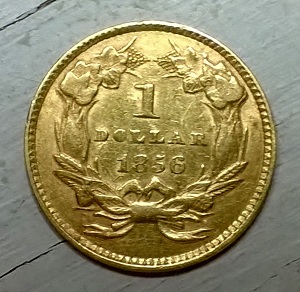 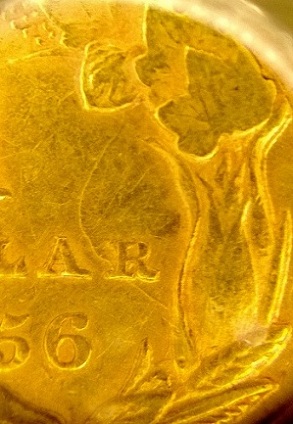 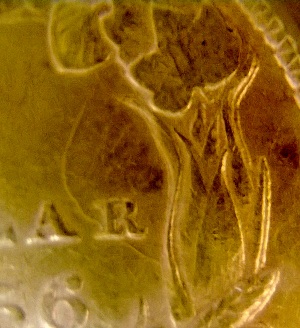 |
|
|
|
Pillar of the Community
743 Posts |
That is cool, I don't see anything on the obv. that would make that clash mark, but maybe the chin? I don't know much about gold sorry I can't help. There has been some discussion in the VAM forum about your 1904-O possible VAM 4B with no pitting. Kris Edited by 7TF
04/08/2014 4:47 pm
|
|
Valued Member
United Kingdom
477 Posts |
I take it the coin orientation of that coin is like modern U.S. coinage, if so that curve at the back of the neck on the obverse would be in the same position as the 'die clash' on the reverse. Maybe the obverse was struck deeper in that part at the back of the neck(curved part), so much so that the reverse reflects the hit? Gold is a very soft metal after all. If you look at the reverse on this coin linked, you can see the same strike mark. I believe it's from the rear of the neck line on the obverse. http://www.pcgscoinfacts.com/Coin/Detail/7540Again on this later dated one the same mark is on the back, it's definitely from the obverse neck line. I can't add this link but there's a 1861 with the exact same mark. I think it was a competitor site, so I won't spell it out. Edited by awallin01
04/08/2014 5:12 pm
|
|
Valued Member
 United States
134 Posts |
Hi Kris, Yeah, I'm completely lost on this one.  It doesn't seem to line up at all. I just thought post and see, as it were. Perhaps a gold guru might come along and say, "Oh, that's because of _____." Fingers crossed.  Steve |
|
Valued Member
United States
134 Posts |
Thanks awallin... that is definitely a good analogy, and terrific suggestion! Cheers!
|
|
Valued Member
United Kingdom
477 Posts |
No problem mate ;), I'll try and find a name for it as that will help answer this. I'm not having much luck with finding the correct terminology, hopefully someone knows the name of this.
Edited by awallin01
04/08/2014 5:20 pm
|
|
Valued Member
United Kingdom
477 Posts |
Quick question does the mark come outwards on the reverse, or inwards? It might be 'clashed dies' if it's inwards, if it goes outwards it a strong strike on the other side-I don't know a name for that. Hopefully someone will put me out of my terminology misery lol.
|
|
Valued Member
United States
134 Posts |
Clarification: Do you mean is it 'raised', or incuse? Is that what you mean by outward and inward?
If that is what you mean, it is raised.
|
|
Valued Member
United Kingdom
477 Posts |
Yeah that's what I meant :), my coin terminology borderlines non-existent. I can't find a correct term for that, but it seems like on the rear neck it was a strong strike on that part. Surely there's a term for that, but that's what I think it is.
|
|
Bedrock of the Community
United States
17884 Posts |
Not sure why you folks don't think it lines up. To my eye the curving line from the wreath through the R and back to the wreath matches up perfectly with the curve of the back of Liberty's neck up along the back edge of the headdress.
A clashmark is created when the dies come together and it tends to show the edges where the field meets the devices. Now when the dies hit it is the fields that hit and the result on the damaged die is the same as it would be on a planchet. the area when the field hits is slightly depressed and the area where the devices are remains higher as if it was trying to fill the device void. (But since the die steel is much harder than a planchet the height difference is very slight.) So on the die the area from the line toward the center of the die is slightly higher than from the line toward the wreath. When this damaged die hits the planchet the higher field toward the center hits the planchet first and on the coin as you go from the center of the coin toward the rim the field will be slightly LOWER on the center side of the line and higher on the rim side so it will seem to be raised as you cross the line.
|
| |
Replies: 9 / Views: 2,105 |
|








 Posted 04/08/2014 4:59 pm


