Coin Community Family of Web Sites Join Thousands of Coin, Bullion, & Money Collectors
Join Thousands of Coin, Bullion, & Money Collectors Specializing in Modern Numismatics Royal Canadian Mint products, Canadian, Polish, American, and world coins and banknotes. Royal Estate Auctions - $1 Coin AuctionsVancouvers #1 Coin and Paper Money Dealer 300,000 items to help build your collection! Coin, Banknote and Medal Collectors's Online Mall


Username:
Password:
Save Password
Forgot your Password?


This page may contain links that result in small commissions to keep this free site up and running.

Welcome Guest! Registering and/or logging in will remove the anchor (bottom) ads. It's Free!

Fake Error 5p ?

To participate in the forum you must log in or register.
Author Previous TopicReplies: 8 / Views: 5,179Next Topic  
Pillar of the Community
Anaximander's Avatar
United Kingdom
709 Posts
 Posted 05/29/2014  10:21 am Show Profile   Bookmark this topic Add Anaximander to your friends list Get a Link to this Message Number of Subscribers
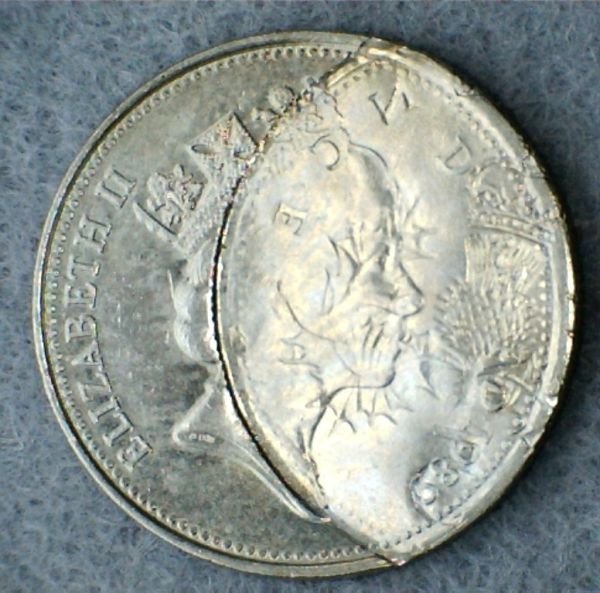
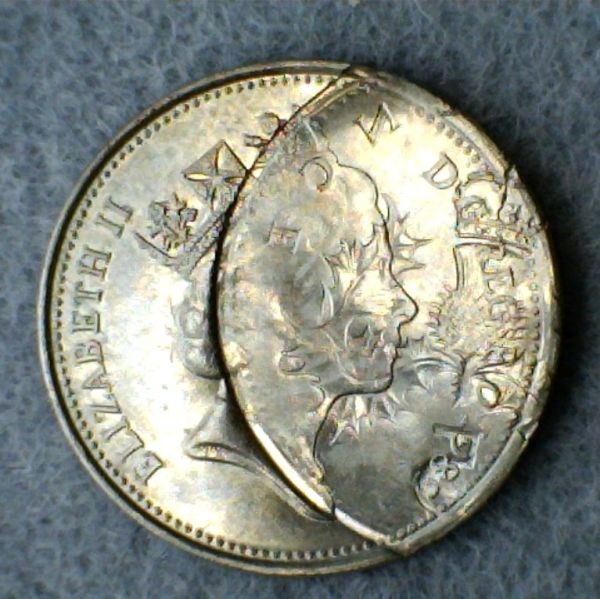
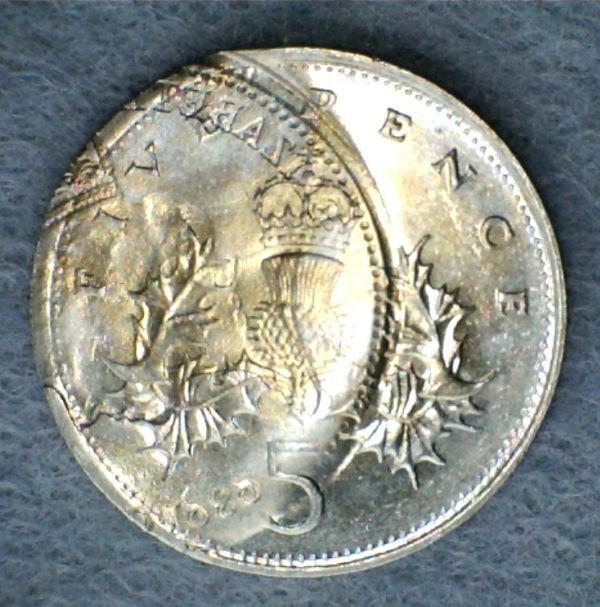
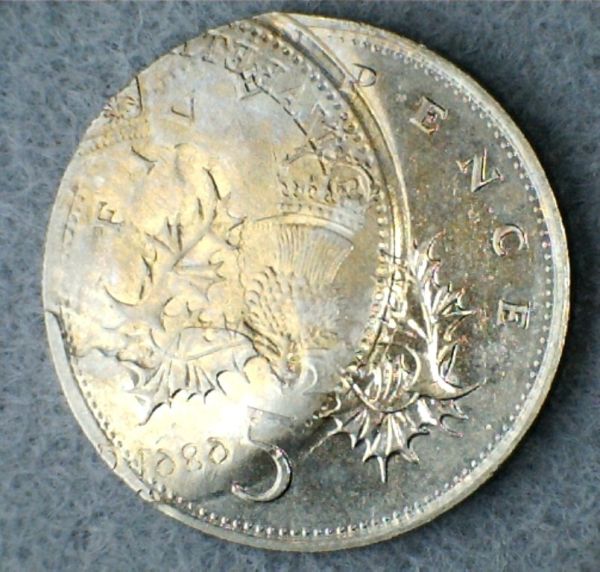
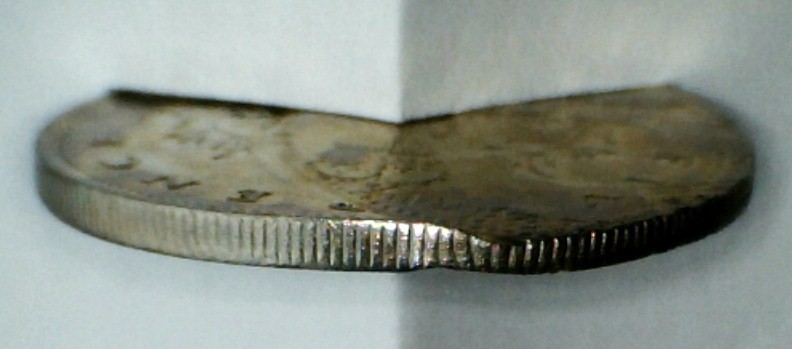
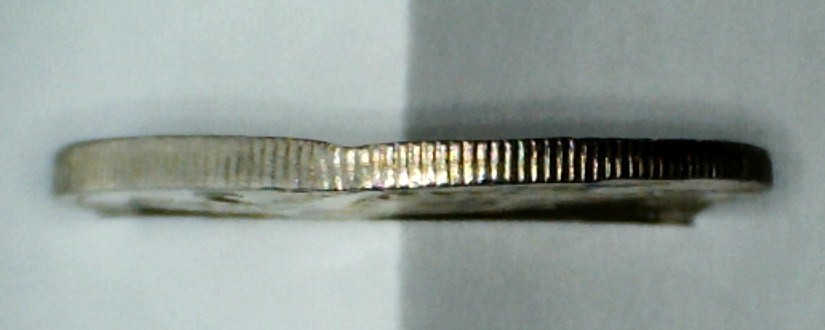
I have a small collection of UK decimal error coins which I use to help me learn about the mint process. Recently I read of bogus error coins being made by wedging one between two others and clamping it in a vice. I now strongly suspect some of my collection are imposters!

Have a look at this 1989 5p. Any comments on its pedigree?

Obverse:

Fake-Error-5p-?

Fake-Error-5p-?

Reverse:

Fake-Error-5p-?

Fake-Error-5p-?

Edge from above Queen's head:

Fake-Error-5p-?

Edge from below Queens head:

Fake-Error-5p-?

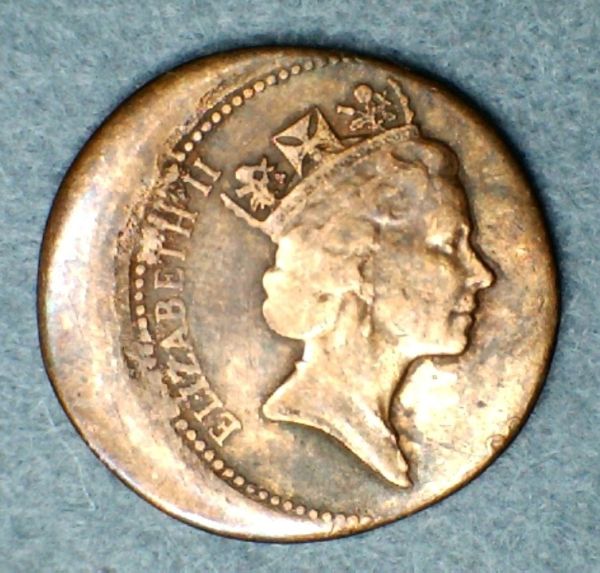
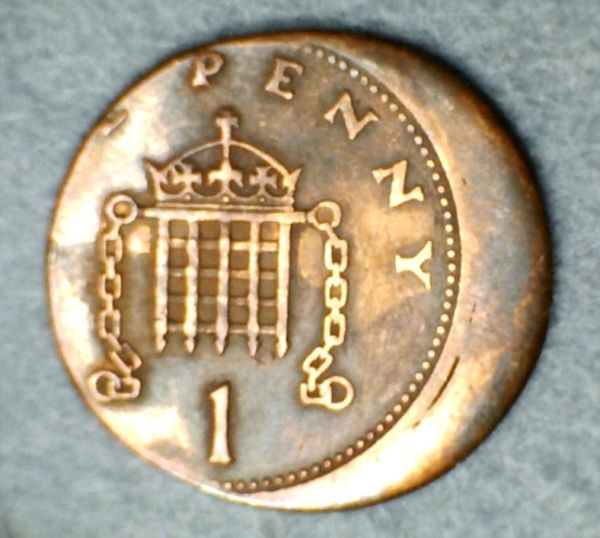
And finally, two views of a broadstrike(?) penny, just because I like them...

Fake-Error-5p-?

Fake-Error-5p-?
Pillar of the Community
nalaberong's Avatar
Canada
2805 Posts
 Posted 05/29/2014  10:52 am  Show Profile   Bookmark this reply Add nalaberong to your friends list Get a Link to this Reply
Yes, #1 is a garage job. Most errors should NOT be bent.

But the penny looks awesome, was it a circulation find?
Moderator
Learn More...
Sap's Avatar
Australia
16859 Posts
 Posted 05/29/2014  11:06 am  Show Profile   Bookmark this reply Add Sap to your friends list Get a Link to this Reply
The 5p is definitely a "vise job" - or "vise job", depending on which version of English you're speaking. The doubling is mirror-reversed, and incuse - typical giveaway for a bogus error. It can, of course, be an "accidental" object - if three coins were placed under something heavy for a long time, for example, you'd get the same effect. But either way, it's not a mint error - it's PMD.

The 1p looks like a legitimate off-centre broadstrike to me.
Don't say "infinitely" when you mean "very"; otherwise, you'll have no word left when you want to talk about something really infinite. - C. S. Lewis

Pillar of the Community
Anaximander's Avatar
United Kingdom
709 Posts
 Posted 05/29/2014  1:05 pm  Show Profile   Bookmark this reply Add Anaximander to your friends list Get a Link to this Reply
Thank you for the prompt response.

As I learn more about the minting process these things become clearer. For the 5p to have been genuine,(which it isn't), two other coins would have to have become stuck in the press, one at the top and one at the bottom. I now realise that such an event just would not happen. Experience comes at a price....


Talking of which, have a look at this.

http://www.ebay.co.uk/itm/1997-2-Tw...em3f36b90e72

... a UK £2 coin with the Queen's head on the wrong side!! You can even see part of a row of double dots by the F D.

The design on a £2 coin is pressed after the two parts have been assembled. So how could part of the design from one die swap sides with the same part from the other die? Hmmmmmm.....

And no, I have not bought one of these. Even though I am still a novice, I have learned enough to avoid that one.

What other bogus errors are out there? Does anyone have any useful tips?
Pillar of the Community
nalaberong's Avatar
Canada
2805 Posts
 Posted 05/29/2014  5:37 pm  Show Profile   Bookmark this reply Add nalaberong to your friends list Get a Link to this Reply
Remember that bimetallic coins are struck by one die, so there is zero possibility of the core being struck with the opposite die that the ring was struck by. Some people don't know how the process works so the bidding for an item like you posted goes up far beyond two pounds... bad news for them.
Valued Member
Moralclimate's Avatar
United Kingdom
188 Posts
 Posted 05/29/2014  5:47 pm  Show Profile   Bookmark this reply Add Moralclimate to your friends list Get a Link to this Reply
Surely they are struck by two dies, one on each side?

Is it only 1997 dated £2 that can be tampered with like this?
Moderator
Learn More...
Sap's Avatar
Australia
16859 Posts
 Posted 05/29/2014  7:26 pm  Show Profile   Bookmark this reply Add Sap to your friends list Get a Link to this Reply
Any bimetallic coin can have its core flipped. It's surprisingly common to find Canadian $2 coins that have been core-flipped.

A bimetallic coin is made of two separate pieces of metal. Different metals react differently to temperature, expanding and contracting at different rates. So exposing the coin to either extreme heat or extreme cold (which one works depends on the properties of the two metals in question) can loosen the core enough to allow it to simply pop out. Then you can put it back in backwards, upside-down, sideways or whatever. As with many "fake errors", it's even entirely possible that such things are made "accidentally", by someone whose coin fell apart on them and they reassembled it without paying any attention to which way around it "should" have been. The coin gets spent and the next person to pay attention to it "discovers" what they assume to be some kind of error coin.

Quote:
What other bogus errors are out there? Does anyone have any useful tips?

The most useful tip is, of course, what you have already discovered: to become familiar with how coins are actually made, so that you can look at a coin with an "error" and fail to imagine any possible way the coinage process can go wrong in such a way as to produce that error.

For example: one-sided coins are a common "fake error". But a coin is made by pressing a blank piece of metal in between two coin dies. A genuine "one-sided error", where one side is perfectly normal and the other side is perfectly smooth and flat, is as logically impossible to create in the mint as the sound of one hand clapping. To create a genuine one, someone in the mint would have had to deliberately create a blank die, specifically to create a one-sided coin. This usually only happens for experimental patterns and trial pieces. Now, there are things that can fall in between a die and a planchet that you might think could create a "one-sided coin", but they tend to create other kinds of errors - a brockage, for example, is made when a coin fails to eject, gets stuck in the die and the next coin is struck with the first coin still stuck in the die. Or, if two blanks fall into the press at the same time, one on top of each other - this creates two "one-sided coins" of a sort, but because there's twice as much metal between the dies as there's supposed to be, the surplus metal tends to squirt out all over the place and the resultant coins look entirely unlike a fake "one sided coin", which is usually made simply by grinding down one side of a perfectly normal coin with a grinder of some kind.

Likewise, "two-headed coins" are rare and valuable errors when genuine, but are commonly and fairly easily faked. Making one in the mint is nearly impossible because the dies used for obverses and reverses for coins are usually not interchangeable; they deliberately make them from differently shaped pieces of metal to fit into different shaped slots in the press; the square peg on the obverse die won't fit into the round hole of the reverse die-slot on the press. They do this specifically to make it difficult for an inattentive mint worker to accidentally put the wrong side in the wrong place. Most fake double-sided errors are " Magician's coins", trick coins made so a coin-tosser can call heads and win every time; these are made by taking two perfectly normal coins, grinding one coin down until it's just a thin one-sided disc and grinding out a shallow bowl-shaped hole into the other side of the second coin just big enough to accept the disc. The tell-tale to look for is the gap between the disc and the bowl, often carefully hidden inside the rim on one side.
Don't say "infinitely" when you mean "very"; otherwise, you'll have no word left when you want to talk about something really infinite. - C. S. Lewis

Valued Member
Moralclimate's Avatar
United Kingdom
188 Posts
 Posted 06/01/2014  7:15 pm  Show Profile   Bookmark this reply Add Moralclimate to your friends list Get a Link to this Reply
I've seen it claimed both about UK £2 and Canadian $2 ('toonies') that only those from the first year or so of production had cores that separated easily if the coin was frozen. There are simple ways they can produce the coins so that the core and ring interlock, described well here: http://www.fleur-de-coin.com/articles/bi-metallic. The Canadian Mint says its process is patent. Whether such methods are proof against heating up the ring while chilling the core, I don't know.

Some "bimetallic" coins are in fact made of three metals; as the above article also notes, the cores of €1 and €2 coins are made of an alloy/nickel/alloy sandwich. Maybe this is more about saving money on metals? I understand that the largest ever Euro coin faking operation involved a syndicate who obtained cores and rings of decommissioned Euro coins sent to China as scrap metal, reassembled them and smuggled them back to Europe: http://www.dailymail.co.uk/news/art...ry-ring.html . It somewhat beggars belief that the components had been sold without at least giving the rings a good wrecking first.
Pillar of the Community
Anaximander's Avatar
United Kingdom
709 Posts
 Posted 06/03/2014  11:13 pm  Show Profile   Bookmark this reply Add Anaximander to your friends list Get a Link to this Reply
Thank you for the above. I read those articles with interest.

http://24carat.co.uk/frame.php?url=...nttrial.html

Try this link for an interesting article on a trial £2 coin dated 1994.
  Previous TopicReplies: 8 / Views: 5,179Next Topic  

To participate in the forum you must log in or register.


Disclaimer: While a tremendous amount of effort goes into ensuring the accuracy of the information contained in this site, Coin Community assumes no liability for errors. Copyright 2005 - 2026 Coin Community Family- all rights reserved worldwide. Use of any images or content on this website without prior written permission of Coin Community or the original lender is strictly prohibited.
Contact Us  |  Advertise Here  |  Privacy Policy / Terms of Use

Coin Community Forum © 2005 - 2026 Coin Community Forums
It took 0.39 seconds to rattle this change. Forums