| Author |
 Replies: 70 / Views: 8,911 Replies: 70 / Views: 8,911 |
|
|
|
Valued Member
 Australia
117 Posts |
Very interesting discussion. All three coins were graded MS63RB. The first two were, of course, graded by NGC and the 1952 penny was graded by PCGS. I'm interested in these coins because I'm trying to get to the heart of what is involved - or perceived to be involved - in coin grading. In my opinion, the 1952 penny is not in a 'mint state.' Whether or not a coin is determined to be in a mint state depends on what is perceived to be wear and what will be seen by others as due to a weak strike. I'm not convinced this can be determined objectively, but I'm open to persuasion. I am also trying to learn the hard lesson that how beautiful a coin is has nothing to do with its grade. The 1938 penny looks perfectly horrible to me! Surely, the discolouration is not just due to toning, but some kind of damage to the surface of the coin. I'm just going on the images, though, as I don't own that one. (I own the other, the 1949.) But if I'm right, surely it doesn't quality as a mint state coin.
|
|
Valued Member
Australia
315 Posts |
So you believe that the 1952 is as good of quality as the top two coins, If it was going to get a MS grade, it definitely shouldn't be 63, look at the marks on it compared to the other two. Wow and it got RB, must have been high as a kite that day.
Edited by coinsaus
06/27/2014 02:24 am
|
|
Valued Member
Australia
117 Posts |
coinaus, I don't believe that the 1952 deserves an MS grade, but then again you might have been directing this question to wwwww, who apparently does. I'm trying to grasp this point of view at the moment, but haven't yet accepted it.
Edited by jimjamtwo
06/27/2014 02:26 am
|
|
Valued Member
Australia
315 Posts |
Sorry Jim, this was directed at wwwww with that comment. Do you have a pic of the other side?
|
|
Valued Member
Australia
117 Posts |
No, I don't. I forgot to grab one when I came across this coin online yesterday. The reason was that I wanted to focus on the kangaroo in particular.
|
|
Valued Member
Australia
117 Posts |
Here's a close up of the kangaroo. 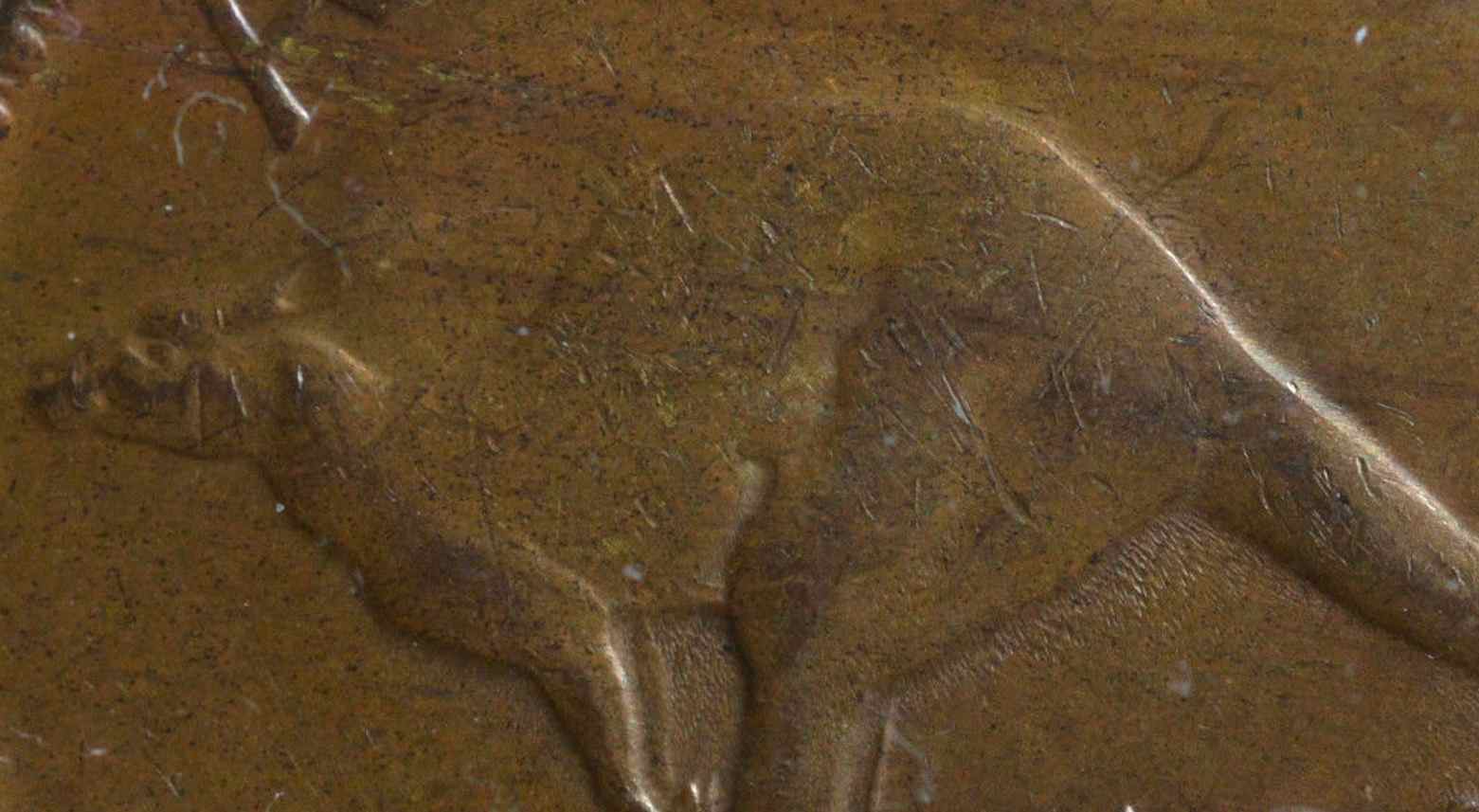 |
|
Valued Member
Australia
315 Posts |
Look at all the marks down the kangaroo's leg and the head, not even close to the league of the other two. Also I would be a little concerned about the top left coin as the top of the kings ear look incredibly weak, could even be wear with the lustre hiding it.
|
|
Valued Member
Australia
117 Posts |
Is it possible for a coin to look as battered as this one and still not be suffering from any wear? I don't see how it could, but then again I'm here to be educated!
Edited by jimjamtwo
06/27/2014 02:33 am
|
|
Valued Member
Australia
315 Posts |
I reckon the owner got very lucky with the grading but I'd hate to be the purchaser and then try to sell it again  |
|
Valued Member
Australia
117 Posts |
Someone wrote above, 'The third coin is Nowhere near being a Mint State coin, APCGS?'
Well, no, PCGS.
I'm finding APCGS rigidly adhering to the Sheldon scale - at least when it comes to my coins - so I was surprised to read this.
|
|
Pillar of the Community
Australia
7096 Posts |
The third coin IS a "Soft strike" but there is obvious wear on the high points of the Kangaroo , Hip shoulder tail and there are many more dings and scrapes than the first two coins. I think PCGS "Dropped the Ball" on this one. Defiantly not MS in my eyes and I would most certainly NOT pay MS money for that horror  |
|
Pillar of the Community
Australia
541 Posts |
Differentiating between a weak strike and wear isn't a subjective thing. Either a point has wear on it or it doesn't. For any coin we can look at it through a high powered microscope to determine if a point has wear, this isn't practical so coin collectors developed ways of estimating the level of wear a coin has. For high grade coins we rely on the reflectivity of a coin to grade it. When a coin is struck, the pressure is released through little grooves on the surface of the coin, this in turn affects how light reflects off the coin in what is called lustre. When a coin is worn, light reflects differently off the worn point. This variance in reflectivity is how we detect wear in high grade coins. In lower grade coins this method is ineffective as most of the coin's surface has wear. At the low AU or high XF levels we can do a comparison between the protected surfaces and the exposed surfaces to get a good indication of its grade but for lower grade coins we rely on detail. Quote:
So you believe that the 1952 is as good of quality as the top two coins, If it was going to get a MS grade, it definitely shouldn't be 63, look at the marks on it compared to the other two. Wow and it got RB, must have been high as a kite that day. From the photos, the 1949 looks like a higher grade coin. Since it was graded 63, I suspect there are surface hairlines which aren't visible in the photo. The 1938 has a lot of spotting which would preclude a 64 grading. The 1952 has carbon streaking and a number of bagmarks outside of the focal points which preclude a 64 grading. |
|
Valued Member
Australia
315 Posts |
 Trout, and RB, where's the red? Quote:
I'm finding APCGS rigidly adhering to the Sheldon scale - at least when it comes to my coins - so I was surprised to read this. So I'm guessing you have used APCGS? How is the grading as I have read numerous times that people on here think they overgrade. I am thinking of giving them a try but still in two minds. |
|
Valued Member
Australia
315 Posts |
Hi wwwwww, do you agree with the RB rating?
|
|
Pillar of the Community
Australia
7096 Posts |
Quote:
So I'm guessing you have used APCGS? How is the grading as I have read numerous times that people on here think they overgrade. I am thinking of giving them a try but still in two minds. NO way would I use APCGS , after their initial MS40 type grades and the way they overgrade and ignore cleaned and damaged coins. I'll stick with NGC and PCGS thank you, They may not be perfect but they are hip and shoulders over APCGS  |
| |
Replies: 70 / Views: 8,911 |






 First Page


 Posted 06/27/2014 02:20 am


