|
This page may contain links that result in small commissions to keep this free site up and running.

Welcome Guest! Registering and/or logging in will remove the anchor (bottom) ads. It's Free!
To participate in the forum you must log in or register. | Author |
 Replies: 19 / Views: 8,250 Replies: 19 / Views: 8,250 |
|
Pillar of the Community
Australia
1041 Posts |
hi all i have seen this banknote for sale a test or trial from the first polymer any thought on it a its rarity and its value I have found a picture of david Solomon who invent hold one like it any help would be great and I would realy like to buy it 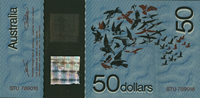 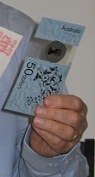 |
|
|
|
Pillar of the Community
Australia
908 Posts |
Have you bought this one already Shane?
|
|
Pillar of the Community
 Australia
1041 Posts |
no but will do the deal in the morning if any good
|
|
Pillar of the Community
Australia
1041 Posts |
it fits my interesting collection area
I think any way
you guys will tell me like normal
|
|
Pillar of the Community
Australia
1041 Posts |
what has happened are you all stumped or is this nothing
|
|
Valued Member
Australia
193 Posts |
I am no expert on these but that particular one is from the 1970's and is one of the earliest prototypes of polymer.
Just from that historical position, it should therefore carry some premium but just how much it is worth I can't guess.
The silver optical laser device, showing in the clear strip, was a major initiative to combat counterfeiting. It seems today we use other techniques on our polymers to make it hard for counterfeiters.
|
|
Valued Member
Australia
75 Posts |
Those "notes" were polymer trial pieces. They were all supposed to have been destroyed.
Any surviving pieces most likely would be considered stolen property and liable to seizure by the federal police.
Purchasing that "banknote" is inadvisable. If you have already done so and cannot return the "note", for you own protection I suggest you ask admin to remove this thread.
Edited by agent86
07/23/2014 5:13 pm
|
|
Valued Member
Australia
121 Posts |
Now I want one of those, agent86!
|
|
New Member
Australia
32 Posts |
shane I found this listing in the polymer bank notes of the world. So I wouldn't worry to much about them that have been sold before 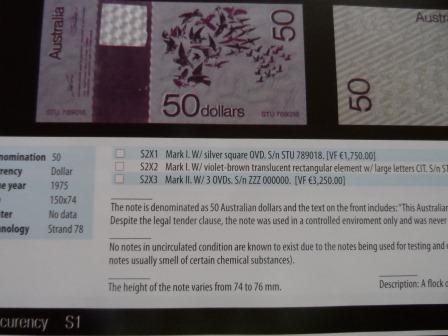 |
|
Valued Member
Australia
193 Posts |
Good find cheri. Very expensive by the look of it. I wonder how many of those particular ones were made?
|
|
New Member
Australia
32 Posts |
I did find this good reading and also all the notes still stored at fisherman bend with all the items and all the employees and printers took some home
1967: May - $10 forgeries appeared. The Reserve Bank of Australia (RBA) was concerned about the imminent release of colour photocopiers.1968: April - Cooperation between CSIRO and Note Issue Department (NID) of the RBA for a new type of banknote began, with a meeting between CSIRO and RBA executive officers in Melbourne.: Thredbo "Think-In" was attended by CSIRO scientists, RBA administrative and technical officers, and university scientists. The scientists present were mainly physicists, with two chemists, Dr Sefton D. Hamann, then Chief of the CSIRO Division of Applied Chemistry, and Dr David H. Solomon. The aim was "to produce a more secure form of note" to combat forgeries, particularly by photographic means. It was recommended that CSIRO undertake development of new cellulosic and synthetic papers in collaboration with the NID. Initially the Bank sponsored work at CSIRO directed toward the production of new types of papers from natural fibres, with early development concentrating on distinctive materials. In failing to obtain a sufficiently distinctive substrate, the emphasis shifted to producing paper-like substrates with plastic materials.1969-1970: RBA grant of $11,000 was made to CSIRO Division of Forest Products for experimental production of distinctive papers.1972: Optically variable devices (OVDs) in plastic note were proposed by Dr Solomon and Dr Hamann. Dr Hamann worked on OVDs exploiting optical physics, while Dr Solomon worked on chemically based OVDs. The use of diffraction gratings as a security device followed a suggestion by Dr. Bowen, the ex-Chief of CSIRO Radiophysics, that was taken up by Dr Hamann. Dr Hamann suggested using modified rulings that yielded a diffraction pattern markedly different to any commercially available gratings. The security afforded by gratings stemmed from their resistance to reproduction by photographic and print methods.: July - A two year development agreement was concluded. RBA provided a grant of $23,000. Rising confidence in the project led CSIRO to make a major commitment to it, over and above grants by the Bank, in the following years. The six stages in the research and development of the new banknote and the five stages of the parallel Machine Readable Feature (MRF) Project received RBA funding totalling approximately $1.5 million from 1972 to 1987, to CSIRO's Division of Applied (Organic) Chemistry.1973: 5 March - RBA reported that degradation tests of plastic samples compared favourably with those of paper banknotes. Progress report gave details of work on the production of montage diffraction gratings, the embossing of banknotes to give a paper feel, moire patterns, investigations of liquid crystals, and comparisons of plastic substrate in single sheets to laminate.: September - Joint CSIRO/RBA patent application, entitled "Improvements in or related to security tokens", was filed. New CSIRO-RBA agreement was made, with RBA agreeing to provide an additional $60,000 for a further two years. Support staff and equipment were obtained.: October - Polymer/Tissue/Polymer laminate was developed using various clear fillings. 1974: Project was now centred on the CSIRO Division of Applied Organic Chemistry. Drs Solomon and Hamann were joined by other CSIRO researchers investigating the possibility of an all-plastic note and possible security features. Several important aspects of the project had emerged: the use of laminated plastic substrate; embossing to give a paper-like feel; and the use of various OVDs, including diffraction gratings and moires. Other OVDs considered were thin metal films, liquid crystals and holograms. A number of different laminates were produced. With the technique of lamination used to combine materials, synthetic paper substrates were produced with reinforcing mesh/fabric between the layers. These centre laminates were code-named Strand 75. The all-plastic laminate eventually chosen for further work was code-named Strand 78 - the year it was hoped to have the new notes in circulation. Strand 78 was developed as a clear, biaxially-oriented polypropylene laminate, in which OVDs could be inserted without the necessity of punching holes. Laminates with tissue inserts were unacceptably limp and tended to stick together.: The feasibility of production on a pilot scale was investigated. $39,700 was granted by CSIRO Executive to enable development to be brought to a decision point.: April - Cooperation took place with ACI (Regis) and Union Carbide.: August - Reports gave details of progress on the pilot scale laminator, randomly spaced moire devices, the development of liquid crystals (later dropped), and anticipated mass production methods and equipment. The joint RBA-CSIRO CNRD Committee was re-constituted with the project moving into its developmental phase. Now designated the Currency Note Research and Development Project (CNRD), the research effort increased appreciably following a CSIRO-RBA agreement on project objectives. Dr David Solomon, Chief of the Division of Applied Organic Chemistry, now led CSIRO research on the project. The project's objectives were clarified to encompass four main elements: a polymer-based substrate, with laminated film and coatings; imaging with intaglio, tints and numbering; primary security (OVDs), for the man in the street; and, secondary security (MRF), for authentication in high speed sorting. A pilot plant was built at Fishermens Bend. A total of 57 man years were devoted to the project during the next six years.: September - Diffraction grating submasters were produced. Mark 1 banknote production was to be designed and tested.1975: June - The first contract employees (non-CSIRO) commenced in early 1975, followed by Project Leader, G.P. Wischer. Several additional CSIRO research staff were appointed, making a total of 14 employed on the CNRD project in the 1975-76 period. With Jack B. Ross as Project Supervisor, CSIRO staff working on the project in this period included Dr Geoff Hawthorne, Bob Brett, Max Linton, Bryan Loft, Dr Jonathan Hodgkin, Jean Swift, Dr Tom Spurling, and Ian Marwick. Dr Robert Lee joined the CNRD project on the 3 March 1975, along with Dr. Mario Girolamo. Dr. Girolamo was appointed to work on the plastic technology. Dr Lee researched the use of OVDs in banknotes following the work of Dr Hamann, at the Division of Applied Organic Chemistry until July 1979, when he transferred to the Division of Chemical Physics at Clayton. Dr. Lee was directly employed by the CNRD project until 1977, prior to joining CSIRO.: July - Reports gave details of progress in a number of areas including: continuous diffraction grating replication and the cooperation of Weapons Research Lab/Establishment (S.A.) and Footscray Ammunition Factory; production of reinforced laminate with 14" laminator and extrusion coating of fabric; tests developed to assess note material and subjective properties of notes; and a hot-stamping technique for OVD insertion. It was further reported that: the RBA had been given responsibility for laminate production and testing, as well as printing and inks; Strand 75 was to be produced with a clear window as a security device; Strand 77 was to be produced with a thermochromic or photochromic security device and grating; Strand 78 was to include a moire; laboratory testing had begun; and a plan had been proposed to renovate Bayfords building for pilot production.1976: January - A report recommended that the RBA take responsibility for further development and production aspects of Strand 78, as well as printing, cutting, quality control and physical and mechanical testing. Other topics reported on included: the ability of polyurethane lacquer to increase scuff resistance; the possibility of gratings production via electron beam lithography; investigations of holograms, birefringence, double refraction and polarising films; problems noted with RBA Chambon press printing and sheeting with Strand 75, clear polypropylene being better. It was also recommended that the RBA employ more staff to support G. P. Wisher and K. Clark.: June - It was agreed that sheet/web operation was only a stop-gap solution with web feed the final intention.: August - It was agreed that the RBA should consider the problems of scaling up, while CSIRO still continued to research alternatives.: September - Design freeze for Mark 1 note agreed upon. The development of Strand 75 mesh-reinforced laminates was to cease in favour of oriented polypropylene with high fold resistance and tear strength. A clear laminate blanked by gravure printing was to provide the background for text printing. There would be a clear area for an OVD, offset printing and letterpress numbering, and modulated line spacing for gratings, with the "butterfly" pattern selected for recognisability. The hot-stamp grating transfer process was to be developed, along with techniques for reproducing zone plate moire onto foil, including fine line printing, photography, electrography and dye transfer. Photochromic inks were to be researched, but liquid crystal OVDs were discarded due to common commercial availability. With the design freeze, many options currently being worked on were put on hold. The aim was to minimise unknown factors. Various types of OVDs, inside printing of the laminate and the incorporation of security devices within a fully encapsulated laminate, were put aside. The latter two options depended on web feed production and had the potential to greatly enhance note life. In a compromise, continuous web feed was downgraded to sheet feed for trial print run and subsequent production.: December - Pilot note production commenced. Several hundred notes were produced in the following months, with all "design freeze" elements. Ther were problems with OVD insertion and adhesion onto Strand 78 M, with gratings also lacking brilliance.1977: July - Reports gave details of progress in areas including: the use of "Shorko" polypropylene films as replacement for ICI films; the intitiation of UV ink research; the acquisition of a Tampoprint machine and the investigation of fine-line metal plate printing; the incorporation of a spectroscopic label in transfer tape.: November - Reports gave information on: the durability of UV inks; the obtaining of good Tampoprint reflection moires; coating, embossing and "Turbula" testing; the evaluation of the JEOL electron beam machine as the most satisfactory of those tested; visits to ICI and British Cellophane regarding Propaphane films, coatings and inks.: November - The Assessment Panel met. CNRD notes had been subjected to preliminary tests designed to evaluate strength, resistance to wear, handling and counting properties. Initial reactions had been favourable. The beginning of the full testing process with the Panel supported this view. However, two significant shortcomings were noted - fold and recovery characteristics were viewed as inferior to paper notes. Strength of CNRD note was superior when new, less so when the perimeter was nicked. The toppan grating was favoured for its greater brilliance, while moires were not highly rated on the grounds of recognisability, nor were photochromic inks because of their short life. It was also noted that gratings and moires were vulnerable to crumpling. For this reason, gratings composed of small tesserae were developed, in preference to large unified images, a principle applied to moires as well. 1978: March - Extended range of note test methods approved by CNRD Committee. The Assessment Panel had noted that evaluation of preliminary test samples was made difficult by overtesting i.e. testing beyond a condition suitable for normal use. A comprehensive test program designed to closely simulate the critical environmental elements leading to deterioration of notes in normal use was thus developed.: June - Report on revised test methods and results commented on the feasibility of producing unique EBX tessellated gratings. It further reported that: the moire had been improved but its recognisability and durability was doubtful; and the durability of photochromics was limited.: 24-27 July - Tangalooma Conference.1979: Report describes the CNRD Committee's opinion that the production process was practical, that the CNRD notes offered an acceptable improvement in security over conventional notes, that the CNRD note handled satisfactorily, and that the endurance of the tessellated OVDs was satisfactory.: August - Forward Planning Committee under Professor Fink made its recommendations.1980: April - RBA Governor expressed the possibility that the RBA might buy-out CSIRO's interest in CNRD.: May - It was decided to purchase EBX machine.: June - Drs Solomon and Girolamo, and Mr J.B. Ross were transferred to Bayfords for 12 months.: August - Gravure machine requirements and a 10,000 sheet trial program were discussed. Mr E. Peacock (CMPS) was appointed as Project Consultant.: 22 September - Agreement of rights was signed by CSIRO and RBA. Essential elements of the agreement were that the technology was to be a joint property, with the RBA free to produce Australian currency notes. The technology was to be kept confidential, with overseas currency and non-currency uses to be negotiated only if agreed to by both parties. The profits from overseas marketing were to be shared equally. If the RBA had not used a substantial part of the technology within Australia by 1984, the rights would revert to CSIRO. CSIRO was to reimburse the RBA for its costs from the proceeds of marketing the technology. CSIRO began to push export potential of the technology, while the RBA was concerned with currency note security. Although it planned to exchange the CNRD technology in the Four Nations Group (US, UK, Canada), the RBA felt that other avenues of exploitation would jeopardise the security of the new notes.: Technology transfer from CSIRO to RBA begins. CSIRO involvement was limited to assisting in the solution of problems relating to transferring the technology from the pilot plant to a production plant.1981: Papers outlining a theory for generalised curvilinear gratings by Dr R. A. Lee were cleared by the RBA. The value of Dr Lee's theory was that diffraction patterns could be determined with high speed, with a systematic design procedure that takes into account the effects of crinkling and light source variation. Originally written in the 1976-1979 period and submitted for clearance prior to Dr Lee's transfer to the Division of Chemical Physics in 1979, they were published in Optica Acta in 1983.: EBX system delivered to the RBA Note Printing Branch (NPB). The development of the oblique line-scanning EBX system by Mr Graham Quint and Mr Alan Wilson, was a major advance in the field of electron beam technology. The system allowed fine-scale, exotic diffraction structures and new possibilities in the area of integrated optics and micro-electronics.1982: April - Dr J.H. Hodgkin was seconded for 12 months from the Division of Applied Organic Chemistry to the RBA-NPB Craigieburn. : November - J.B. Ross was seconded for 12 months to RBA-NPB Craigieburn. Alan Wilson was also on secondment to the RBA around this period, later resigning from CSIRO in 1985 to become an independent consultant to the Bank. The CNRD Project was now largely taken over by the RBA, with the number of CSIRO CNRD staff reduced to three, from a peak of 17 in 1977-78.1984: It was agreed that CSIRO should not "foreclose", that the RBA had "used a substantial part of the CNRD technology in Australia". It was suggested that negotiations on a new agreement commence. 1987: December - A new CSIRO-RBA agreement was signed, with all rights to the CNRD technology, apart from CATPIX II, to be sold to the RBA. Security of the currency continues to restrain commercial use of most of the CNRD technology.1988: 27 January - Public issue of the plastic AB series $10 note began. After correcting some initial production problems, the improved AA series of commemorative notes was issued.Much of the information for this historical summary came from CNRD Project review literature contained within the collection itself. See INDEX: CNRD Project History and CNRD Reports.
|
|
Valued Member
Australia
75 Posts |
Quote:
shane I found this listing in the polymer bank notes of the world. So I wouldn't worry to much about them that have been sold before
Thanks cheri. That is all interesting. Can you please give the reference as it is hard work reading your pasted text? I saw some of these "test notes" years ago. I was advised at the time to keep well away from them, which is why I suggested shanew avoid them. If some have been publically sold without any problem, then of course there is a precedent. |
|
New Member
Australia
32 Posts |
|
|
Pillar of the Community
Australia
1041 Posts |
well there not that rare at all these were at edlins coin auctions today missed a few dam it here is the link http://www.edlins.com.au/200/p/Inte...Page129.html 1941 1980s Note Printing Australia $50 turquoise, brown & black polymer trial note, featuring 2 different OVD security devices, flock of birds design, S/N ZZZ000000, roughly cut along bottom, very early trial of polymer note 40000 technology, inclds original letter from Reserve Bank Governor RA Johnston - see photo 1942 1980s Note Printing Australia $50 blue, brown & black polymer trial note, this variant has no OVD in the clear panel, 3 grey dots near the 50 identify this variant, S/N 10000 STU789018, crease through clear panel - see photo 1943 1980s Note Printing Australia $50 blue, brown & black polymer trial note, this variant has no OVD in the clear panel, 3 red dots near the 50 & pen mark 'B' identify this 10000 variant, S/N STU789018 - see photo 1944 1980s Note Printing Australia $50 blue, brown & black polymer trial note, no OVD security device, flock of birds design, brown colour stage very light also included 10000 yellow plain trial note with clear panel, S/N of first STU789018 (2) First Previous Next Last |
|
Valued Member
Australia
193 Posts |
Given your research now, what is the estimation or sale price, for that $50 note you first posted.
|
|
Pillar of the Community
Australia
1041 Posts |
20 to 30k for type 1 and 9k to 12k type 2
|
| |
Replies: 19 / Views: 8,250 |
To participate in the forum you must log in or register.
Disclaimer: While a tremendous amount of effort goes into ensuring the accuracy of the information contained in this site, Coin Community assumes no liability for errors. Copyright 2005 - 2026 Coin Community Family- all rights reserved worldwide. Use of any images or content on this website without prior written permission of Coin Community or the original lender is strictly prohibited.
Contact Us | Advertise Here | Privacy Policy / Terms of Use
|
| Coin Community Forum |
© 2005 - 2026 Coin Community Forums |
| It took 0.46 seconds to rattle this change. |
 |
|
| |
| |







 Posted 07/22/2014 07:17 am


