| Author |
 Replies: 7 / Views: 4,093 Replies: 7 / Views: 4,093 |
|
|
Pillar of the Community
United Kingdom
837 Posts |
Amongst the hoards of the 2012 5p coins out there there is a tiny percentage that have a passing resemblance to proofs ( as seen on the 5p on the left) i.e. the Queens portrait has an almost frosted look and their shiny surface around the portrait is slightly different to that of regular 2012 5p coins you are most likely to encounter. 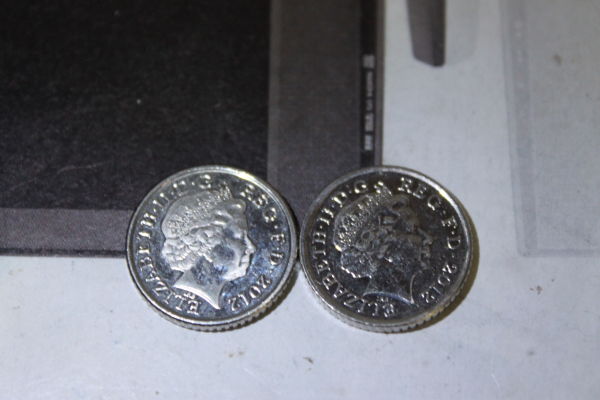 The peculiar 5p coins dont have that full mirror like look but they have a distant resemblance to it , unfortunately I couldnt quite capture this correctly in the pictures as the 5p has been handled a few times previously and my lighting technique wasnt quite good enough to differentiate that aspect .... but here is a closer look at the Queens portrait to illustrate the difference (if you cant quite see the difference properly please try looking at the picture of the peculiar 5p from a slight angle and pay attention to the lower neck area of the Queen and her hair ) the perculiar 5p below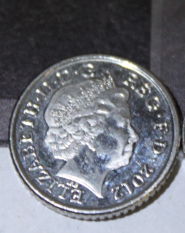 the majority of standard 2012 5p coins look like the one show below the majority of standard 2012 5p coins look like the one show below 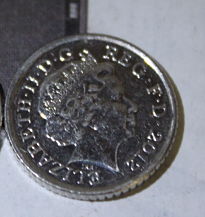 these peculiar 5p coins have have got me wondering whether a die used to strike proofs was "accidentally" used to strike circulating 5p coins afterwards.....so far I have only come across 6 such 5p coins out of loads of 2012 5p coins. I havent seen any 2013 & 2014 dated 5p coins with that peculiar look from the hundreds I have gone through  so this phenomenon is most certainly amongst a small % of 2012 5p coins ....thoughts, explanations or alterative theories are welcome  Edited by DaytR
08/11/2014 3:03 pm
|
|
|
|
Valued Member
United Kingdom
252 Posts |
Bah... NOW you post this !
I just cashed in £15 worth of steel 5p's just last week !
DOH !
|
|
Moderator
 Australia
16985 Posts |
It seems to me far more likely to find actual proof coins in circulation, rather than some mixup (erroneous or deliberate) in dies at the mint. I'm not quite sure how The Royal Mint does things, but I'm pretty sure that at the Royal Australian Mint, proof dies and uncirculated dies can't simply be interchanged; the presses they fit into are different. A proof die fitted into the circulation press would be like a square peg in a round hole. That being said, I don't think the coins you're finding are actual proofs. The "frosting" effect on proofs covers the entire portrait; your "frosting" appears only on the high points, with the low points (such as deep in the queen's neck) showing mirror finish. I can't think of any process that would make the frosting selectively "go away" like that. These 2012 coins are made of nickel-plated steel, rather than the traditional cupronickel used for pre-2012 coins. They will wear differently. Specifically, I think what you're seeing is the highly mirrored nickel plating wearing off the high points, showing either bare steel or an unpolished plating material underneath (again, I'm not familiar enough with the method of production of the blanks to say for sure). I suspect you aren't seeing it on newer coins either because they've changed their plating technique to avoid this problem or that the newer coins simply haven't been in circulation long enough for the plating to wear down to that point yet. Don't say "infinitely" when you mean "very"; otherwise, you'll have no word left when you want to talk about something really infinite. - C. S. Lewis
|
|
Pillar of the Community
 United Kingdom
837 Posts |
Quote:
I just cashed in £15 worth of steel 5p's just last week ! Ooops ! Quote:
That being said, I don't think the coins you're finding are actual proofs. The "frosting" effect on proofs covers the entire portrait; your "frosting" appears only on the high points, with the low points (such as deep in the queen's neck) showing mirror finish Absolutely , I have scratched my head for many months over that partial frosting you rightly observed .... Quote:
Specifically, I think what you're seeing is the highly mirrored nickel plating wearing off the high points, showing either bare steel or an unpolished plating material underneath (again, I'm not familiar enough with the method of production of the blanks to say for sure). I suspect you aren't seeing it on newer coins either because they've changed their plating technique to avoid this problem or that the newer coins simply haven't been in circulation long enough for the plating to wear down to that point yet. Interesting stuff , the thing about these peculiar 5p coins is that a few that I saw (more tha a year ago) were among fresh new ones that hadnt been in circulation and had just been delivered by the armored truck which made me even more intrigued. Given that a lot of 2012 5p coins have now circulated a for a little while I have looked through some recent ones from change to see how they have fared and they look more like the standard 2012 5p in the bottom picture ..... Your suggestion about plating techniques is fasciating because The Royal Mint has more than one plating technique for nickel plated steel coins and they are currently minting tonnes of 5p coins ...... Edited by DaytR
08/12/2014 3:50 pm
|
|
Valued Member
United Kingdom
252 Posts |
Here's 3 I found in what was left of my steel 5p's.  The middle and right ones, I assume, are due to circulation. The left one certainly seems different. However, as the next pic shows, there's a frosted area behind the D.G. too :-/  ------------- Has anyone heard anything, or even noticed infact, that there appears to be some wired edge 1992 5p's in circulation. (Just like the 10p's) Weight and thickness are the same.  |
|
Pillar of the Community
United Kingdom
837 Posts |
Quote:
Here's 3 I found in what was left of my steel 5p's. Fascinating stuff , how big was your stash of steel 5p coins before ? Do you have stashes of other coins too ?  I am glad you have observed this fascinating phenomenon ! You are right, that perculiar look (on the left 5p coin) is quite different from "rubbed" circulated 5p coins. How new is your left 5p coin ? Yeah , 1992 5p coins are quite distinct when looking at the edge from the obverse, you can easily spot them by that feature . I am really starting to like them a lot  Edited by DaytR
08/19/2014 3:37 pm
|
|
Pillar of the Community
United Kingdom
837 Posts |
Quote:
The "frosting" effect on proofs covers the entire portrait; your "frosting" appears only on the high points, with the low points (such as deep in the queen's neck) showing mirror finish. I can't think of any process that would make the frosting selectively "go away" like that While thinking about this subject an interesting idea just hit me , given that the coins in question exhibit partial frosting - I thought, what if the coins were meant to be proofs but the failed quality control checks due to lack of full frosting effect ( possibly due to some imperfection in the die) hence some clever lady or chap at the mint thought it would be best to just toss them into circulation instead of binning them since they are with all intents and pruposes 5p`s |
|
New Member
United Kingdom
28 Posts |
Why not email The Royal Mint and ask them? You might get lucky with an answer... |
| |
Replies: 7 / Views: 4,093 |
|
To participate in the forum you must log in or register.
 
- Help With Identification Please.
- 1969-S Lincoln Cent Machine Doubling Or Double Die Obverse
- 1999 Lincoln Cent - Die Clash
- 1809 Half Cent For Grading
- 1987 - D Lincoln Cent Grade Check
- 1987- D Lhc Possible RPM Or DDO In Date
- You Know What I Want That Final Number To Be
- Bronze Coin To Id. Greek Or Roman?
- A Ridiculously Badly Written Computer Aided Book, Coin Collecting Bible, 2024
- Liberty Head 10/11 Stars Obverse With A Sick Looking Eagle On The Reverse Holed 0.59g 13.06mm
- The Tyrant Collector - PCGS Youtube Interview
- Counterfeit Detection: ANA Video - Introduction, With Brian Silliman And Jim Robinson Ep. 1
- Counterfeit Detection: ANA Video - Mistakes, Risk Factors, And Counterfeits & Alterations, Ep. 2
- Counterfeit Detection: ANA Video - Pimples And Pits, Looking At Cast Counterfeits, Ep. 4
- Counterfeit Detection: ANA Video - What Year Is That Cent? Key Date Coins, Ep. 5
- Counterfeit Detection: ANA Video - Diagnostics Of The 3, 5, And 10 Cent Coins, Ep. 6
- Counterfeit Detection: ANA Video, Counterfeit Quarter Dollar Diagnostics, Ep. 7
- Counterfeit Detection: ANA Video, Counterfeit Classic Commemorative Coins Diagnostics, Ep. 8
- Counterfeit Detection: ANA Video, Counterfeit Silver Dollar Diagnostics, Ep. 9
- Counterfeit Detectection: ANA Video, Classic US Gold Coin Diagnostics, Ep. 10
Disclaimer: While a tremendous amount of effort goes into ensuring the accuracy of the information contained in this site, Coin Community assumes no liability for errors. Copyright 2005 - 2026 Coin Community Family- all rights reserved worldwide. Use of any images or content on this website without prior written permission of Coin Community or the original lender is strictly prohibited.
Contact Us | Advertise Here | Privacy Policy / Terms of Use
|
| Coin Community Forum |
© 2005 - 2026 Coin Community Forums |
| It took 0.3 seconds to rattle this change. |
 |
|










 Posted 08/11/2014 7:28 pm


