|
This page may contain links that result in small commissions to keep this free site up and running.

Welcome Guest! Registering and/or logging in will remove the anchor (bottom) ads. It's Free!
To participate in the forum you must log in or register. | Author |
 Replies: 6 / Views: 4,173 Replies: 6 / Views: 4,173 |
|
|
Valued Member
United States
54 Posts |
Before I started reading these threads the other evening, I knew basically nothing about coin photography. After spending a few hours researching, I'm looking for a few more answers. My wife has a Nikon D40, which as far as I can tell does not have a macro setting. If I want to use this camera for coin photography, my options appear to be to purchase a macro lens ($600-$700+) or a close up filter kit such as the Hoya 55mm ($29.95 on Amazon.com). It doesn't make sense to me to purchase the expensive macro lens when I could purchase another camera that features macro/super macro settings, such as the Canon s5 I've read so much about. I guess my question is, can I take good quality coin photos with the D40 and close up filter, or do I need to purchase the Canon s5 or similar camera with macro setting? I'd also like some opinions on the setup I found at the following web address: http://store.tabletopstudio-store.com/ezprost.html Any comments/opinions/advice would be greatly appreciated. |
|
|
|
Moderator
 United States
23522 Posts |
OK, we'll address each question separately. I think you'll find the D40 to be more than enough camera to give you excellent coin photos. Your task is to figure out how to optimize your camera/lens combination for best results. If you have multiple lenses, you need to decide which one is most appropriate for the task. Determine the minimum distance from the subject at which the lens will focus; in any event, you probably won't want to be less than 10" from the coin in order to get the lighting right. My guess is, the only improvement a closeup kit will offer is the ability to make the image larger on the sensor than your existing lens; you'll already be able to focus sharp shots at the minimum distance required for good lighting. As an example, here's an image I just quickly composed and shot using my Digital Rebel with the inexpensive 18-55 kit lens: 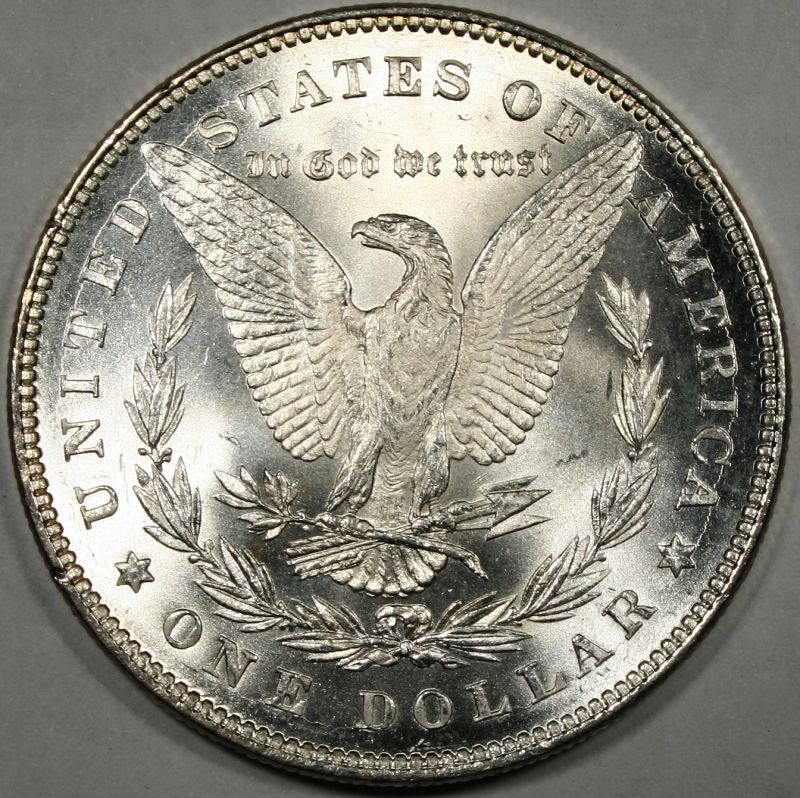 I have the coin about 12" from the lens, which was zoomed all the way in. I did no playing with the lighting, in the interest of getting an image into my post as quickly as possible. The image you see is 800px; I had to downsize that from the original 1300px the camera caught. Although I have 8MP on-hand to your D40's 6MP, under similar conditions you will achieve images well over 1000px in diameter for a similar coin. That's too large to use on the Internet.  The point is, I believe you already have the equipment for successful coin photography. The D40 is an excellent camera. I think we should work to maximize your existing capabilities before spending money on more equipment. Regarding the setup you linked: I wouldn't spend the money. I don't think it's beefy enough to reliably support your camera, and in any event it isn't large enough to get the camera a sufficient distance from the subject to allow you to use effective lighting. I have a grand total of about $50 in to completely separate lighting rigs, one halogen and one fluorescent, and although the copystand I mount the camera on cost $75, you can do something very similar in capability with any cheap floorstanding tripod and the edge of a table. I'll be happy to walk you through the process. By the way, welcome to Coin Community. Can you tell you've touched on a subject that's near and dear to me?  |
|
Valued Member
 United States
54 Posts |
Thanks for the reply--I've read through many of your posts and was hoping my questions would catch your attention. According to the specs, the 18-55 lens that came with the D40 has a minimum focus distance of 11.4 inches. If I'm understanding you correctly, you are saying that this is close enough to take good coin pictures, so the D40's lack of a macro setting is not a major drawback. Many of the threads emphasize the importance of macro capability, which is why I was weighing purchasing a macro lens (sigma 150mm or the nikkor 105mmVR) or another camera with macro/super macro settings. Regarding lighting equipment and copystands, what exactly do you recommend as optimal? Regarding the fabric canopy and illuminated background panel, do these provide any benefit at all? Under the theory that this is 80% equipment and 20% photographer, I'm willing and able to acquire what is needed to do the job right.
|
|
Moderator
United States
23522 Posts |
Since a dSLR like your Nikon is not a "complete" unit, being a combination of camera and lens, it does not require a special "Macro" setting like a fixed-lens point-and-shoot. A dSLR with a Macro setting just establishes a preset of conditions conducive to macro photography in the camera's brain, all settings you can manually adjust yourself. A P&S Macro setting changes both brain and lens settings, making it a requirement in such a camera. Here's how I used to do it, with a floorstanding tripod: 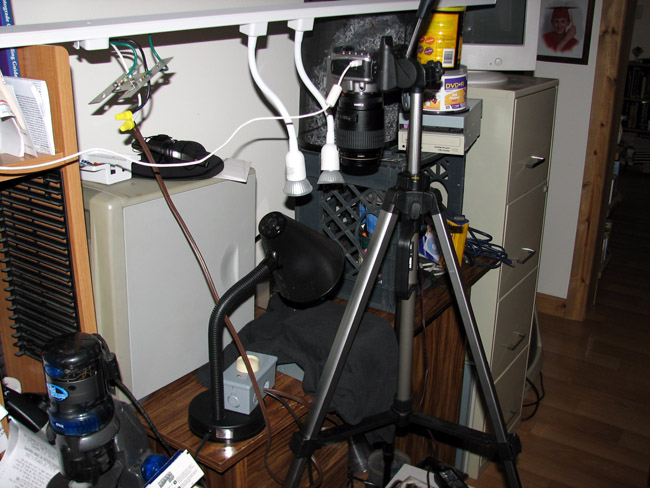 That's mostly to give you an idea of how to get the coin and the camera together; the vertical adjustability of the tripod is invaluable when you're trying to zero-in the proper distance between the lens and the coin. With the 18-55, you might find yourself 16" above the coin with it zoomed in, or 10" above with it zoomed out. An illuminated background will do you more harm than good, since the photographic subject is opaque. The radically-different light levels will just confuse the camera. The fabric screen is a good idea for diffusion, but I contend that it'll be insufficient to diffuse bright-enough light to make diffusion necessary. Furthermore, the majority of your circumstances will be better-served with direct light. The best coin photographers I know, people who make me look like the rookie I am, are using one or two relatively low-wattage incandescent lights that are easily adjustable for position. For the record, though, I've done almost no experimentation with diffused light. There could be real potential there I'm unaware of. If it's 80% equipment, half of that 80% is lighting. And 15% of the other 20% is knowing how to use that lighting. |
|
Valued Member
United States
54 Posts |
Thanks for explaining the distinction between point and shoot and dslr with respect to macro photgraphy. I didn't realize I was comparing apples to oranges. Regarding the illuminated panel background and canopy setup, I saw this employed by a company called "Numisphoto" at the ANA show in Milwaukee a few weeks ago. The photographer placed subject coins on a piece of black velvet sitting inside the canopy on the illuminated panel. There was additional lighting from the side and possibly above. I saw the images on a computer monitor but did not see any actual photos. Right now, I have the camera and lens and that's it--no tripod or other accessories. What particular copystand and lighting equipment would you purchase if you were starting from scratch, as I am? |
|
Moderator
United States
23522 Posts |
Hmmm. Numisphoto is Charles Daughtrey, "Coppercoins" on this forum. He's an accomplished coin photographer, and if that's how he's doing it, then there has to be something to the method. I guess he's keeping the lens from seeing any of the background light, and using it as reflected lighting. There's merit to the concept, and I know he gets excellent shots. With regard to lighting, I can only advise that it be as movable, and as small, as possible. Gooseneck lamps/tracks, like I'm using, or something like an articulated table lamp. Generally speaking, you're going to want the ability to get the lighting as close to the lens as you can, shining down as close to perpendicular to the coin as you can. Of course, there are exceptions to the rule. In my own efforts - note I'm still using the same lighting rig you see in my pic above - the gooseneck lights never get more than 8" or so away from directly above the coin. Even then, I usually only go that far to keep them from reflecting off of slabs. It's preferable that the specific coin illumination lamps be as close to *all* the light on the coin as possible (no overhead lights or other room illumination), because that will make white balance settings all the easier. The specific type of lamp you use is fairly unimportant if your ability to adjust white balance is good, as I'd expect with a D40. Good copystands are, in my opinion, massively overpriced. I used my tripod for many months until I finally found, and bought, a used Testrite CS-3 on ebay for $75. All you really need is the ability to make the lens nice and square to the coin, which is much easier with the coin laying flat and the camera pointed straight down. A tripod has the advantage of being portable, and much more useful than a copystand. |
|
Valued Member
United States
54 Posts |
Thanks for sharing your advice and knowledge. I think I've got enough to get started. I'm sure I'll be posting again soon!
|
| |
Replies: 6 / Views: 4,173 |
|
To participate in the forum you must log in or register.
Disclaimer: While a tremendous amount of effort goes into ensuring the accuracy of the information contained in this site, Coin Community assumes no liability for errors. Copyright 2005 - 2026 Coin Community Family- all rights reserved worldwide. Use of any images or content on this website without prior written permission of Coin Community or the original lender is strictly prohibited.
Contact Us | Advertise Here | Privacy Policy / Terms of Use
|
| Coin Community Forum |
© 2005 - 2026 Coin Community Forums |
| It took 0.28 seconds to rattle this change. |
 |
|
| |
| |







 Posted 08/19/2007 12:53 pm


