









 Posted 09/01/2014 6:03 pm


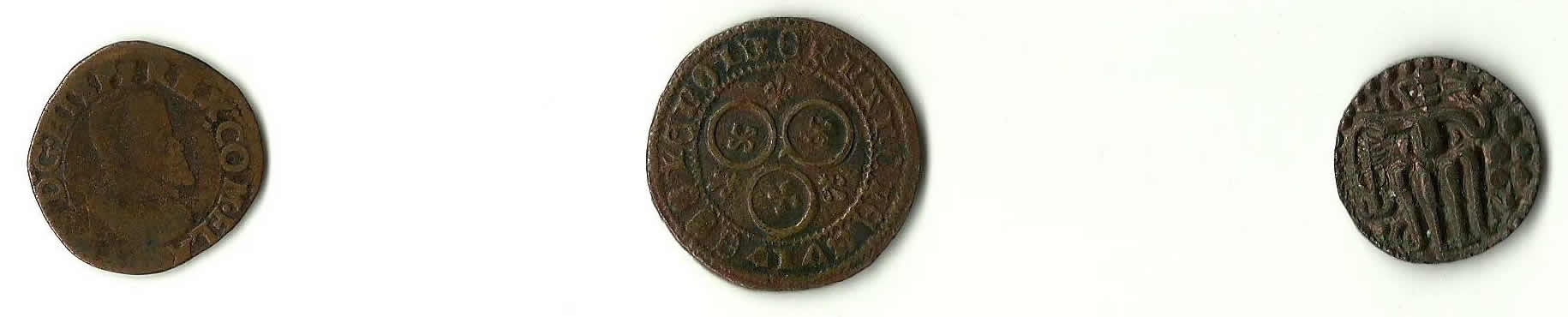
I believe the first one is Spanish Netherlands - the "COM FL" in the obverse legend translates to "Count of Flanders".
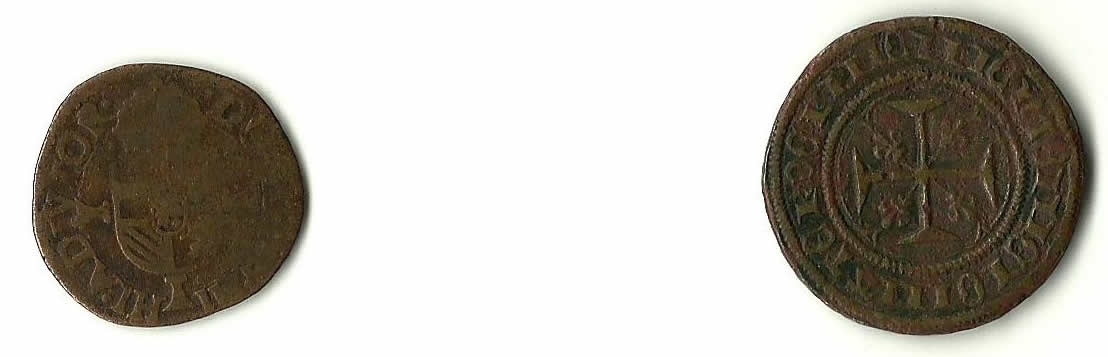
I'm pretty sure your second piece is a jeton, not a coin. The legend on the bottom pic reads "O MATER DEI MEMENTO MEI". Here's a very similar one on the UKDFD database.
The third item is a copper massa from mediaeval Sri Lanka. The reverse pic is upside-down. It dates roughly from AD 1200-1300. A narrower date-range is possible, if the reverse inscriptions can be read. This website has a handy guide for identifying the inscriptions of the commonest coins. The scan isn't easy to read upside-down but I'm pretty sure yours is of King SahasaMalla, whose brief reign (AD 1200-1202) nevertheless produced a large amount of coinage.
I'm pretty sure your second piece is a jeton, not a coin. The legend on the bottom pic reads "O MATER DEI MEMENTO MEI". Here's a very similar one on the UKDFD database.
The third item is a copper massa from mediaeval Sri Lanka. The reverse pic is upside-down. It dates roughly from AD 1200-1300. A narrower date-range is possible, if the reverse inscriptions can be read. This website has a handy guide for identifying the inscriptions of the commonest coins. The scan isn't easy to read upside-down but I'm pretty sure yours is of King SahasaMalla, whose brief reign (AD 1200-1202) nevertheless produced a large amount of coinage.
Don't say "infinitely" when you mean "very"; otherwise, you'll have no word left when you want to talk about something really infinite. - C. S. Lewis


