Quote:
Is it correct the 'palace coins' were used only by the people who lived en worked in the palace?
Baidu is China's major search engine and its online encyclopedia
defines a palace coin as follows:
"A small portion of ancient charms came from the palace. People refer to this type of charm as a 'palace coin'.
The use of palace coins began during the Tang Dynasty and continued to the Qing Dynasty where their development reached its peak.
Palace coins were cast at official furnaces and their major use was as decorations in the palace during major festivals.
Every year during the twelfth lunar month, the departments responsible for casting palace coins would send to the palace some finely cast palace coins to be hung from the palace lanterns.
Regarding Qing Dynasty palace coins, most had the emperor's era name on the obverse side. The reverse side would have
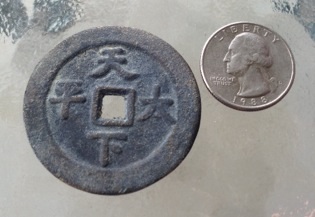
tian xia tai ping, the
eight trigrams, or good luck sayings.
Among these palace coins, those with the era name on the obverse side and the eight trigrams on the reverse were typically used as
ridgepole charms.
The major difference between palace coins and charms made by the people is that the palace coins were made out of fine brass and were very well made."
As an example,
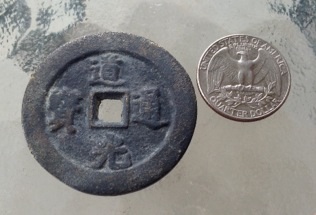
this is an authentic dao guang tong bao palace coin which can be compared to the OP's coin. This authentic palace coin sold in 2012 at a Beijing auction for the equivalent of $2,060.
Gary












 Posted 09/14/2014 6:31 pm


